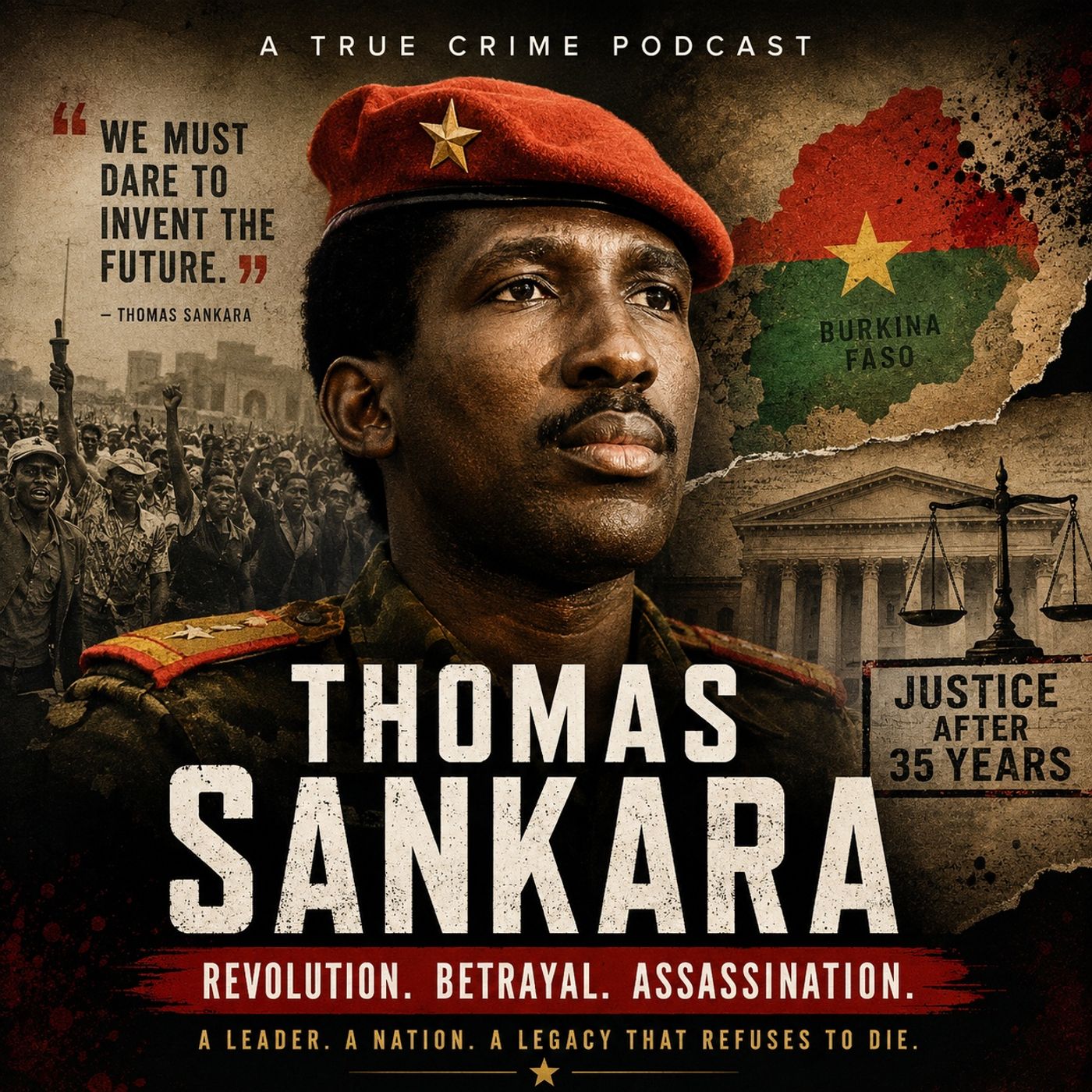
Burkina After Sankara
The Story
A young revolutionary promised to transform one of Africa's poorest nations—but four years later, he was assassinated by men he once trusted. This true crime documentary explores the rise, betrayal, assassination, and enduring legacy of Thomas Sankara through verified historical records, witness accounts, and the landmark trial that sought justice decades later.Become a supporter of this podcast: https://www.spreaker.com/podcast/dark-american-crime--7005371/support.
Thanks for listening to Dark American Crime. The next episode is coming soon.
This episode includes AI-generated content.
Part one, The Gunshots that Changed Africa. Opening music, slow, tense, atmospheric narrator. October fifteenth, nineteen eighty seven. The afternoon sun hung over Waggadougu, the capital of Burkina Faso, as another meeting was about to begin. Inside the headquarters of the National Revolutionary Council, President Thomas Sankara sat with members of his government. It was supposed to be an ordinary discussion about the future of a nation that had spent the last four years attempting one of Africa's most ambitious political experiments.
Outside the city carried on as usual. People walked through crowded streets. Vendors sold fruit beneath the scorching sun. Children played in dusty neighborhoods. Few could have imagined that within minutes, the sound of automatic gunfire would echo through the capital, and that one of Africa's most influential leaders would be dead before the day was over. The attack lasted only moments. When the sh shooting stopped, Thomas Sankara and twelve of his companions lay dead. He was just thirty seven years old.
No public trial followed, no immediate independent investigation revealed the full truth. Instead, an official version of events was quickly announced, while questions began to spread across Burkina Faso and far beyond its borders. For years, many of those questions would remain unanswered. Who planned the attack, why was one of Africa's most popular revolutionary leaders killed by fellow soldiers, and how did one of his closest allies become the country's new ruler within hours. Those questions continue to shape the history of Burkina Faso today.
This is the story of Thomas Sankara, not simply the story of his death, but the remarkable life that made his assassination one of the most consequential political killings in modern African history. Before he became president, before he became known as Africa's chay Gavara, Thamas Sankara was a young army officer with an unusual belief He believed that one of the poorest countries in the world did not have to remain poor forever. He believed that corruption was not inevitable, that African nations could stand on their own without depending on foreign powers, that ordinary people, not political elites, should shape the future of their country.
These ideas won him devoted supporters, but they also earned him powerful enemies. To understand why Thomas Sankara was killed, we first need to understand the country he sought to transform. Today it is known as Burkina Faso, but for much of the twentieth century it was called Upper Volta. Located in West Africa, the country had been under French colonial rule before gaining independence in nineteen sixty. Independence brought hope, yet for many citizens, daily life changed very little. The economy remained fragile.
Most people relied on agriculture. Droughts frequently devastated harvests. Poverty was widespread. Political instability became almost routine. Military coups replaced elected governments. Presidents came and went, Promises were made and broken. For ordinary families, survival often mattered more than politics. By the early nineteen eighties, many young people had become frustrated. They watched a small political elite in joy privilege while millions struggled to afford food, health care, and education.
Among those frustrated young officers was Captain Thomas Sankara. Unlike many military leaders of his era, Sankara did not seek luxury. He lived simply. He admired discipline. He read widely studying history, economics, and revolutionary movements around the world. He was also an accomplished guitarist, often playing music with friends after military duties. Those who knew him described a man who could move move effortlessly between serious political debate and warm conversation. He possessed charisma, confidence, and an unusual ability to inspire people from very different backgrounds.
As his reputation grew, so did his influence within the military. Many younger officers believed Burkina Fazzo needed dramatic change. Older political figures, however, viewed these ambitious officers with increasing suspicion. The nation stood at a crossroads. One path promised continuity, the other promised revolution. Thomas Sankara Cho's revolution not merely through speeches, but through action. His political rise would be swift. Within a few years, he would become president. Once in office, he would launch reforms unlike anything seen in much of Africa at the time.
Government officials were expected to reduce extravagance. Public funds would be redirected toward development. Mass vaccination campaigns aimed to protect millions of children. Efforts began to improve literacy and expand education. Women's rights became a central part of government policy, challenging long standing traditions. Environmental initiatives sought to combat desertification by planting millions of trees. Supporters saw these reforms as bold and necessary. Critics argued that his pace was too fast, his methods too confrontational, and his rhetoric too uncompromising.
Internationally, Sankara challenged powerful governments and financial institutions. He criticized debt, arguing that it kept African nations dependent on wealthier countries. He urged African leaders to pursue greater economic independence. His speeches gained attention across the world. Many admired his courage, others viewed him as a threat to established political and economic interests. Within Burkina Faso, tensions continued to grow. Not everyone welcome the revolution. Some traditional leaders opposed his reforms.
Sections of the military became divided, Political rivals watched carefully. Even relationships within Sankara's own inner circle began to show signs of strain. Among those closest to him was a fellow military officer named Blaize Compare. The two men had once shared revolutionary ideals, They had worked together, trusted each other built a movement side by side, but history has repeatedly shown that political alliances can change, sometimes gradually, sometimes overnight. By October nineteen eighty seven, Burkina Fazzo stood on the edge of a crisis.
Few citizens could fully see. The disagreements within the country's leadership had deepened, Rumors circulated, loyalties shifted, Yet Thomas Sankara continued working, believing his revolution could survive. Then came that afternoon, gunfire erupted. Within minutes, the revolution lost its leader. The official explanations that followed would be questioned for decades. Families mourned, supporters demanded answers, Historians searched for evidence, Investigators reopened files. Years later, court rooms would eventually hear testimony that had remained buried for decades.
But before the bullets, before the betrayal, before October fifteenth, nineteen eighty seven, there was a young boy growing up in a modest household who could never have imagined that one day millions would remember his name the gunshots that changed Africa. October fifteenth, nineteen eighty seven. It was just after midday in Waggadogu, the capital of Burkina Faso. The heat was relentless, the streets were busy, and for most people, it seemed like another ordinary Thursday market. Traders bargained with customers, children made their way home from school, and government workers carried on with their daily routfees.
Inside the headquarters of the National Revolutionary Council, however, history was about to take a violent turn. President Thomas Sankara, only thirty seven years old, had gathered with several of his closest advisers for a meeting. They planned to discuss the future of the country's revolution, a movement that had promised to free Burkina Faso from poverty, corruption, and foreign dependence. It was a meeting like many others they had held before, but this one would never end. Without warning, heavily armed soldiers surrounded the building.
Moments later, the silence was shattered by bursts of automatic gunfire. Witnesses would later recall hearing several rounds echo through the compound. Panics spread almost instantly. Some people ran for cover, while others froze, unsure of what was happening. Within minutes, thirteen men, including President Thomas Sankara, lay dead. The revolution had lost its leader by nightfall, another man had taken control of the country. That man was blaze. Compare a military officer who had once been one of Sankara's closest friends, trusted allies, and fellow revolutionaries.
How could two men who once fought side by side become enemies? Why was one of Africa's most admired leaders killed by members of his own military, who benefited from his death? And why would it take more than three decades before many of the answers finally began to emerge. These questions have fascinated historians, journalists, investigators, and ordinary people across the world for decades. This is not just the story of an assassination. It is the story of hope, ambition, loyalty, betrayal, and the price of challenging powerful interests.
To understand why Thomas Sankara was killed, we must first understand the country he tried to transform. Before it became known as Burkina Faso, the country was called Upper Volta, a former French colony in West Africa. Like many African nations, it gained independence in nineteen sixty, raising hopes that freedom from colonial rule would bring prosperity and stability. Instead, independence brought disappointment. Although the French flag no longer flew over the country, many of the old problems remained.
Poverty was widespread. Most people survived through farming and recurring droughts often destroyed crops. Health care was limited, education was out of reach for many families, and corruption became deeply rooted in government institutions. Political instability quickly became the norm. Military coups replaced elected governments. Presidents came and went, Promises were made, promises were broken. Ordinary citizens watched as political leaders fought for power, while everyday life remained painfully difficult.
By the late nineteen seventies and early nineteen eighties, frosus sstration had spread throughout the country. Young soldiers, teachers, students, and workers began asking difficult questions. Why was one of Africa's poorest nations so rich in potential yet so poor in reality. Why were foreign countries still influencing decisions long after independence. Why did a small political elite enjoy wealth while millions struggled to survive. Among those asking these questions was a young army captain named Thomas Isidore Noel Sankara.
Unlike many military officers, Sankara was known for living simply. He rejected luxury. He believed leaders should live like the people they served. Friends described him as disciplined, intelligent, and deeply curious. He loved reading books on history, politics, philosophy, and economics. He admired leaders who challenged injustice and believed that African countries could determine their own future without depending on outside powers. But Sankara was more than a He was also a talented musician who played the guitar.
He enjoyed cycling. He often laughed with friends and was known for his sense of humor. Those who met him remembered his confidence and his ability to inspire people with words that were both passionate and practical. As his popularity grew within the military, so did his influence. Many younger officers believed he represented a new generation of leadership. Older politicians, however, viewed him with suspicion. To them, Sankara's ideas were dangerous. He criticized corruption openly. He challenged traditional political structures.
He argued that African nations should reject economic systems that kept them dependent on wealthier countries. His speeches began attracting attention far beyond Burkina Faso. Supporters saw him as a fearless patriot. Critics saw him as a radical who threatened established interests. In nineteen eighty three, following a period of political turmoil, Thomas Sankara became president of Upper Volta through a military backed revolution supported by fellow officers including Blaze Compare. Soon after taking office, he made a decision that symbolized his vision for a new nation.
He renamed the country Burkina Faso. The name means the land of upright people, combining words from two of the country's major languages. It was more than a change of name. It was a declaration that the country would chart a different course. Sankara launched sweeping reforms. Government ministers were ordered to reduce unnecessary spending. Official luxury cars were sold, Public officials were encouraged to live modestly. Mass vaccination campaigns protected millions of children against deadly diseases.
Schools and health centers were expanded. Large tree planting campaigns aimed to stop the spread of the Sahara Desert. Women's rights became a central part of government policy. Forced marriages and female genital mutilation were publicly condemned women were appointed to senior government positions. Sankara argued that a revolution could never succeed if half the population remained oppressed. To many Burkinnaby citizens, these reforms brought hope for the first time. They believed genuine change was possible, but change often creates resistance.
Not everyone welcomed Sankara's vision. Some traditional leaders believed he was moving too quickly. Certain business interests opposed his economic policies. Some military officers disliked his leadership style. Foreign governments watched carefully as he criticized international debt and Western influence in Africa. Sankara insisted that African countries should rely on their own resources rather than borrowing money that would leave future generations burdened by debt. His speeches made him popular across Africa and among anti colonial movements worldwide.
They also made him powerful enemies. Meanwhile, tensions were quietly growing inside his own government. The friendship between Thomas Sankara and Blaze Compare had once appeared unbreakable. They had trained together, they had planned together, they had seized power together. Many believed they were brothers in everything but blood. Yet beneath the surface, disagreements began to emerge. Exactly when those disagreements turned into hostility remains a subject of historical debate. What is certain is that by October nineteen eighty seven, Burkina Fazzo's leadership had become deeply divided.
Rumors spread through the military, Whispers of betrayal grew louder. Still, Sankara continued his work. He believed in the revolution, He believed in the future. He had no idea that time was running out. On the afternoon of October fifteenth, nineteen eighty seven, the gunfire ended his life. Within hours, Blaze Compare announced that he had taken power, claiming the change was necessary for the country's future. For years, the official story would dominate. Questions were discouraged, evidence disappeared, witnesses remained silent.
Families mourned in private. But history has a way of resurfacing. Decades later, investigators reopened the case, Documents were examined, witnesses testified. A historic trial would finally begin to uncover what happened on that October afternoon. The story of Thomas Sankara is not only the story of a president who was assassinated. It is the story of a man who believed Africa could stand proudly on its own and who paid the ultimate price for those beliefs. The making of a revolutionary every great political leader has a beginning.
Long before Thomas Sankara became a symbol of revolution, before crowds cheered his speeches, and before his name became known across Africa, he was simply a young boy growing up in a country struggling to define its future. Thomas Isidore Noel Sankara was born on December twenty first, nineteen forty nine, in Yaco, a town in what was then the French colony of Upper Volta. He came from a modest family. His father, Joseph Sankara, had served in the French colonial army before working as a police officer.
His mother, Marguerite Kinda, was known for her deep religious faith and strong family values. Growing up, Thomas experienced two different worlds. On one hand, he lived under French colonial influence, where many of the country's political and economic decisions were controlled from outside Africa. On the other hand, he was surrounded by local traditions, cultures, and communities that had existed long before colonial rule. These contrasting experiences would later shape his worldview. Friends and relatives remembered Thomas as a disciplined and curious child.
He enjoyed learning and asked questions that many adults found unusual for someone his age. He wanted to understand why some people lived comfortably while others struggled to survive. Even as a boy, he was interested in fairness and justice. Education became an important part of his life. He attended Catholic schools, where teachers quickly noticed his intelligence and determination. At one point, some believed he might become a priest. He was quiet, respectful, and deeply thoughtful, but Thomas felt drawn toward a different path.
He admired discipline and believed the military could serve the nation rather than simply protect those in power. After completing his early education, he enrolled in a military academy in Catiogo. It was here that his life began to change. Military training was demanding. Cadets woke before sunrise. Days were filled with physical exercises, weapons training, and strict discipline. Many recruits focused only on becoming officers. Thomas, however, spent much of his free time reading. He devoured books on African history, world politics, economics and philosophy.
He studied revolutionary leaders from around the world, trying to understand how nations had freed themselves from oppression and inequality. Among the figures who influenced him were Kwame Kruma of Ghana, whose vision of African unity inspired many young leaders, and anti colonial thinkers who argued that newly independent nations needed more than political freedom, they also needed economic independence. These ideas left a lasting impression for Sankara. Independence meant little if a country remained dependent on foreign powers for its food, finances and political direction.
His education continued abroad. As a young officer, he traveled to Madagascar for advanced military training. The visit proved to be one of the most important experiences of his life. Madagascar was going through a period of political unrest. Students and workers protested against corruption, inequality, and authoritarian rule. Sankara witnessed these demonstrations firsthand. He saw ordinary citizens demanding accountability from their leaders. He also saw how governments could lose the trust of the people when they ignored injustice.
The events in Madagascar convinced him that lasting political change required more than military strength. It required the support of ordinary people. When Sankara returned to Upper Volta, he was no longer just a promising military officer. He had become a man with a vision. As he rose through the ranks, he earned respect for his professionalism and courage. One event in particular increased his popularity. In nineteen seventy four, Upper Volta went to war with neighboring Mali over a disputed border area known as the Agasher Strip.
Although the conflict was brief, Sankara's leadership during the fighting earned him recogniz within the armed forces. He was seen as brave, calm under pressure, and committed to his fellow soldiers. Yet, despite his growing reputation, Sankara remained uncomfortable with the way politics worked in his country. Military governments replaced civilian governments, corruption continued, the lives of ordinary people showed little improvement. He believed the nation's greatest enemy was not another country.
It was poverty, it was inequality, it was corruption. Around this time, Sankara formed close friendships with several young officers who shared his frustrations. Among them was Blaze Compare. The two men became close allies. They discussed politics for hours, debated Africa's future, and dreamed of transforming their country. Many who knew them described their friendship as exceptionally strong. Together, they represented a younger generation of officers who believed Upper Volta deserved better leadership.
Neither man imagined that history would one day place them on opposite sides of one of Africa's most shocking political tragedies. By the early nineteen eighties, Upper Volta faced mounting economic problems, public dissatisfaction increased. Military governments struggled to maintain legitimacy within the armed forces. Sankar's popularity continued to grow. His speeches were unlike those of traditional politicians. He spoke directly, He avoided complicated language. He challenged corruption openly.
Young people admired his honesty. Workers appreciated his concern for ordinary citizens. Even some senior officers recognized his ability to inspire those around him. In nineteen eighty one, Sankara was appointed Secretary of State for Information. The appointment placed him inside government, but it also created new tensions. He quickly became frustrated with corruption and political compromise. Rather than remain silent, he resigned. During his resignation, he reportedly declared that misfortune to those who muzzle the people.
The statement became widely remembered because it reflected his belief that governments should never silence public voices. His resignation made him even more popular among those who wanted change. Soon afterward, Sankara was appointed Prime Minister. Although the position gave him greater influence, it also alarmed conservative political leaders and foreign governments that viewed his ideas as increasingly radical. His growing popularity worried those who feared losing power. Before long, he would be removed from office and placed under house arrest.
But imprisoning Thomas Sankara would have an unexpected consequence. Instead of weakening his movement, it would strengthen it. Supporters filled the streets demanding his release. Young soldiers remained loyal to him. Among those preparing to act was his trusted friend Blaze Compare. Within months, Upper Volta would experience another coup. This time, Thomas Sankara would emerge not as a prisoner, but as the nation's new president. His revolution was about to begin, But with every revolution comes resistance, and although Sankara believed he was building a better future, powerful enemies were already watching his every move.
Part three, The Revolution begins By nineteen eighty three, Upper Volta was a nation on the edge. Years of military coups had left the country politically unstable, and public confidence in the government was rapidly fading. Inflation was rising, unemployment remained high, and poverty affected the overwhelming majority of the population. For many citizens, independence from France had brought little real improvement. The faces in government had changed, but the struggles of ordinary people had remained the same.
Against this backdrop, Tom miss Sankara's popularity continued to grow. His speeches were unlike those of most politicians. He spoke in simple language that ordinary people could understand. He criticized corruption without hesitation, condemned wasteful government spending, and argued that Africa's future depended on self reliance rather than foreign aid. To many young people, he represented hope. To many powerful figures, he represented danger. Earlier that year, Sankara had been appointed Prime Minister under President Jean Baptiste Auadrogo.
Although his time in office was brief, it was enough to attract international attention. His outspoken criticism of foreign influence and his growing relationships with revolutionary governments alarmed both conservative leaders within Upper Volta and some foreign governments. The concerns soon turned into action. On May seventeenth, nineteen eighty three, Thomas Sankara was arrested and placed under house arrest. The official explanation was vague, but many believed his detention was intended to remove him from politics before his influence became impossible to control.
Instead, the opposite happened. News of his arrests spread quickly across the country. Students left their classrooms to protest. Trade unions organized demonstrations, workers walked off their jobs. Ordinary citizens gathered in the streets demanding his release. For the first time, it became clear that Thomas Sankar's popularity extended far beyond the military. The government had underestimated the public support for him. While demonstrations continued, Sankar's closest allies began discussing their next move.
Among them was Captain Blaize Compare. The two men had built a close friendship over many years. They had trained together, shared similar political beliefs, and dreamed of transforming their country. Compare believed Sankar's arrest was both unjust and politically motivated. Rather than negotiate, he chose action. On the night of August fourth, nineteen eighty three soldiers loyal to Blaze compare launch to coup. The operation moved quickly. Government buildings were secured, key military positions were taken.
Resistance was limited. Within hours, the existing government had collapsed. Thomas Sankara was released from detention at just thirty three years old. He became president of Upper Volta. Crowds celebrated in the streets. Many believed a new era had begun. In his first public addresses, Sankara made it clear that his presidency would be unlike any before it. He rejected the image of the wealthy African leader surrounded by luxury. He insisted that public office was a responsibility, not a privilege.
He argued that government officials should live under the same conditions as the people they represented. These were not merely campaign promises, they became government policy. Luxury Mercedes Spend's cars used by ministers were sold and replaced with more affordable vehicles. Government spending was reduced. Officials were expected to account for public money. Extravagant lifestyles were openly criticized for a country accustomed to political elites living comfortably while ordinary citizens struggled.
These changes were remarkable. Sankara also believed that the nation's identity needed to change. The name Upper Volta had been inherited from the colonial era, referring to the Volta River that passed through the region. To Sankara, the name represented a past that no longer reflected the country's aspirations. On August fourth, nineteen eighty four, exactly one year after the revolution, he announced a new name. Upper Volta would become Burkina Faso. The name combined words from two major local languages and is commonly understood to mean the land of upright people.
Citizens would be known as Burkinnaby. The national flag, with its red and green colors and a yellow star at the center, symbolized the ideals of the revolution. For many citizens. The changes inspired pride. The country was beginning to define itself on its own terms, but Sankara believed that changing symbols was not enough. The lives of ordinary people had to improve. His government launched ambitious nationwide campaigns. Schools were built in rural communities, health care services expanded.
Mass vaccination programs reached millions of children, protecting them against diseases such as measles, yellow fever, and meningitis. Roads were constructed, new reservoirs and wells improved access to clean water. In several regions. Tree planting campaigns sought to slow the advance of the Sahara desert. Agricultural policies encouraged farmers to increase food production so the country could rely less on imported goods. Sankara often repeated a simple idea, the country that cannot feed itself cannot truly be free.
He encouraged citizens to buy locally produced goods. Government officials war clothing made from locally produced fabric instead of imported luxury materials. He hoped these measures would strengthen the national economy and encourage self sufficiency. Another defining feature of Sankar's presidency was his commitment to women's rights. He argued that no society could develop while women remained marginalized. His government appointed women to senior public positions, encouraged girls education, and publicly opposed forced marriage and female genital mutilation.
These positions challenged long standing social norms and earned both praise and criticism. To supporters, Sankara was creating a fairer society. To critics, he was moving too quickly and disrupting established traditions. Internationally, his speeches attracted increasing attention. He criticized the global economic system, arguing that debt kept African nations dependent on wealthier countries. He called on African leaders to unite and pursue policies based on independence and dignity. Many young Africans admired his courage.
Some foreign governments, however, viewed his ideas with growing concern. Back home, resistance was quietly building. Some government officials disliked the strict anti corruption measures. Certain military officers felt excluded from decision making. Traditional leaders objected to reforms that reduced their influence. Business interests complained about economic policies they believed threatened their profits. Although Sankara remained confident, the coalition that had brought him to power was beginning to show signs of strain.
Not every disagreement was visible to the public. Some took place behind closed doors. Some involved people who had once stood beside him as trusted comrades. Among them was Blaize Compare. At first, there was little in medication that the friendship between the two revolutionary leaders was weakening. Publicly, they continued to appear united Privately, However, differences in strategy and political direction were beginning to emerge. Few people realized that these tensions would eventually reshape the history of Burkina Faso forever the land of upright people.
The first year of Thomas Sankar's presidency was unlike anything Upper Volta had experienced since gaining independence. His government moved with remarkable speed. While many political leaders spent years making promises, Sankara believed that change had to be immediate. Every day that passed without action, he argued, was another day that millions of Burkinnaby remained trapped in poverty. His message was simple. A government existed to serve its people, not itself. This philosophy shaped nearly every decision his administration made.
One of his first priorities was fighting corruption. For decades, public office had often been viewed as a path to wealth. Government officials enjoyed expensive cars, generous salaries, and privileges that were unimaginable to ordinary citizens. Sankara wanted to end that culture. He reduced the salaries of senior officials, including his own. Government ministers were expected to travel modestly, Lavish spending with public funds was discouraged. Luxury was no longer considered a symbol of success.
Instead, Sankara argued that leaders should set an example through discipline and simplicity. He often appeared in a plain military uniform rather than expensive suits. Unlike many heads of state, he rejected displays of personal wealth. Supporters praised these decisions as proof that he genuinely believed inequality. Critics, however, argued that his style of leadership was too strict and that some of his reforms were implemented too quickly. Despite the criticism, Sankar pressed ahead. Health Care became another major focus.
At the time, preventable diseases claimed the lives of thousands of children each year. Medical facilities were scarce, especially in rural areas. Working with international health organizations, the government launched one of Africa's largest vaccination campaigns. Within a short period, millions of children were vaccinated against diseases including measles, meningitis, and yellow fever. The campaign was widely recognized as a major public health achievement. Education also received unprecedented attention.
New schools were built across the country. Teachers were encouraged to work in remote communities. Literacy programs targeted adults who had never received formal education. Sankara believed education was more than learning to read and write. He believed it gave people the ability to think independently and participate in building their nation. Agriculture remained the backbone of Burkina Fazzo's economy. Most families depended on farming for survival, yet poor infrastructure and unpredictable weather often led to food shortages.
Sankara believed that no nation could claim true independence if it depended on imported food. His government encouraged farmers to increase production through improved techniques and community cooperation. New dams and irrigation projects were introduced in several regions. Local food production increased during much of his presidency, and many communities reported improved harvests. Environmental protection became another priority. The advancing Sahara desert threatened farmland across the country.
In response, large scale tree planting campaigns were organized. Communities, schools, and government workers participated in efforts to restore degraded land. Millions of trees were planted in an attempt to slow desertification. While environmental challenges remained. The campaigns reflected Sankhar's belief that protecting nature was essential to the country's future. Perhaps no issue demonstrated his willingness to challenge tradition more than women's rights. Sankara argued that women could not remain second class citizens if Burkina Faso hoped to develop.
He appointed women to senior government positions. He encouraged girls to attend school. His government publicly opposed forced marriages and female genital mutilation. He also called for men to share household responsibilities, arguing that equality began at home. These ideas were revolutionary in many parts of the country. Many women welcomed the reforms. Others admired the government's willingness to address issues that previous leaders had ignored. At the same time, some traditional leaders and conservative groups strongly opposed these changes.
To them, Sankara was interfering with long established customs. His government also encouraged citizens to support local industries. Imported luxury goods were discouraged. Public officials were expected to wear clothing made from locally produced cotton. Sankara believed that every purchase of imported products weakened the national economy. If Burkina Faso wanted true independence, he argued it had to produce more of what it consumed. This philosophy extended beyond economics. He challenged African leaders to reject excessive dependence on foreign loans.
In speeches across the continent, Sankara warned that debt could become a new form of control. He argued that political independence meant little without economic independence. His words resonated with many young Africans. They saw in him a leader who spoke openly about problems that others avoided. Internationally, however, his speeches attracted criticism from some governments and financial institutions. Not everyone appreciated his direct challenges to the existing global order. Within Burkina Faso, another challenge was emerging.
To carry out many of his reforms, Sankara relied on local committees known as the Committees for the Defense of the Revolution. These committees were created to encourage community participation, fight corruption, and help implement government policies at the local level. Supporters believed they brought ordinary citizens into the political process. Critics argued that some committees became overzealous, intimidating opponents and exercising authority beyond their intended role. Reports of abuses in certain areas began to generate concern.
Although Sankara acknowledged that mistakes could occur, he insisted that the revolution's overall goals remained necessary. By the middle of his presidency, Burkina Faso had become one of the most talked about countries in Africa. Some viewed it as a model for independent development, others saw it as a risky political experiment. Inside the government, disagreements slowly became more noticeable. Not every official agreed with the pace of reform. Some believed Sankara demanded too much too quickly.
Others feared the growing number of political enemies the government was creating. Among those closest to the president, subtle differences in opinion were beginning to surface. The friendship that had once united Thomas Sankara and Blaze Compare remained publicly intact, but beneath the surface pressures were building. No one yet knew how significant those tensions would become. For the moment, Thomas Sankara remained focused on one goal above all else, to prove that even one of the world's poorest nations could choose its own future through determination, sacrifice, and integrity.
Enemies of the revolution By nineteen eighty five, Thomas Sankara had become one of the most recognizable political leaders in Africa. His speeches were quoted across the continent. Students admired him. Young military officers looked to him as an an example of courageous leadership. Many ordinary citizens believed they were witnessing the birth of a new kind of African government, one that valued honesty over privilege and public service over personal wealth. But admiration did not guarantee safety.
The more popular Sankara became among ordinary people, the more resistance he faced from powerful interests. Some of his strongest opponents were inside Burkina Faso itself. Traditional chiefs had long held significant influence in many communities. For generations, they had collected taxes, controlled land, and exercised authority over local affairs. Sankara believed these systems often reinforced inequality. His government reduced many of the chief's official powers, arguing that all citizens should be equal before the law.
Many traditional leaders deeply resented the decision. Some viewed it as an attack on their heritage and authority. Others feared they would lose the respect and in fluence they had built over decades. At the same time, wealthy businessmen found themselves under increasing pressure. Sonkar's government promoted locally made products and discouraged the importation of luxury goods. Companies that depended on imported merchandise faced growing challenges. Government contracts became more closely monitored, Officials accused of corruption were investigated.
For those who had benefited from the old system, the revolution threatened both their income and their influence. Within the civil service, reactions were mixed. Some public employees supported the reforms, Others complained that Sankara demanded impossible levels of discipline. Attendance was monitored more closely, corruption was punished more aggressively. Government workers were expected to justify their spending and demonstrate accountability. To supporters. These measures represented responsible leadership.
To critics, they felt harsh and uncompromising. The military, too, was becoming increasingly divided. Although Sankara himself was a soldier, not every officer agreed with his vision. Some believed the armed forces should remain focused on national defense rather than political transformation. Others felt promotions and appointments favored those who were personally loyal to the revolution. Rumors of dissatisfaction spread quietly through military barracks. Few spoke openly. Many simply watched and waited.
Meanwhile, Sankara continued speaking boldly on the international stage. One of his most memorable appearances came in July nineteen eighty seven at a summit of the Organization of African Unity in Adis Ababa, Ethiopia. There he delivered a passionate speech about Africa's growing foreign debt. He argued that debt had become a tool of economic domination. According to Sankara, many African countries were being forced to spend more money repaying loans than improving the lives of their own citizens.
He challenged fellow African leaders to reject this system together. If Burkina Faso stands alone, he warned, in essence, I may not be here at the next conference. His words would later be remembered with haunting significance. Less than three months later, he was dead. Whether his international positions directly contributed to his assassination remains a matter of historical debate. What is well documented is that his speeches made him one of the most outspoken critics of economic dependence in Africa.
At home, the pressures continued to mount. The revolutionary government had achieved notable successes in health care, education, agriculture, and public administration, yet not everyone experienced these changes in the same way. Some workers complained about strict labor policies. Certain journalists criticized limits on political opposition and press freedom during the revolutionary period. Human rights organized nations later raised concerns about arrests and the treatment of some political opponents.
These criticisms remain an important part of understanding Sankara's presidency. To many supporters, he was an honest leader trying to transform an impoverished nation under enormous pressure. To some critics, aspects of his government were too centralized and intolerant of dissent. Both perspectives continue to be discussed by historians today. Through it all, one relationship attracted particular attention. Thomas Sankara and Blaze Compare had once seemed inseparable. They had planned the revolution together, They had trusted one another during some of the country's most dangerous political moments.
Compare held important positions within the government and remained one of the president's closest associates. Publicly, there was little indication of serious conflict between them. They appeared together at official events, they continued to speak about the revolution's goal, yet behind closed doors, differences were becoming harder to ignore. Several accounts from people close to the government suggest that disagreements had emerged over the direction of the revolution, foreign policy, and the pace of reforms.
Exactly how deep those disagreements became remains disputed, and historical sources do not agree on every detail. What is clear is that by nineteen eighty seven, the unity that had defined the revolution's early years was beginning to fracture. Some officials believed Sankara needed to compromise. Others believed compromise would destroy everything the revolution stood for. Sankara chose to continue pushing forward. He believed history would judge leaders not by how comfortable they made the powerful, but by how much they improved the lives of ordinary people.
It was a belief that inspired millions. It was also a belief that left him increasingly isolated. As nineteen eighty seven entered its final months, the atmosphere when Waggadogu was changing. Political conversations became more cautious, Rumors circulated through military circles, alliances quietly shifted. The revolution still appeared strong from the outside, but beneath the surface, cracks had begun to spread. Soon those cracks would become impossible to hide the gathering storm. As nineteen eighty seven progressed, the atmosphere inside Burkina Fazo's government grew increasingly tense.
To the outside world, Thomas Sankara still appeared firmly in control. He continued attending official meetings, inspecting development projects, and delivering speeches that emphasized discipline, integrity, and national independence. But behind closed doors, the unity that had once defined the revolution was beginning to unravel. The disagreements were no longer limited to minor policy debates. They had become questions about the future of the country itself. Some members of the government bel believed Sankara's reforms had moved too quickly.
They argued that the pace of change was creating unnecessary enemies, both within Burkina Faso and abroad. Others worried that the country's growing isolation could have serious economic consequences. Burkina Faso remained one of the poorest nations in the world. Despite improvements in agriculture, health care, and education, the country still faced enormous financial challenges. Some officials believed cooperation with neighboring governments and international institutions required a more moderate approach.
Sankara disagreed. He believed compromising on his principles would betray the revolution. Throughout his presidency, he had insisted that African nations should determine their own future without allowing foreign governments or financial institutions to dictate their policies. To him, independence was meaningless if it existed only on paper. These convictions earned him admiration across Africa. They also increased the pressure surrounding his government. Relations with some neighboring countries became complicated.
Several regional leaders viewed Sankara's revolutionary message with caution. His calls for radical reform inspired many young Africans, but they also raised concerns among governments that feared similar movements within their own borders. Historians continue to debate the extent to which foreign interests influenced events inside Burkina Faso during this period. Various theories have been proposed over the years. However, while some archival material and testimonies point to regional political tensions, many claims about direct foreign involvement remained disputed or lack conclusive evidence.
What is firmly established is that Burkina Faso was operating in a highly complex political environment during the final months of Sankara's presidency. Inside the military, uncertainty continued to grow. The armed forces had been the foundation of the revolution, now they were becoming its greatest source of instability. Some officers remained fiercely loyal to Sankara, others questioned whether his leadership could survive mounting political pressure. Among those closest to him was Blaze Compare.
For years, the two men had shared an extraordinary bond. They had planned together, taken risks together, trusted each other with their lives. Many people believed their friendship was unbreakable. Yet by late nineteen eighty seven, reports from individuals close to the government suggest that serious disagreements had emerged between them. Exactly what was said during their private meetings has never been fully established. No complete official record exists. Some witnesses later described increasing political differences.
Others suggested personal relationships within the leadership had become strained because many conversations occurred behind closed doors. Historians remain cautious about drawing firm conclusions. What is beyond dispute is what happened next. During the weeks leading up to October fifteenth, political rumors spread rapidly through Waggadougu. Government officials noticed unusual movements within sections of the military. Some soldiers appeared uncertain about where their loyalties should lie. Others avoided discussing politics altogether.
Despite these warning signs, Sankara continued his normal routine. He refused to surround himself with excessive security. Unlike many heads of state, he did not isolate himself behind heavily armed guards. He believed leaders should remain accessible to the people they served. Friends and colleagues would later say this confidence reflected both his courage and his belief that the revolution still enjoyed broad support. Whether he underestimated the danger remains a question historians continued to consider.
In the days before the assassination, Sankara maintained a demanding schedule, met with government officials, reviewed development projects, discussed economic reforms, prepared for future policy initiatives. There is no reliable evidence that he expected an attack to occur on October fifteenth. Meanwhile, those around him sensed that something was changing. Political conversations became quieter. Trust became harder to place. Every decision seemed to carry greater weight than before. The optimism that had characterized the early years of the revolution was gradually giving way to uncertainty.
For ordinary citizens. However, daily life continued. Farmers tended their fields, children attended school, markets remained crowded. Most people had no idea that the country's leadership was approaching one of the most significant turning points in its history. The revolution that had begun with so much hope was entering its most dangerous chapter. Within days, Burkina Faso would witness an event that would alter its political future for decades. The friendship that had helped bring a revolution to power was about to collapse under the weight of politics, ambition, and betrayal.
On the afternoon of October fifteenth, nineteen eighty seven, the sound of gunfire would bring Thomas Sankar's presidency to an abrupt and violent end. October fifteenth, nineteen eighty seven. Thursday, October fifteenth, nineteen eighty seven began like many other days in Wagadougu. The capital woke to clear skies and warm temperatures. Government offices opened as usual traffic moved through the streets and vendors arranged their goods in busy market places. There was little to suggest that by the end of the afternoon, Burkina Fazzo's political history would be changed forever.
Thomas Sankara followed his normal routine. Despite being president, he maintained a relatively modest lifestyle. He avoided excessive displays of power and was known for keeping a lighter security presence than many other heads of state. Throughout the morning, he attended to government business. Officials later recalled that nothing appeared unusual. Meetings continued, documents were reviewed, plans for ongoing government projects were discussed. That afternoon, Sankara was scheduled to attend a meeting at the headquarters of the National Revolutionary Council, located at the Entente Building in Waggadogu.
Several senior officials and close associates were expected to be present. The meeting itself was not considered extraordinary. It was part of the government's regular work. Shortly before the meeting began, those attending gathered inside the building. Outside, life continued normally. Very few people knew that armed soldiers were already moving into position at approximately four pm, vehicles carrying soldiers approached the compound. According to witness accounts presented years later, the operation unfolded quickly.
The soldiers surrounded the area, limiting any opportunity for escape. Then came the gunfire. Automatic weapons erupted, breaking the afternoon silence. The attack lasted only a short time. Inside the meeting room, confusion spread instantly. Witness testimony presented during later investigations suggested that Sankara remained remarkably calm during the first moments of the assault. Several accounts state that he told those with him to remain calm while he stepped forward. Some testimonies indicate that he hoped to prevent further bloodshed by confronting the attackers himself.
Because many of the people present were killed during the attack, the precise sequence of events cannot be established with complete certainty. What is certain is that Thomas Sankara was shot and killed during the assault. Twelve other officials and associates also lost their lives. The attack was swift, there was no prolonged exchange of fire. Within minutes, the president of Burkina faz was dead. News did not reach the public immediately. Instead, confusion spread through government offices and military installations.
Rumors traveled faster than official information. Some believed an accident had occurred, Others suspected another attempted coup. As uncertainty grew, soldiers secured key government buildings throughout the capitol. Radio stations came under military control. Strategic locations were occupied. The movement of troops made it increasingly clear that something far larger than an isolated shooting had taken place. Later that evening, an official announcement was made. Blaze Compare declared that he had assumed leadership of the country.
He stated that the change in government had become necessary because the revolution had lost its direction. The takeover was described as a rectification of the revolutionary process, rather than its end. For supporters of Sankara, the announcement came as a profefeck. Many had viewed Compare as the president's closest friend and most trusted. Ally, the fact that he emerged as the new leader almost immediately after the assassination raised questions that would persist for decades. Who had planned the operation, when had the decision been made, how many people had been involved.
Those questions remained unanswered for years. The bodies of Thomas Sankara and the twelve others who died alongside him were buried quickly. No independent public investigation followed. Official information about the killings was limited. For many families, there was little opportunity to seek answers. Speaking openly about the events of October fifteenth became increasingly difficult. As Blaise Compare consolidated power, Burkina Faso entered a new political era. Many of Sankara's policies were gradually revised or abandoned, International relationships shifted, the country's political direction changed.
Meanwhile, the circumstances surrounding the assassination remained largely hidden from public scrutiny. Outside Burkina Faso, reactions began to emerge across Africa. Many people struggled to believe that one of the continents most influential revolutionary leaders had been killed by fellow soldiers. Supporters mourned his death, Observers questioned the official explanation. Journalists attempted to piece together the limited information that was available, Yet without a thorough investigation, certainty remained elusive.
For the family of Thomas Sankara. The tragedy was deeply personal. For his supporters, it marked the end of a revolution they believed could transform Africa. For historians, it became one of the continent's most significant political assassinations. The events of that afternoon would shape Burkina Fazzo's future for generations. But while the gunfire had ended Thomas Sankara's life, it had not ended the questions surrounding his death. Those questions would wait years, then decades before they could finally begin to receive answers a new man in power.
The morning after the assassination, Burkina Faso awoke to a different country. Thomas Sankara was dead. Blaze Compare was now the nation's leader. For many citizens, the transition happened so quickly that they struggled to understand what had taken place. Rumors spread through neighborhoods, markets, and workplaces. Some people believed there had been a disagreement within the government. Others whispered that it had been a carefully planned coup. Reliable information was scarce. State controlled media announced that the change in leadership was necessary to save the revolution.
Blaze Compare described the takeover as a rectification, arguing that Thomas Sankar's policies had isolated Burkina Faso from its neighbors and created growing tensions within the country. According to the new government, the revolution itself was not over, simply needed a new direction. Not everyone accepted that explanation. Many of Sankara's supporters were devastated. To them, the assassination was not a correction, it was a betrayal. The friendship between Sankara and Compare had become one of the defining stories of the revolution.
They had planned together, fought together, and seized power together. Now one was dead, the other ruled the country. In the days that followed, the new government moved quickly to establish control. Military units secured important government buildings. Senior officials believed to be loyal to Sankara were removed from influential positions. Some were detained for questioning. Others chose to remain silent, fearing that speaking openly could place them in danger. Across the capital, people became cautious about discussing politics in public.
Families lowered their voices when talking about the assassination. Friends avoided sensitive conversations outside their homes. An atmosphere of uncertainty settled over the country. Thomas Sankar's burial also became a source of controversy. He and the twelve men who died alongside him were buried soon after the attack. There was no state funeral recognizing his years as president. Many supporters believed the burial was carried out too quickly and without the dignity that the country's leader deserved.
His grave remained simple and largely unmarked for many years. For his family, the pain was compounded by unanswered questions how exactly had he died, who gave the orders? Why had no independent investigation been conducted. The new government offered few additional details. Official explanations remained limited, and the subject gradually disappeared from public discussion. As the months passed, Burkina Fazzo's political direction began to change. Several of Sankar's policies were modified. The government's relationship with international financial institutions improved, Diplomatic ties with neighboring countries became stronger.
Some economic policies shifted away from the revolutionary approach that had defined Sankar's presidency. Supporters of the new administration argued that these changes helped stabilize the country supporters of Sankara believed the revolution's original ideals were being abandoned. The debate would continue for decades. Outside Burkina Faso, reactions were mixed. Across Africa. Many political leaders expressed condolences. Students, activists, and supporters of Pan Africanism mourned the loss of a leader they believed had challenged corruption, inequality, and foreign dependence.
International newspapers reported the assassination, but many details remained unclear without an independent investigation, Speculation often filled the gaps left by missing evidence. Over time, Thomas Sankar's image began to take on a symbolic meaning. His speeches continued to circulate. His photographs appeared on posters, books and banners. Young Africans who had never met him began reading his speeches and studying his ideas. Even after his death, his influence continued to grow inside Burkina Faso.
However, discussing his legacy remained politically sensitive for many years. Questions surrounding the events of October fifteenth, nineteen eighty seven remained largely unanswered. Witnesses stayed silent, important documents were difficult to access. Some evidence was reportedly lost or never made public. As a result, historians often found themselves relying on testimony collected years after the events had occurred. This made reconstructing every detail extremely difficult. Despite these challenges, one fact remained undeniable.
The assassination of Thomas Sankara had changed Burkina Faso forever. The revolution that had promised to transform one of Africa's poorest nations had ended in violence. Its leader was gone, its surviving members were divided, and the man who had once stood beside him now occupied the highest office in the country. For many people, justice seemed impossibly far away. Years turned into decades, children grew into adults, governments changed, the world moved on. Yet one question refused to disappear.
Could the truth about Thomas Sankara's assassination ever be fully uncovered? Decades of silence. After the assassination of Thomas Sankara, Burkina Faso entered a new political era under Blaze Compare. What many expected to be a temporary transition soon became a long presidency. Year after year, Compare remained in power, eventually leading the country for twenty seven years. As time passed, discussion of Thomas Sankara became increasingly limited within Burkina Faso. For many of his supporters, speaking publicly about the circumstances of his death carried risks.
The official account of the events remained largely unchanged, and there was no independent criminal investigation into the assassination. Questions persisted, but answers remained elusive. Sankara's widow, Mariam Sankara, became one of the most prominent voices calling for justice after her husband's death. She and her children eventually left Burkina Faso. Living in exile, she continued to speak about the need for an independent investigation and accountability for those responsible. She consistently argued that her family deserved to know the full truth about what had happened on October fifteenth, nineteen eighty seven.
Human rights organizations also expressed concern. Over the years, several groups called for greater transparency, arguing that unresolved political assassinations weakened public confidence in justice and democratic institutions. Despite these calls, little changed the years passed. A new generation grew up knowing Thomas Sankara not as the country's president, but as a historical figure whose speeches and photographs continued to circulate throughout Africa. His ideas, however, refused to disappear.
Students read his speeches in universities. Activists quoted his words during demonstrations. Writers published books examining his presidency. Documentary filmmakers revisited the events surrounding his assassination across Africa and beyond. Sonkara gradually became a symbol of integrity, self reliance, and resistance to corruption. Ironically, his international reputation grew stronger long after his death. Within Burkina Faso, opinions about his presidency remained divided. Supporters remembered his efforts to improve health care, education, agriculture, and women's rights.
Critics continued to point to concerns about restrictions on political freedoms during the revolutionary period and argued that some of his governing methods were overly rigid. Historians generally agreed on one point. Thomas Sankara remained one of the most influential political figures in modern African history. As the years passed, pressure for a proper investigation slowly increased. Journalists continued examining old records. Researchers interviewed former officials. Witnesses who had remained silent for years began sharing their accounts.
Some described the political tensions inside the government during the final months before the assassination. Others spoke about unusual military movements in the days leading up to October fifteen. Not every testimony agreed, memories differed. Some witnesses contradicted one another. Because so much time had passed, separating fact from rumour became increasingly difficult. Even so, a clearer picture slowly began to emerge. Questions also arose about official records. Supporters of Sankara argued that important documents had either disappeared or remained inaccessible.
Some investigators believed additional evidence might still exist within government archives. Others feared crucial records had been lost forever. Without complete documentation, many aspects of the assassination remained impossible to verify conclusively. Throughout the nineteen nineties and early two thousands, political stability largely prevailed under Blaize Comparis government. Internationally, Burkina Faso developed new diplomatic relationships and participated in regional peace efforts. At home, However, many families affected by past political violence continued waiting for answers for them, Justice delayed increasingly felt like justice denied.
Despite the silence surrounding the case, Thomas Sankar's legacy continued to inspire people across Africa. His speeches about self reliance, dignity, and good governance were translated into multiple languages. Young leaders frequently cited his example. Artists painted murals in his honor, Musicians wrote songs celebrating his vision for Africa. The memory of the man endured even as the official investigation remained frozen. Then, nearly three decades after the assassination, everything changed.
In twenty fourteen, widespread public protests erupted across Burkina Faso. The demonstrations were sparked by proposed constitutional changes that would have allowed President Blaze Compared to seek another term in office after nearly three decades of rule. The protests quickly grew into a nationwide movement. Thousands of citizens filled the streets, government buildings were surrounded. The political pressure became overwhelming. Facing mounting unrest, Blaze Compare resigned and fled the country for the first time since October nineteen eighty seven.
The political landscape had fundamentally changed. The departure of the man who had ruled Burkina Fazo since Sankara's death opened a door that had remained closed for twenty seven years. Families who had waited decades for justice began to hope once again. Investigators prepared to reopen one of Africa's most significant political assassination cases. The search for the truth was finally about to begin. The investigation reopens. The resignation of Blaze Compare in October twenty fourteen marked a turning point in Burkina Fazo's history.
For nearly twenty seven years, questions surrounding the assassination of Thomas Sankara had remained largely unanswered. Now, with a new transitional government in place, many believed the time had finally come to investigate one of the country's darkest chapters. The demand for justice grew louder. Citizens gathered at public events carrying portraits of Thomas Sankara. Activists called for transparency, Journalists renewed their investigations for Sonkar's family. The moment carried deep emotional significance.
After decades of waiting, there was finally hope that the truth might emerge. One of the first major developments came. In twenty fifteen, Burkina Fazzo's military justice system officially reopened the investigation into the assassination. Investigators began collecting evidence that had not been fully examined for decades. Witnesses were invited to testify. Former military officers were questioned, Government archives were reviewed. The investigation faced enormous challenges from the very beginning.
Almost three decades had passed since the killings. Many witnesses had died, Others struggled to remember precise details. Some individuals who might have possessed valuable information had left the country years earlier. Physical evidence was limited, important records were missing. Even so, investigators pressed forward. One of their first priorities was confirming the circumstances of Thomas Sankara's death. In May twenty fifteen, authorities authorized the exhumation of his remains. It was a solemn moment.
Family members, legal representatives, and forensic specialists gathered as the grave was carefully opened. The purpose was not symbolic, it was scientific. Experts hoped that modern forensic techniques could provide information that had never been documented properly. In nineteen eighty seven. The examination revealed evidence consistent with multiple gunshot wounds, supporting long standing accounts that Sankara had been killed during the armed assault on October fifteenth, nineteen eighty seven.
Although the forensic examination could not answer every question, it strengthened key parts of the historical record. Investigators also examined military communications, official documents, and witness statements. Some officials described tensions inside the government during the final weeks before the assassination. Others recounted unusual troop movements on the day of the attack. As with many investigations involving events decades earlier, not every account matched perfectly. Investigators had to compare testimony carefully, separating confirmed facts from memories that had faded over time.
Attention soon focused on several former officials connected to the events of October nineteen eighty seven. Among them was Blaize Compare, who by then was living outside Burkina Faso after leaving office. Military prosecutors eventually charged him in absentia with offenses including complicity in the assassination of Thomas Sankara and related crimes. Compare consistently denied responsibility. His legal team rejected the allegations, maintaining that he was not guilty of the charges brought against him.
Because he remained outside Burkina Faso, he did not appear before the court during the proceedings. The reopening of the case attracted international attention across Africa. Many viewed the investigation as more than a criminal inquiry. It was seen as a test of whether a nation could confront its own history, even when that history involved former leaders and powerful political figures. For younger generations, the investigation also became an opportunity to learn about Thomas Sankar's presidency.
Many had been born after his death. They knew his image from posters and documentaries, but had never lived through the revolution themselves. Now they watched as their country's courts attempted to reconstruct events that had taken place decades earlier. The legal process moved slowly. Investigators gathered documents, interviewed additional witnesses, and prepared evidence for trial. Every statement had to be verified as carefully as possible. Every piece of evidence was examined in light of the passage of time.
The case was complex. It involved political history, military operations, forensic science, and testimony stretching back nearly thirty years. Despite these obstacles, one thing was clear. The silence that had surrounded Thomas Sankar's assassination for decades had finally been broken. The search for accountability was no longer confined to history books or family memories. It had entered the court room for the first time since the gunfire echoed through Wagadougu on October fifteenth, nineteen eighty seven, Those accused of involvement in the assassination would face a judicial process examining the evidence before the law the trial of a nation.
On October eleventh, twenty twenty one, more than thirty four years after Thomas Sankara was assassinated, a trial unlike any other in Burkina Fazzo's history finally began. For decades, many believed this day would never come. Families had waited, witnesses had grown older, some of the people who could have testified had already passed away. Yet at last, a military court in Waggadogu opened proceedings to examine one of Africa's most significant political assassinations. The court room quickly became the center of national attention.
Journalists from across Africa arrived to cover the case. International observers watched closely. For many Burkinnaby citizens, the trial represented more than a legal process. It represented an opportunity to confront a painful chapter that had shaped the country's history for more than three decades. Fourteen men were charged in connection with the events of October fifteenth, nineteen eighty seven. Some appeared in court to answer the charges. Others were tried in absentia because they were outside Burkina Faso or could not be brought before the court.
Among the most prominent defendants was former President Blaze Compare. Although he did not attend the proceedings, he remained at the center of public attention throughout the trial. His lawyers maintained that he denied responsibility for the assassination. The prosecution, however, argued that evidence gathered during the investigation pointed to a carefully organized operation rather than a spontaneous military confrontation. Over the following months, the court heard testimony from former soldiers, government officials, investigators, and individuals connected to the revolutionary government.
Some witnesses described the atmosphere inside Burkina Faso during the final weeks before the assassination. They spoke of growing political disagreements, increasing mistrust and tensions within the military leadership. Others focused on the events of October fifteenth itself. Witnesses described hearing gunfire at the Entent building, Some recounted the movements of military vehicles. Others explained what they saw in the immediate aftermath of the attack. Not every witness remembered events in exactly the same way that was expected.
More than three decades had passed, Human memory fades with time, and investigators had to compare different accounts carefully. The court also reviewed documentary evidence collected during the renewed investigation. Military records, forensic findings, official correspondence, and other materials were introduced as part of the proceedings. Judges examined how these documents aligned with witness testimony. Lawyers for the defense challenged aspects of the prosecution's evidence. They questioned certain witness accounts and argued that some conclusions relied too heavily on recollections made many years after the events.
The prosecution responded by emphasizing that multiple pieces of evidence, when considered together, supported their case. The trial was conducted over several months. Each hearing attracted significant public interest outside the courtroom. Many citizens gathered to discuss the testimony. Radio stations analyzed each day's proceedings. Newspapers published detailed reports. For younger Burkinnaby who had never experienced Sankara's presidency, the trial became an education in their country's history.
For older generations, it reopened memories they had carried for decades. Thomas Sankara's widow, Mariam Sankara, attended portions of the proceedings. For her, the trial represented the continuation of a struggle that had lasted nearly thirty five years. She had spent decades calling for justice, often believing it might never arrive. Now she watched as a court examined evidence surrounding her husband's death. The emotional weight of the trial extended far beyond the Sankara family. Relatives of the twelve other men killed alongside the president also hoped the proceedings would finally acknowledge their losses.
The case reminded the nation that October fifteenth, nineteen eighty seven, had claimed thirteen lives, not one. As the hearings continued, the judges prepared to evaluate thousands of pages of evidence and testimony. The responsibility before the court was immense. Its decision would become one of the most significant judicial rulings in Burkina Faso's modern history. For the first time since the assassination, the question was no longer whether the case would be investigated. The question had become whether the evidence presented in court would establish criminal responsibility under the law.
The verdict. After months of testimony, legal arguments, forensic evidence and witness examinations, the trial of Thomas Sonkar's assassination reached its final stage for Burkina Faso. It was a moment decades in the making. The military court had spent months reviewing evidence from one of the country's most controversial political events. Thousands of documents had been examined, dozens of witnesses had testified. Every argument from the prosecution and the defense had been carefully considered.
Now the nation waited for the court's decision. On aid April sixth, twenty twenty two, the verdict was delivered. The court room was filled with journalists, lawyers, victims, families and observers who understood the historical significance of the moment. Among those found guilty was former President Blaize Compare, who had been tried in absentia because he was living outside Burkina Faso. The military court convicted him of complicity in the assassination of Thomas Sankara and of undermining state security.
He was sentenced to life imprisonment. Former military commander Hyacinth Cafando, who was also tried in absentia, received a life sentence after being found guilty for his role in the assassination. Another former military officer, Gilbert Diendra, who appeared before the court, was also convicted and sentenced to life imprisonment. Several other defendants received varying prison sentences based on the court's assessment of their involvement. A number of individuals were acquitted after the judges concluded that the evidence against them was insifie efficient to establish criminal responsibility for the Sonkara family.
The verdict marked the end of a legal battle that had lasted more than three decades. Although no court decision could undo the events of October fifteenth, nineteen eighty seven, the judgment represented official recognition that the assassination had been a criminal act requiring accountability. Mariam Sankara welcomed the verdict while acknowledging that true justice could never fully erase the loss of her husband. Supporters of Thomas Sankara gathered in several locations across Burkina Faso to reflect on the court's decision.
Some celebrated what they viewed as a victory for justice. Others remained emotional, remembering the decades during which the case had remained unresolved. The verdict also attracted international attention. News organizations around the world reported the outcome, describing it as one of the most significant judicial decisions in Burkina Faso's history. Legal experts noted that the case demonstrated how political crime times even decades old, could still be examined through judicial processes.
At the same time, practical challenges remained. Because Blaze Compare and Hyacinthe Cafando were outside Burkina Faso, the life sentences imposed by the court were not immediately carried out. Questions remained about whether they would ever return to Burkina Faso to serve those sentences. Compare continued to deny responsibility for the assassination. His legal representatives rejected the court's conclusions. The verdict therefore settled the matter legally within Burkina Faso's judicial system, but public debates surrounding the events of nineteen eighty seven continued.
Historians also continued their work. While the trial answered many important questions, some aspects of the assassination remained subjects of historical research. Political decisions made behind closed doors, private conversations between key figures, and the motivations of certain individuals, or areas where complete certainty made never be possible. This is often the reality of historical investigations involving political violence. Not every question receives a definitive answer. Nevertheless, the trial established an official judicial record that future researchers can examine, alongside historical documents and witness testimony.
For many Burkinnaby citizens, the proceedings demonstrated that even the most powerful political figures could one day be held accountable before the law. The case also renewed international interest in Thomas Sankara's life and ideas. His speeches were republished, documentaries introduced his story to younger audiences. Universities organized discussions about his political philosophy and his vision for African self reliance. More than thirty years after his death, Thomas Sankara had once again become part of global political conversation.
The man whose voice had been silenced in nineteen eighty seven, continued to influence debates about leadership, integrity, and independence across Africa and beyond. The legacy of Thomas Sankara. More than three decades after his assassination, Thomas Sankar's influence continued to grow. For many leaders, death marks the end of their impact on history. For Sankara, it became the beginning of a legacy that extended far beyond the borders of Burkina Faso. His speeches, once delivered to crowds in village squares and international conferences, found new audiences through books, documentaries, universities, and the Internet.
Young Africans who had never lived during his presidency began studying his ideas. To them, Thomas Sankara was more than a former president. He was a symbol of principled leadership. One of the reasons his legacy endured was the example he set while in office. He rejected many of the privileges traditionally associated with political power. He reduced his own salary, He discouraged extravagant lifestyles among governments officials. He promoted transparency and accountability, insisting that public office was a responsibility rather than an opportunity for personal enrichment.
These actions stood in sharp contrast to the corruption that had affected many governments across the continent. Supporters pointed to his personal integrity as one of his greatest strengths. His commitment to self reliance also remained influential. Sankara believed African nations should produce more of what they consumed and depend less on foreign aid and imported goods. He encouraged local industries, supported domestic agriculture, and argued that economic independence was essential to political freedom.
Although economists continue to debate the long term effectiveness of some of his policies, few dispute that his vision challenged conventional thinking about development in post colonial Africa. Another lasting aspect of his presidency was his advocacy for women's rights. At a time when many political leaders rarely addressed gender equality, Sankara argued that national development depended on the full participation of women. His government appointed women to positions of authority, encouraged girls education, and publicly opposed practices such as forced marriage and female genital mutilation.
Many scholars continued to describe these policies as among the most progressive in Africa during the nineteen eighties. Environmental protection formed another important part of his legacy. Long before climate change became a global concern, Sankara warned about deforestation and desertification. His government organized nationwide tree planting campaigns and encouraged sustainable management of natural resources. Today, environmental activists often cite these initiatives as evidence of his forward looking approach to governance.
Yet Thomas Sankara's legacy is not without complexity. Historians generally acknowledged that while his government achieved notable progress in several areas, it also faced criticism. Some opponents argued that political freedoms were restricted during the revolutionary period. Human rights organizations later raised concerns about the treatment of certain political opponents and the activities of some local revolutionary committees. Recognizing these criticisms is an important part of understanding his presidency in full.
History rarely presents leaders as entirely flawless or entirely unsuccessful. Instead, it invites careful examination of both achievements and shortcomings. Despite these debates, Sonkar's reputation continued to expand internationally. Streets, schools, and public spaces in different parts of Africa have been named in his honour. His image appears on murals, banners, and works of art. Musicians have written songs celebrating his vision. Authors have published biographies examining his life and ideas.
Political activists continue to quote his speeches during campaign's calling for accountability and reform in Burkina Faso itself. His memory gradually returned to public life following the reopening of the assassination investigation and the twenty twenty two verdict. Official recognition of his historical importance increased. Public ceremonies honored his contribution to the nation. Citizens openly discussed his presidency without the same level of political sensitivity that had existed for many years.
For younger generations, Thomas Sankara became both a historical figure and a source of inspiration. His story demonstrated how quickly political fortunes can change. It also illustrated the risks faced by leaders who challenge powerful interests. Whether one agrees with all of his policies or not, his commitment to living according to his principles remains one of the defining features of his life. Thomas Sankara governed Burkina Faso for just over four years. Yet his influence has lasted for decades.
Few political leaders serve for such a short period while leaving such a lasting impression on their country, their continent, and the wider world. His assassination ended his presidency, it did not end the ideas he believed in. Those ideas continue to be debated, studied, admired, and challenged by people seeking to understand one of Africa's most remarkable political figures. The questions that remain. The twenty twenty two trial answered many of the questions surrounding Thomas Sankar's assassination.
For the first time, a court examined evidence, heard witness testimony, and delivered judgments regarding the events of October fifteenth, nineteen eighty seven. For many people, that marked a significant step toward justice, But history is rarely as simple as a court room verdict. Even after the trial concluded, several questions continued to be debated by historians and researchers. One of the biggest questions concerns the full planning of the assassination. The court concluded that the attack was not not a spontaneous act of violence.
Instead, it found that it had been organized. However, historians continued to study exactly how the planning unfolded, who participated at each stage, and what roles various individuals may have played. Another area of discussion involves regional politics. During the nineteen eighties, West Africa was experiencing frequent political instability. Military coups, civil conflicts, and ideological rivalries were common across the region. Burkina Faso did not exist in isolation, its relationships with neighboring countries were often influenced by broader political developments.
Researchers continue to examine diplomatic records, government archives, and historical correspondence from that period. Some evidence has become available over the years, while other records remain incomplete or inaccessible. As a result, historians continue to debate the wider political environment in which the assassination occurred. Another important question concerns foreign influence. Over the years, numerous theories have circulated claiming that foreign governments or intelligence agencies played a role in Sonkara's death.
These theories have appeared in books, documentaries, and political discussions. However, despite years of investigation, many of these claims remain unproven. The twenty twenty two trial focused on evidence that could be presented before the court, It did not establish legal responsibility for any foreign government. For that reason, historians continue to distinguish carefully between documented evidence and speculation. This distinction is essential. Political assassinations often generate rumors that can persist for decades.
Responsible historical research requires separating verified facts from claims that cannot be supported by reliable evidence. Another question concerns Thomas Sankara himself. Could the assassination have been prevented. Some observers believe warning signs had become increasingly visible during the months leading up to October nineteen eighty seven. Political disagreements had intensified, rumors circulated within sections of the military. Supporters later wondered whether stronger security measures might have protected the president.
Others argue that Sankara's leadership style made such precautions unlikely. He preferred remaining accessible rather than surrounding himself with heavy security. He believed trust was essential to leadership. Whether different decisions could have changed history is something no one can answer with certainty. Historians can examine evidence, they cannot rewrite the past. The assassination also changed Burkina Fazzo's political trajectory after Blaze compare assumed power. Many of Sankara's revolutionary policies were gradually revised, the country's economic and diplomatic priorities shifted.
Supporters of the new government argued these changes brought greater stability and improved international relations. Supporters of Sankara believed the revolution's original vision had been abandoned. This debate remains part of Burkina Fazzo's political history today. What cannot be disputed is the impact of October fifteenth, nineteen eighty seven. The deaths of Thomas Sankara and the twelve men who were killed alongside him altered the course of an entire nation. Generations of Burkinnaby have grown up discussing that single afternoon.
For some, it represents the loss of a visionary leader. For others, it serves as a reminder of the dangers of political division and violence. The story also highlights the importance of accountability. Justice, delayed for more than three decades, was still pursued. Witnesses came forward, evidence was examined, a court reached its conclusions, Although not every question was answered. The willingness to investigate such a significant event demonstrated the value of legal institutions and historical inquiry.
Today, Thomas Sankar's life continues to be studied in universities, discussed by political leaders, and remembered by millions of people across Africa and around the world. His presidency lasted only a few years, the debates surrounding his life and death continued decades later. His story remains one of the most significant political narratives in modern African history, not only because of how he died, but because of the ideals he chose to live by a revolution that outlived its leader. History has a way of judging leaders differently than their own generation.
During his lifetime, Thomas Sankara was admired by many, criticized by others, and feared by some of the most powerful people in politics. His reforms divided opinion, and his bold speeches often placed him at the center of controversy. Yet after his death, something unexpected happened. His reputation continued to grow across Africa. Young people who had never heard him speak in person began reading his speeches. University students studied his political philosophy. Activists quoted his words during demonstrations against corruption and poor governance.
His portrait appeared on murals, banners, t shirts, and books, becoming one of the most recognizable images of modern African political history. Many compared him to other revolutionary figures who became more influential after their deaths than they had been during their lives. His message remained remarkably consistent throughout his presidency. He believed that political leaders should serve the people, not enrich themselves. He argued that Africa possessed enough natural and human resources to build prosperous nations without becoming permanently dependent on foreign assistance.
He believed education should empower citizens, health care should reach every community, women should have equal opportunities, public money should be spent honestly, and governments should remain accountable to the people who elected or supported them. These principles continued to inspire political discussions long after the revolution had ended. In Burkina Faso, younger generations gradually rediscovered his story. Many had grown up during Blaze Comparison presidency and knew little about the events of nineteen eighty seven.
As more books, documentaries, and historical research became available, they began asking questions about the country's past schools and universities, introduced discussions about Sankara's leadership. Researchers published new studies examining both his achievements and the challenges of his presidency. His legacy became part of a broader conversation about Africa's future outside Burkina Faso. His influence also expanded. Political leaders from different African countries referenced his commitment to integrity.
Civil society organizations used his speeches to encourage transparency and responsible governance. His ideas about economic independence continued to spark debate among economists and policymakers. Some agreed with his vision of reducing dependence on foreign aid, others argued that modern economies require international cooperation and investment. These discussions reflected the lasting relevance of the question Sankara had raised decades earlier. Even today, scholars continue examining the practical results of his reforms.
His vaccination campaigns are widely recognized as a major public health success. His environmental initiatives are often cited as early examples of large scale conservation efforts in Africa. His commitment to women's participation in public life is regarded as one of the most progressive aspects of his administration. At the same time, historians continue to examine criticisms of his government, including concerns about restrictions on political opposition and certain presctices adopted during the revolutionary period.
Understanding Thomas Sankara requires acknowledging both his accomplishments and the complexities of his presidency. No historical leader exists without controversy. What distinguishes Sankara is the extent to which his ideas have remained relevant decades after his death. His story has also become a lesson about political courage. He challenged corruption, even when doing so created powerful enemies. He chose simplicity over luxury while holding the highest office in the country. He accepted personal sacrifice as part of public service.
Whether one agrees with every decision he made or not, those qualities continue to earn respect from many observers Today. Visitors to Waggadogu can find monuments, murals, and memorials dedicated to his memory. Each year, commemorations are held to remember his life and the twelve men who died alongside him on October fifteenth, nineteen eighty seven. For their families, the loss remains deeply personal for the nation. It remains a defining moment in its history. Thomas Sankara often spoke about the future rather than himself.
He believed that ideas were stronger than individuals. In many ways, history proved him right. The bullets fired on October fifteenth, nineteen eighty seven ended his life. They did not end the conversations he had started. His speeches continue to be read, his vision continues to be debated, his leadership continues to be studied, and his name remains one of the most influential in modern African history more than three decades after his assassination. Thomas Sankara's greatest legacy may not be the policies he introduced or the offices he held.
It may be the example he left behind, a reminder that leadership can be measured not only by power, but by integrity, conviction, and the willingness to place a nation's future above personal gain. The final chapter. The story of Thomas Sankara is not simply the story of a president. It is the story of a nation searching for its identity. It is the story of a young military officer who believed that one of the world's poorest countries could become an example of honesty, self reliance, and dignity.
Whether history remembers him as a revolutionary, a reformer, or an idealist, one fact is beyond dispute. He changed Burkina Faso forever. During his four years in power. He attempted to reshape nearly every aspect of public life. He encouraged local production instead of dependence on imports. He reduced government spending and demanded accountability from public officials. He expanded vaccination programs that protected millions of children. He invested in education. He promoted environmental conservation.
He spoke publicly about women's rights at a time when few African leaders were doing so. He challenged corruption wherever he believed he found it. These actions earned him devoted supporters. They also created determined opponents. The political divisions that emerged during his presidency ultimately led to one of the most significant assassinations in modern African history. On October fifteenth, nineteen eighty seven, Thamas Sankara and twelve of his colleagues were killed during a military coup.
For decades, the circumstances surrounding their deaths remained clouded by unanswered questions. Families waited, supporters demanded accountability. Historians searched for evidence, journalists continued investigating. Then, more than thirty years later, Burkina Fazzo reopened the case. The investigation led to a historic trial. Witnesses testified, forensic evidence was examined, documents were reviewed. The court ultimately convicted several individuals, including former President Blaze Compare in absentia, for their roles in the assassination.
The Verdi did not erase decades of pain, could not bring back the lives that had been lost, but it demonstrated that even the most significant political crimes can still be examined through the legal system, regardless of how much time has passed. Today, Thomas Sankara's legacy continues to inspire discussion across Africa and around the world. Some admire him as one of the continent's greatest leaders. Others continue to debate aspects of his governing style and revolutionary policies. That debate is part of history.
What remains undeniable is the impact he had during his brief time in office. His speeches continue to be studied, His ideas continue to influence conversations about governance, accountability, and African development. His image remains a symbol of integrity for many people seeking political change. Perhaps the most remarkable aspect of Thomas Sankara's story is that his influence did not end with his death. In many ways, it grew stronger. Generations born after nineteen eighty seven continue to discover his writings.
Researchers continue to examine his reforms, political leaders continue to reference his vision of self reliance and public service. History often remembers leaders not only for the offices they held, but for the principles they defended. Thomas Sankar's presidency lasted just over four years, his legacy has endured for decades. His story reminds us that leadership carries immense responsibility. It also reminds us that political change can inspire hope, create conflict, and leave lasting consequences for generations to come.
Thank you for listening to this documentary on the life, leadership, assassination, and legacy of Thomas Sankara. His story remains one of the most important political histories in modern Africa, one that continues to encourage reflection on justice, leadership, and the enduring power of ideas.
 Apple Podcasts
 Castbox
 Castro
 Goodpods
 Moon FM
 Overcast
 Pocket Casts
 Podbean
 Podcast Addict
 Podcast Republic
 Spotify