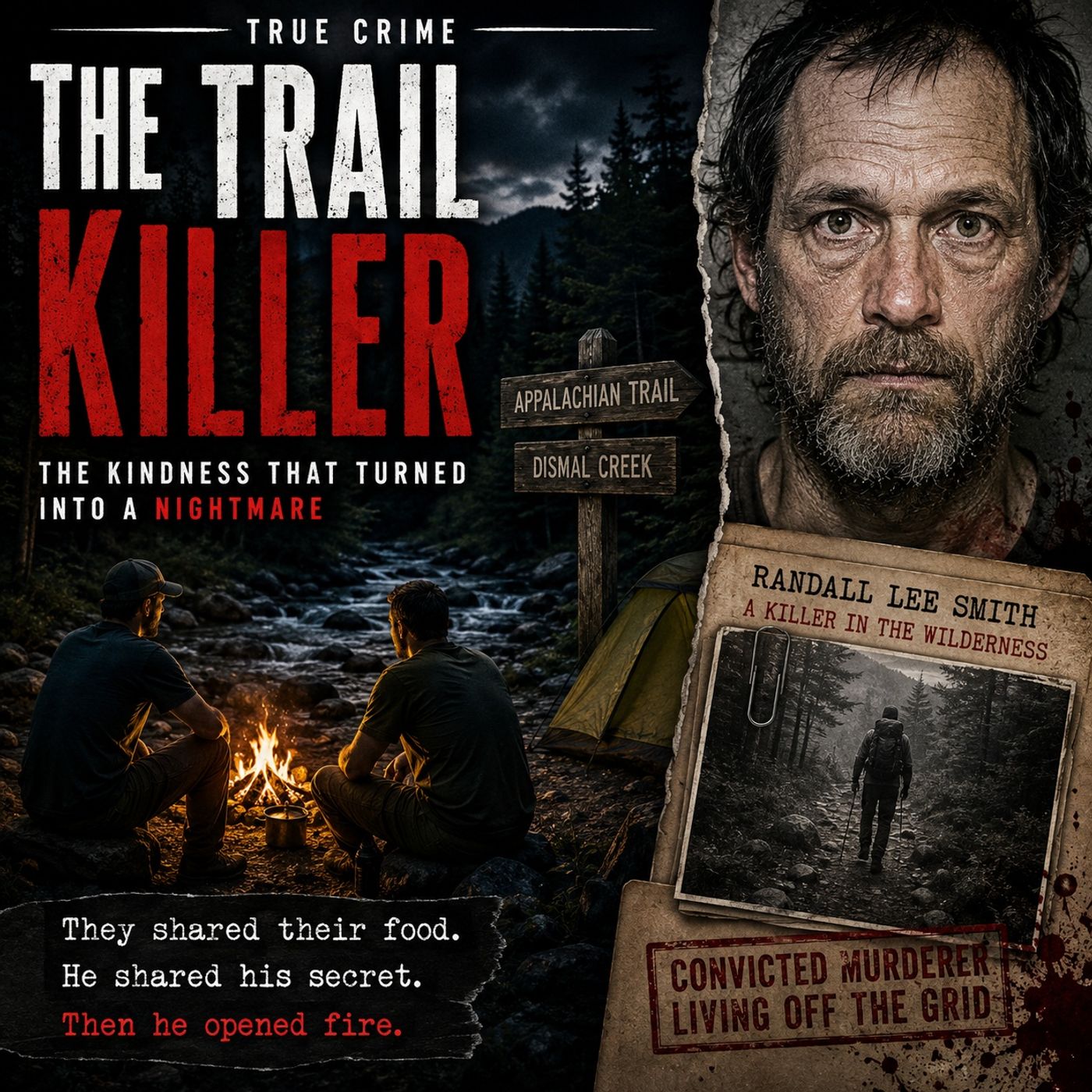
Campfire Betrayal
The Story
Two kind-hearted campers offered food and friendship to a hungry stranger they met on the Appalachian Trail. Hours later, that same man opened fire, turning a peaceful night into a desperate fight for survival. As investigators uncovered his true identity, they realized they were hunting a notorious killer hiding behind a false name. This is the chilling true story of betrayal, survival, and one of the Appalachian Trail's darkest crimes.Become a supporter of this podcast: https://www.spreaker.com/podcast/dark-american-crime--7005371/support.
Thanks for listening to Dark American Crime. The next episode is coming soon.
This episode includes AI-generated content.
The Appalachian Trail has always carried two reputations to millions of hikers. It is a place of peace, a ribbon of wilderness, stretching more than two thousand miles through forests, mountains, valleys, rivers, and forgotten towns. People travel from across the world to walk even a small section of it. They leave behind phones, deadlines, and city noise in exchange for bird song, rushing streams, and nights beneath stars untouched by artificial light. There is an unwritten rule among those who spend enough time there.
If you meet another hiker, you acknowledge them. If they need water, you share yours. If they're injured, you help them. If they're hungry, you feed them. On the Appalachian Trail, strangers often trust each other, because sometimes out there, strangers are all you have. Most people believe that code keeps everyone safe. But every now and then someone arrives who doesn't follow the rules. Someone who sees the mountains differently, someone who believes the trail belongs only to them. Someone who smiles while imagining murder.
On the afternoon of May sixth, two thousand and eight, the forests around Dismal Creek looked almost magical. The sunlight filtered through towering hardwood trees, casting long golden beams onto the moss covered ground. Cold mountain water rushed over smooth stones, carrying with it the unmistakable scent of fresh earth and pine. It was the kind of afternoon photographer's dream about, the kind that convinces people nature heals every wound. Yet hidden beneath that peaceful landscape was a man carrying a secret so dark that no one around him could have imagined what he had already done or what he was about to do.
He introduced himself as Ricky Williams. It wasn't his real name. Almost nobody knew that. To anyone passing by, Ricky appeared harmless. He was fifty four years old, lean almost to the point of looking sick, with weathered skin burned by years. Beneath the sun, his gray hair peeked out beneath a faded baseball cap, and his clothes looked as though they hadn't been replaced in years. His boots were worn nearly flat. His backpack had been patched so many times it looked more like stitch together fabric than an actual backpack.
Beside him, walked a loyal dog that rarely wandered more than a few feet away. The pair had become familiar faces to hikers passing through sections of western Virginia. Most assumed Ricky was simply another drifter who had chosen the mountains over modern life. Some even admired him. He seemed peaceful, quiet, polite. He often smiled. He thanked anyone who offered food. He never appeared threatening, and that appearance would save his life again and again. For nearly three weeks, Ricky and his dog had been camping around Dismal Creek.
Every morning followed almost exactly the same routine. Wake before sunrise, gather firewood, boil creek water, walk the trails, fish whenever possible, Meditate for hours, talk softly to himself. Sometimes he chanted. Sometimes he sat perfectly still for so long that squirrels climbed within feet of him without realizing another human was nearby. To outsiders, it looked like a man searching for spiritual peace. But inside Ricky's mind, something very different was happening. The isolation wasn't calming him, It was feeding something dangerous.
Food had become increasingly difficult to find. His supplies had nearly disappeared. The fuken goods he'd packed weeks earlier were gone. The crackers had long since turned into crumbs. Even his dog was beginning to look thinner. That afternoon, hunger finally drove him to Dismal Creek with a fishing pole. If he couldn't catch trout, neither he nor his dog would have much to eat. He cast his line, nothing again, nothing. Thirty minutes passed, then another thirty, not a single bite. Normally, Ricky could fish for an entire day without caring whether he caught anything.
Fishing wasn't only about food. It was about silence, about listening to moving water, about becoming part of the forest. But today was different. Today hunger made every empty cast feel heavier. His dog began pacing nearby. The animal seemed restless, not because of hunger, because something felt wrong. Dogs often noticed danger before people do. The forest itself had become unusually quiet. Bird song faded, even the insects seemed strangely absent. Ricky noticed it too. Then he heard something, a voice faint at first.
Somewhere behind him, branches cracked beneath heavy footsteps. Someone was approaching through the trees. He stopped reeling in his fishing line. His body stiffened. Normally, seeing another hiker would have been welcome, especially today. Anyone carrying extra trail food could easily spare an energy bar or a bag of trail mix. That's simply what people did out here. But another memory surfaced. One this mountain had never completely forgotten. Years earlier, not far from where Ricky now stood, two hikers had been murdered.
The killings had shocked the Appalachian Trail community. People still spoke about them decades later. The victims had trusted a stranger. They never made it home. Even now, experienced hikers occasionally mentioned that tragedy around campfires as a reminder that wilderness isn't always dangerous because of bears. Sometimes it's dangerous because of people. Ricky knew that story. Everyone around these mountains knew it. He couldn't help wondering who was now walking toward him. The footsteps stopped for just a moment.
Neither man moved. Then a figure emerged from the trees. He looked to be in his early thirties, fletick, clean shaven, wearing hiking boots, fishing gear, and carrying a backpack over one shoulder. The stranger smiled immediately afternoon, he said warmly, you having any luck? Ricky studied him for several seconds. There was no aggression, no sign of intoxication, no weapon in his hands, only a fishing pole. Ricky finally relaxed, not much, He admitted, haven't caught a thing. The younger man laughed, You're not alone.
He stepped closer before introducing himself. My name's Scott. He extended his hand. Ricky shook it. I'm Ricky. Scott looked at the nearly empty area around Ricky. You camping out here? Ricky nodded, been here for weeks. Scott's expression softened. You got enough food? There was a brief pause. Pride almost kept Ricky from answering honestly. Finally he sighed no. Scott didn't hesitate. He opened his backpack without asking another question. He pulled out two energy bars, then a bag of chips, then fresh fishing bait.
He tossed them toward Ricky. There you go. Ricky caught them almost instinctively. For a second, he simply stared. People often say kindness costs nothing. Out here, kindness can mean survival. You didn't have to do that, Ricky said quietly. Scott shrugged. Someone would do the same for me. That sentence perfectly captured the Appalachian Trail. Neither man knew that before this day ended, one would be fighting to stay alive. The other would reveal a nightmare hidden beneath years of lies. Ricky carefully unwrapped one of the energy bars, breaking off a small piece before handing the rest to his dog.
The animal devoured it in seconds, its tail wagging for the first time that day, Ricky smiled faintly. Hunger had a way of stripping away pride, and in that moment, Scott's simple act of generosity felt like a gift far greater than food. Thank you, Ricky said quietly. Scott waved it off. That's what people do out here. Those words lingered in Ricky's mind. Four years, the Appalachian Trail had operated on trust. It wasn't written in any guide book, but every experienced hiker understood it. You looked out for one another because the wilderness could become unforgiving without warning.
A twisted ankle, an empty water bottle, a sudden storm, any one of those could become life threatening. If nobody stopped to help. Scott believed in that code completely. He had no reason not to. As the afternoon wore on, the two men stood shoulder to shoulder along the creek, occasionally exchanging stories between casts. The water sparkled beneath the late afternoon sun, and after nearly an hour of bad luck, the trout finally began to bite. Scott reeled in the first fish. Minutes later, Ricky landed one of his own.
Soon both men were laughing as they competed over who could catch the biggest trout. To anyone watching from a distance, they looked like old friends reconnecting after years apart. But appearances can be dangerously misleading. Scott spoke easily. He explained that he hadn't come alone. His friend Sean was camped farther up the hill preparing the campsite while Scott tried his luck at the creek. We've been coming out here for years, Scott said, Nothing clears your head like these mountains. Ricky nodded, they're sacred.
Scott smiled politely. I don't know about sacred, but they're definitely peaceful. Ricky's expression changed for only a fraction of a second. So many people don't understand this place. Scott didn't notice. He kept untangling a fishing line. Meanwhile, Ricky stared silently into the moving water. Inside his thoughts, the mountains were far more than beautiful scenery. They were alive. He believed they listened. He believed they remembered. Sometimes, during his long meditations, he imagined the forest speaking back to him.
Whether those voices existed only inside his mind, nobody could say, but Ricky never questioned them. As afternoon drifted toward evening, they had caught several trout between them. Scott looked at the growing pile of fish and grinned, looks like dinner. Ricky chuckled, best meal I've had in weeks. Scott glanced toward the ridge where camp lay hidden among the trees. You should come eat with us, Ricky looked, surprised. You sure, absolutely, I don't want to impose you're not. Scott slung his backpack over one shoulder.
My buddy Shan's cooking tonight. He's a better cook than I am. Anyway. For a brief moment, Ricky hesitated. Part of him wanted to decline something about Scott's friendliness, almost felt suspicious, not because Scott had done anything wrong, because Ricky simply wasn't used to genuine kindness anymore. Years of isolation had changed him. Still, his stomach was empty. His dog needed food. He couldn't say no, I'd appreciate that. The two men packed their fishing gear and started walking through the dense woods.
The trail climbed steadily uphill. Leaves crunched beneath their boots. Evening shadows stretched between the trees. The farther they walked, the quieter everything became. About halfway to camp, Scott suddenly groaned. His fishing rod had snagged itself in the low branches of an oak tree. He tugged once, nothing, twice, Still stuck. Ricky turned back. You need help, Scott laughed. I've got it. He kept pulling. The light line only tangled further. Finally, Scott shook his head. Go on ahead. Ricky looked uncertain.
You sure, yeah, Scott pointed farther uphill the campsites right there. Just follow this path another minute or two. I'll catch up. Ricky hesitated. Something inside him urged caution. He couldn't explain why the woods suddenly felt heavier, almost watchful. Still, Scott had been nothing but kind. Ricky thanked him and continued alone. As he climbed the final stretch, he noticed a faint orange glow flickering through the trees the campfire. A few more steps then he emerged into the clearing. Immediately he froze a massive man sat beside the fire.
He was enormous, broad shoulders, heavy arms, the thick beard. Even sitting down, he looked intimidating. This had to be Shon. The giant looked up instantly. For a split second, confusion flashed across his face, then suspicion. Without saying a word, Sean grabbed a thick wooden club lying beside the fire and stood. The movement was so sudden that Ricky instinctively raised both hands. I'm sorry, Ricky said quickly. Scott told me to come ahead. I think this is your campsite. Seawan didn't lower the club.
He stared hard at Ricky. Every muscle in his body seemed tense. The silence lasted only a few seconds, but to Ricky it felt much longer. Then another voice came from behind. Everything okay. Scott stepped into the clearing, still carrying his fishing pole. He immediately saw the awkward scene. Oh, he laughed, my fault. Turning towards Sean, he smiled, this is Ricky. I invited him for dinner. Sean looked from Scott back to Ricky, then slowly lowered the club. He didn't smile, didn't apologize. He simply nodded once before sitting back beside the fire.
Ricky felt his heartbeat begin to slow, but the uneasy feeling remained. Scott seemed completely unaware. Come on, he said, cheerfully, have a seat. Ricky reluctantly sat beside Seawan. The difference in their size was almost unbelievable. Shawn could probably have lifted Ricky with one arm, Yet despite his intimidating appearance, Shawn remained mostly silent. Scott handed over the freshly caught trout. Shawn immediately began cleaning them with practiced hands. Then Scott walked over to a pickup truck parked nearby.
A second vehicle, a jeep, sat beside it. Moments later, country music exploded through the quiet forest. The radio echoed across the mountains. Ricky visibly flinched to him. The sudden music felt almost defensive. The Appalachian Trail wasn't meant to sound like this. It was suppose to be silent, respectful, sacred. He looked toward Scott, then toward Sean. Neither seemed bothered. They laughed as they prepared dinner. Ricky said nothing, but inside something had begun to change, a feeling, a judgment, an idea.
As darkness slowly settled over Dismal Creek, the campfire became the only light in the surrounding wilderness. Three men sat around the flames. One believed he had just made a new friend, another simply wanted to enjoy a peaceful evening outdoors, and the third was beginning to see the night through a very different lens. None of them knew that before the stars faded from the Virginia sky, gunfire would shatter the silence, blood would soak the forest floor, and one of the most shocking attacks in Appalachian Trail history would unfold.
The fire crackled softly as darkness settled over Dismal Creek. The last traces of daylight disappeared behind the mountain ridge, leaving the three men surrounded by towering trees that seemed to swallow every sound. The only light came from the dancing orange flames and the occasional sparks drifting upward into the black sky. For a few moments, no one spoke. Sean knelt beside the fire with practiced confidence, filleting the trout they had caught. His movements were quick and efficient, evidence that he had done this countless times before.
Scott sat nearby, sipping water from a metal bottle while watching the fish cook over the open flames. Ricky remained seated on a fallen log, his dog curled faithfully beside his boots. Although the evening should have felt peaceful, something continued to bother him. He couldn't quite explain it. It wasn't anything Scott or Sean had actually done. It was simply a feeling. Scott eventually broke the silence. So, Ricky, you've been living out here for weeks, Ricky nodded. Longer than that. You don't ever get lonely.
A faint smile crossed Ricky's face. No, I actually feel more alone when I'm surrounded by people, Scott laughed softly. I don't think I could do it. I like hot showers too much. Even Sean allowed himself a small grin for the first time since Ricky had arrived. The tension seemed to ease. The conversation drifted naturally from camping equipment to fishing stories, favorite sections of the Appalachian Trail, and the wildlife they had encountered over the years. Scott talked about black bears that had wandered through previous campsites.
Sean recalled getting lost in thick mountain fog for nearly six hours. Ricky listened carefully before quietly saying, the forest always brings you back if you know how to listen. Scott tilted his head. What do you mean, Ricky looked into the flames. I mean the woods speak. Neither Scott nor Sean answered. Ricky continued, most people come here hike. They're just visitors. They walk through these mountains without understanding them. But if you stay long enough, the mountains begin talking. Scott exchanged a brief glance with Sean.
Neither interrupted. Ricky's voice became almost hypnotic. I meditate every day, I pray, I chant. I've learned that nature has its own language. When the wind changes, when the birds suddenly stop singing, when the creek sounds different, it's trying to tell you something. Scott smiled politely. I've never thought about it like that. Ricky leaned forward. You should. This place is alive. Sean quietly turned another fish over the fire, still saying nothing. The conversation had become uncomfortable, not because Ricky was threatening, but because there was an intensity behind his words that neither Scott nor Sean had expected.
They had assumed Oomed he was simply an older drifter. Instead, he was describing beliefs that sounded deeply personal, almost obsessive. Trying to lighten the mood, Scott asked, so, what brought you out here in the first place. Ricky took several seconds before answering, I belong here. Scott nodded slowly. I mean before that, family, work, friends. Ricky's expression hardened. I left all that behind. There was finality in his voice. No one asked another question. Silence returned. The fish continued cooking.
Smoke drifted lazily through the trees. Somewhere in the distance, an owl called into the darkness. Ricky reached down and gently scratched behind his dog's ears. The animal suddenly lifted its head, his ears stood straight up stared into the darkness beyond the campsite. Then it let out a quiet wine. Scott noticed, what's wrong with him? Ricky looked toward the trees. I don't know. The dog kept staring. Its body had become stiff, almost frozen. After nearly a minute, the animal finally relaxed again and lay back down.
Scott shrugged, probably smelled a deer. Ricky didn't answer. Instead, he continued staring into the darkness. Something about the woods felt different now, as though they were no longer alone. Of course they weren't. The mountains contained countless animals, countless unseen movements, countless sounds hidden beneath the wind. Still, the uneasy feeling refused to disappear. A few minutes later, the fish were finally ready. The smell alone made Ricky realize just how hungry he truly was. The three men ate quietly.
No one spoke much. The meal disappeared almost as quickly as it had been prepared. When they finished, Ricky leaned back inside. Thank you, I can't remember the last time I had a meal like this. Scott smiled, no problem, I'm just glad we caught enough. Even Sean nodded glad you enjoyed it for the first time all evening. Shawn's voice sounded genuinely warm. Perhaps Ricky had misjudged him after all. Maybe the awkward beginning had simply been a misunderstanding. Maybe everything was fine. But inside Ricky's mind something had already shifted.
As the conversation replayed itself over and over, certain moments kept growing larger. The loud country music, the laughter, the questions about his life, the curious looks between Scott and Sean while he described his meditation rituals. Were they judging him, mocking him, pretending to be polite? The thoughts came quietly at first, then louder, then louder still. By now, the fire had burned lower, the night air had become noticeably colder. Ricky stood I should head back. Scott immediately looked up.
You sure, Yeah, it's getting late. Scott extended his hand. It was good meeting you. Ricky shook it firmly, You too. Then he turned toward Sean. Thanks for cooking. Sean simply nodded, take care. Ricky whistled softly. His dog rose immediately. Together they began walking toward the trail leading back into the forest. Scott watched them disappear between the trees. Nice guy, Scott said. Sean shrugged, A little strange. Scott chuckled, maybe but harmless. Sean tossed another piece of wood onto the fire.
I hope he finds somewhere better to stay. Neither man noticed that only fifteen feet away, hidden among the darkness, Ricky had stopped walking. He wasn't leaving. He slowly turned around. His face was almost impossible. A sea beneath the shadows. Then, without warning, a deafening blast exploded through the mountains. The sound ripped through the forest like a bolt of thunder. For a split second, neither Scot nor Shan understood what they had heard. The explosion echoed off the mountain side, rolled through the trees, and then vanished into the night time.
Seemed to stop. Shawn instinctively reached up to his face. His fingers touched something warm. When he pulled his hand away, it was slick with blood. He stared at it in disbelief. The bullet had torn into the side of his face. For a heartbeat, he couldn't process what had happened. His ears rang violently. The world around him blurred Scott looked at Shan, his eyes wide with confusion. Shan then he saw the blood Shawn. Before either man could react, another gunshot shattered the silence. This time they both saw the flash.
It came from the darkness just beyond the firelight. Standing among the trees was Ricky. Gone was the quiet, grateful old man they had spent the evening feeding. Gone was the harmless drifter who had seemed almost embarrassed to ask for food. His face was cold, emotionless. He held a rifle tightly against his shoulder. His eyes were locked on them. There was no hesitation, no warning, only deadly purpose. Another shot rang out. Scott instinctively dove sideways. The bullet ripped through the campsite, sending sparks and dirt flying ron Scott screamed.
Sean tried to stand. Pain exploded through his head, Blood poured down his neck, soaking his shirt. He staggered backward before collapsing beside the fire. Ricky stepped closer. The campfire illuminated his face just enough for Scott to see something terrifying. He wasn't angry, he wasn't panicking. He looked calm, almost peaceful, as if this violence made perfect sense to him. Scott turned and sprinted into the darkness. Branches whipped against his face. He had no plan, only one instinct get away.
Behind him came another deafening shot. An unbearable pain irrupted across his neck. The force nearly knocked him off his feet. He stumbled fell to one knee. His hand flew instinctively to the wound. When he pulled it away, it was covered in blood. The bullet had passed through his neck. He couldn't breathe properly. Every breath produced a wet, gurgling sound. Still, he forced himself back to his feet. He had to keep moving behind him, Ricky lowered the rifle slightly. Scott was disappearing into the darkness.
For a brief moment, Ricky watched him go. Then he turned back toward Sean. The giant of a man was still alive, barely. He struggled to push himself upright. His vision blurred. Blood dripped steadily onto the ground. Ricky calmly walked closer. Only a few feet separated them. Now Sean looked up. He saw the rifle pointed directly at his chest. There was no hatred in Ricky's expression no rage, only complete emptiness. The trigger squeezed, the rifle roared again. The bullets slammed into Shan's chest.
The impact threw him backward. For several long seconds. He couldn't move, couldn't breathe couldn't think. The world narrowed to unbearable pain. Ricky stood silently over him, believing it was over, believing no one could survive that. But the human body can do astonishing things when flooded with adrenaline. Somewhere deep inside, survival took control, ignoring the agony, ignoring the blood filling his lungs, ignoring the gunman standing only yards away. Sean rolled onto his side, then on to his knees.
Then somehow he stood. Ricky blinked for the first time that night. Surprise crossed his face. Before he could react, Sean turned and ran. Not a slow stumble, not a cautious retreat, a desperate sprint. Every step felt impossible, yet fear pushed him forward. He raced toward the jeep parked at the edge of the campsite. His hands shook violently as he yanked open the driver's door. He threw himself inside. The keys were still in the ignition. He twisted them. The engine roared to life. At almost the same moment, another figure burst from the woods.
Scott. He was staggering wildly. Blood poured from his neck and soaked the front of his shirt. He nearly collapsed as he reached the jeep. Sewn shoved open the passenger door get in. Scott fell inside. The door slam shut without another second to spair. Sean slammed his foot onto the exit. The jeep lurched forward behind them. Ricky raised the rifle once more. Another shot cracked through the night. The bullet missed as the jeep disappeared around the bend. Inside the vehicle, neither man spoke.
They couldn't. Scott pressed both hands against his neck, trying desperately to slow the bleeding. Blood slipped through his fingers anyway. Sean struggled to keep the steering will steady. His vision faded in and out. Blood dripped into one eye. Every breath sent sharp pain through his chest. Neither knew how badly the other was injured. Neither knew whether Ricky was following them. Neither even knew if they would survive the next ten minutes. They only knew one thing they had to reach help. The narrow mountain road twisted through complete darkness.
Every bump sent waves of agony through their bodies. The headlights cut narrow tunnels through the trees behind them. The forest disappeared into silence once again, as though nothing had happened, as though the mountain itself had swallowed the violence. Hole miles away, lights from a small, isolated farmhouse glowed softly in the darkness. It would become their only hope. Neither Shan nor Scott realized that before the night was over, police would uncover the true identity of the man who had just tried to kill them, a name that had haunted the Appalachian Trail for decades.
The jeep bounced violently along the narrow mountain road, its tires throwing gravel into the darkness. As Shan fought to keep control of the steering wheel. Every sharp turn sent a jolt of pain through his body. Blood continued to flow from the wound in his face, and the bullet lodged in his chest made every breath feel like someone was driving a knife deeper into his ribs. Beside him, Scott was fading. His hands were pressed tightly against his neck, desperately trying to stop the blood pouring through his fingers.
Every few seconds, he coughed, and bright red blood splattered across the dashboard. Stay with me, Sean gasped. Scott nodded weakly. I I'm trying. Neither man spoke again. There was no strength left for conversation. The only sounds inside the jeep were the engines straining up hill, their ragged breathing, and the rhythmic clicking of the turn signal that Sean had accidentally switched on during the chaos. Outside, the forest remained eerily still. The Appalachian Trail, which had seemed so welcoming only hours earlier, now felt like a place determined to swallow every trace of what had happened.
Shawn's vision blurred. For one terrifying moment, everything went black, His head slumped forward, the jeep drifted toward the edge of the road. At the very last second, he jerked awake and yanked the steering will back into his lane. Come on, he whispered to himself. Just a little farther, he knew there was a small house several miles down the mountain. It was the only place they might find help. If no one answered, they would both die before sunrise. Minutes passed like hours. Then finally, a faint porch light appeared through the trees.
Sean nearly cried with relief. There he pointed weakly. Scott lifted his head just enough to see it. The jeep rolled into the driveway before coming to a rough stop. Scott reached for the door handle, but his arm barely responded. His body had lost too much blood. Sean looked at him, You've got to go, Scott swallowed painfully. What about you, I'll stay with the jeep. I I can't, you can. Scott took one deep, agonizing breath. Then he forced the door open. The cool night air hit him immediately, his legs buckled.
He caught himself against the side of the jeep before stumbling toward the porch. Each step left droplets of blood behind him. By the time he reached the front door, his clothes were soaked Crimson. He raised one trembling hand and began pounding as hard as he could. Inside the house, two women had just finished eating dinner. They froze. Nobody visited this late, specially not out here. One woman instinctively reached for the telephone. The other cautiously walked toward the front door. The knocking grew louder, more desperate, she switched on the porch light.
Through the small window, she could barely make out the silhouette of a man standing outside. She unlocked the door, opened it only a few inches, and immediately screamed. Standing on the porch was a man drenched in blood from head to toe. For an instant she thought someone had thrown red paint over him. Then she noticed the wound. Blood pulsed from his neck with every heartbeat. He looked directly at her. His lips trembled, Please help me. His voice was barely audible. The woman shouted over her shoulder, call nine one one.
The second woman grabbed the phone immediately as she frantically explained the emergency. The first woman tried to keep Scott standing, but his strength was gone. He whispered only a few words dismal creak. Then his knees gave way. He collapsed onto the porch. The woman knelt beside him, pressing towels against his neck while begging him to stay awake. Then she happened to glance toward the road only then did she notice the jeep Its engine was still running. Headlights illuminated the trees. Someone else was inside.
Within minutes, the distant wail of sirens echoed through the mountains. Police cars, ambulances paramedics rushed toward the porch carrying medical equipment. One team immediately began treating Scott. Another hurried toward the jeep. Inside, they found Sean barely conscious. His face was covered in blood. There was a gunshot wound in his chest, another across his face, Yet somehow he was still alive. The medics exchanged astonished looks. Neither man should have survived injuries like these. Both were loaded into separate ambulances.
Because of the severity of their wounds, helicopters were requested to fly them to a trauma center. As the ambulances sped away, police officers gathered the little information they had one location, Dismal Creek. Nothing more, no names, no suspect, no explanation, but every instinct told them something terrible had happened up there. Without waiting for additional details, multiple patrol cars turned toward the mountain road leading back to Dismal Creek. The officers drove fast, their lights flashing through the darkness.
The winding road offered almost no visibility. Then suddenly head lights appeared around a sharp bend. A pickup truck was facing downhill directly toward them. The officers hit their brakes. The truck slowed to For a brief second, it looked as though both vehicles would safely pass each other. Then, without warning, the pickup accelerated, its engine roared. Instead of staying on the road, it veered sharply toward the embankment. The truck launched off the edge. It rolled violently down the hillside.
Metal screamed, glass exploded. The vehicle flipped again and again before finally coming to rest upside down among the trees. The officers stared in disbelief what just happened. One deputy grabbed his flashlight, another drew his weapon. They cautiously descended toward the wreck. Inside the crushed cab, a lone driver remained alive barely. He was badly injured, but conscious. As firefighters worked to free him, one deputy noticed something odd. The man's dog was wandering nearby alive. The driver never said a word, He simply stared silently into the darkness.
The deputies had no way of knowing it yet, but the man trapped inside that wrecked pickup was the same quiet, hungry drifter who had shared dinner only hours earlier and before sunrise. His true identity would send shock waves through every investigator working the case. The twisted pickup truck lay upside down at the bottom of the embankment, its engine ticking as it cooled. Steam hissed from beneath the crumpled hood and broken glass glittered across the ground. Under the flashing red and blue lights of the patrol cars, the deputies moved cautiously at first.
They didn't know what they were dealing with. Had the driver been fleeing from the scene of a crime, was he simply intoxicated, or had he lost control on the dangerous mountain road. One deputy crouched beside the shattered driver's window and shined his flashlight inside. The driver was still conscious. His face was streaked with blood from the crash, but despite his injuries, he appeared strangely calm, too calm. Can you hear me, the deputy asked. The man slowly turned his head. His expression was blank.
He didn't answer, what's your name? Silence, sir, were you involved in what happened at Dismal Creek? Again? Nothing. The only movement came from the man's loyal dog, which stood a few yards away, quietly watching as emergency crews worked to free its owner. The firefighters eventually cut through the twisted metal and carefully pulled the injured man from the wreckage. As they placed him onto a stretcher. He never resisted, He never asked about the two men he'd left behind. He never asked about his dog.
He simply stared up at the night sky, as if none of this concerned him. One of the deputies exchanged a glance with another officer. This guy's not acting right. No, no, oh, the other replied, He's definitely not. Although they had no proof he was connected to the shooting, the timing was impossible to ignore. Two men had been found riddled with bullets after mentioning Dismal Creek. Now only minutes later, this mysterious driver was speeding away from that same area before crashing in spectacular fashion.
The officers decided they couldn't take any chances. An ambulance would transport the injured driver to the hospital, but one deputy would ride along and remain with him the entire time. If this man knew anything, they weren't letting him disappear. As the ambulance pulled away, the remaining officers climbed back into their patrol vehicles and continued toward Dismal Creek. The mountain road grew narrower, dense forests closed in around them. Finally they reached the area where Scott and Sean had been camping.
The officers spread out with flashlights. At first, they found very little spent shell casings, blood on the ground, the remains of a campfire still glowing faintly. Fishing gear scattered across the campsite. Half clean trout lay abandoned near the fire, now cold and untouched. One officer quietly shook his head. This all happened fast. There were signs of panic everywhere. Boot Prints crisscrossed the clearing, a folding chair had been knocked over, Cooking utensils lay scattered in the dirt. The evidence painted a picture of absolute chaos.
Crime scene investigators were called immediately. While they secured the main campsite, several deputies continued searching the surrounding woods. If the shooter had been living nearby. Perhaps he'd left something behind. Nearly half an hour later, one deputy called out, I found another campsite. The officers hurried toward his voice. Hidden deeper within the forest was a second camp Unlike the first one, this campsite looked permanent. T tent was weathered, firewood had been neatly stacked. There were signs someone had lived here for quite some time.
One officer carefully unzipped the tent flap. The smell inside was overwhelming, old clothes, smoke, damp earth. The beam from his flashlight swept slowly across the interior. Then he stopped. What They knives, dozens of them, large hunting knives, pocket knives, fixed blade survival knives. Some looked brand new, others were badly worn. They counted approximately thirty in total, far more than any camper would ever need. The officers immediately became cautious. One deputy quietly radioed, we've got something unusual.
As they continued searching, the discoveries only became stranger. There was a police scanner capable of picking up law enforcement radio traffic. Several piles of clothing, men's clothing, women's clothing, children's clothing, none of it appeared organized. Nearby sat multiple pairs of eyeglasses. Then came in even more disturbing discovery, eight pairs of women's underwear. The tent fell silent. No one spoke. Every officer was thinking the same thing. Whose belongings were these? Were they trophies or were their innocent explanations?
No one knew. Against one side of the tent rested a detailed map of the Appalachian Trail. Dozens of locations had been circled in dark ink. Some circles were small, others had been drawn repeatedly, almost obsessively. One of the marked locations was Dismal Creek, but there were no notes explaining why any of these places had been selected. Another deputy picked up a portable radio. Inside was an old cassette tape. Curious, he pressed play. Static crackled through the speaker, then a man's voice, low rhythmic chanting.
The words were difficult to understand. The tone was eerie, sounded almost ritualistic. The recording echoed through the quiet forest, sending chills down the backs of everyone standing there. One officer quickly stopped the tape. I've heard enough yet, The strangest discovery was still waiting. Folded neatly beneath several personal items, was a single document. One deputy carefully unfolded it. It was a birth certificate. He read the name once, then again. His eyes widened. He slowly looked up at the others.
You guys, I think we know who this is. The other deputies gathered around. The name printed on the birth certificate belonged to a man whose crimes had terrified the Appalachian Trail decades earlier, a man believed by many never to have set foot on these mountains again. A convicted double murderer, a predator whose name still haunted hikers throughout Virginia. In that insane the pieces of the Knight's terrifying puzzle began falling into place. The quiet drifter who called himself Ricky Williams had never really existed.
The deputy read the name on the birth certificate one more time, hoping he had somehow made a mistake. He hadn't. The document belonged to Randall Lee Smith. For several seconds, no one spoke. Even the seasoned investigators standing inside the tent felt a chill run through them. The name wasn't just familiar, it was infamous. Older officers remembered the case immediately. Younger deputies had learned about it during briefings and from veteran detectives, who warned them that some crimes leave scars that never completely disappear.
One detective finally broke the silence. You're telling me, this is that Randal Lee Smith. The deputy nodded slowly, I think it is. Within minutes, calls were being made up the chain of command. Investigators pulled old case files, dispatch searched criminal records. The information came back quickly. The birth date matched, the identifying details matched. The man who had introduced himself as Ricky Williams was almost certainly Randall Lee Smith, a convicted killer who had once terrorized the Appalachian Trail.
Suddenly, everything about the night took on a completely different meaning. The strange behavior, the isolated campsite, the collection of knives, the police scanner, the map covered with circles. None of it belonged to an ordinary drifter. It belonged to a man with a violent past. As detectives continued documenting the campsite, one investigator carefully examined every item. Inside the tent, the piles of clothing bothered him the most. There were shirts of different sizes, jackets, children's sweaters, women's jeanes, old boots.
Some looked weathered from years outdoors, others appeared almost untouched. Each item was photographed and carefully passedckaged as evidence. The eyeglasses were collected next. Some had cracked lenses, others were intact. No names, no identifying marks, just a growing collection of objects that raised far more questions than answers. Then came the women's underwear, eight pairs, each carefully stored. The detectives exchanged uneasy glances. One quietly asked the question everyone was thinking.
What if these belonged to victims? No one answered. It was entirely possible, but there was no proof, not yet. Crime scene technicians collected DNA samples from everything they could here, fabric personal belongings, anything that might identify previous owners. If Randall had harmed other people over the years, perhaps these items would finally expose those crimes. Outside the tent, another detective unfolded the trail map. He counted every circled location. There were dozens. Some were clustered together, others were miles apart.
One location stood out immediately, Dismal Creek, the place where Sean and Scott had nearly been murdered. The detective traced the circles with his finger. What do these places mean? Nobody knew. Were they campsites, Randall enjoyed places where he meditated, or something much darker. Teams would later search every marked location, But at that moment, standing beneath the trees in the middle of the night, the investigators couldn't shake one horrifying possibility. What if every circle marked another victim.
Back at the hospital, doctors fought desperately to save Sean and Scott. Scott was rushed straight into emergency surgery. The bullet had entered through his neck and exited near his shoulder. He had lost an enormous amount of blood. Surgeons worked through the night, repairing damaged tissue and stopping the bleeding. Every minute mattered across the hall. Shawn's injuries seemed almost unbelievable. The first bullet had torn through his face, the second had entered his chest. Doctors stared at the X rays in disbelief.
One bullet remained lodged inside his body. Another had narrowly missed several vital structures. A trauma surgeon quietly remarked, I honestly don't know how this man drove a vehicle, Neither did anyone else. Yet somehow he had driven four miles through twisting mountain roads while bleeding from multiple gunshot wounds. That decision had almost certainly saved both their lives. Meanwhile, under police guard in another section of the hospital, Randal Lee Smith lay in bed, recovering from injuries suffered during the truck crash.
His wrists were restrained. An officer remained posted outside his room. Detectives attempted their first interview shortly before dawn. They introduced themselves. They explained that two men had been shot. They asked simple questions. What's your name? Silence? Were you camping near Dismal Creek? Nothing? Did you shoot two men tonight? Randal slowly turned his head toward the detective. For a long moment, he simply stared. Then he looked away. He refused to speak, not another word. Hours later, investigators officially confirmed his identity through fingerprints.
There was no longer any doubt the quiet man. Everyone had pitted the hungry camper grateful for a meal. The harmless drifter with the loyal dog was one of the Appalachian Trail's most notorious killers, and as news spread through law enforcement agencies across Virginia, many began asking the same disturbing question. If Randal Lee Smith had been living back on the trail for months or perhaps years, how many times had hikers unknowingly shared food, campfires, or even laughter with a murderer hiding in plain sight.
By sunrise, the news had spread far beyond the small sheriff's office investigating the shooting. A familiar name had resurfaced. Randal Lee Smith was alive, had been living under the alias Ricky Williams, and had allegedly shot two men at a remote camp site on Dismal Creek. For many veteran investigators, it felt like reopening a nightmare they believed had ended decades earlier. Some officers who had worked the original case were now retired, but they still remembered the fear that had gripped the Appalachian Trail after the murders in nineteen eighty one.
Back then, hikers had begun looking over their shoulders, wondering if the next friendly stranger they met might be the last person they would ever see. Now that fear had returned. Only this time, there were even more unanswered questions. Why had Randal attacked Scott and Sean. The two men had done nothing but show him kindness. They had shared their food, invited him to dinner, cooked the fish they had caught together. By every account, they had treated him like a friend. Investigators searched every minute of the evening, hoping to find some trigger.
Did they argue now, did anyone threaten Randal? No? Did Scott or Sean insult him again? No witnesses, meaning the surviving victims themselves, would later insist that nothing unusual happened before the attack. In fact, they both described Randal as quiet, polite, and grateful. Scott remembered feeling sorry for him. He looked like an older man who'd fallen on hard times, he later told investigators. He seemed hungry, lonely. We figured the least we could do was feed him. Sewn agreed. Neither of them had sensed they were sitting beside a convicted murderer.
Neither had imagined the frail man across the campfire was silently watching them, studying them, perhaps even deciding whether they would live or Detectives returned to Randall's campsite with forensic specialists. Every inch of the area was photographed and searched again. The mysterious items recovered from the tent continued to dominate conversations. The clothing, the eyeglasses, the women's underwear, the police scanner, the cassette tape of eerie chanting, the map covered in circles. Each object hinted at secrets Randall had never shared with anyone.
One detective listened to the cassette several more times. The recording wasn't a satanic ritual, as some initially feared. Instead, it appeared to be Randall's own meditation sessions. His voice rose and fell in strange chants, occasionally speaking to nature as though it were a living presence. Some phrases sounded almost like prayers, Others were impossible to understand. Mental health experts who later reviewed the tape suggested Randall may have developed an intensely personal belief system centered around the Appellatation trail itself.
To him, the forest wasn't simply wilderness. It was sacred ground, his home, his refuge, perhaps even his identity. Investigators began considering a disturbing theory. What if Randal believed certain people didn't belong there. What if, in his deeply troubled mind, he had appointed himself guardian of the mountains. No evidence could prove that theory, but it fit what little they knew. Scott remembered one detail from dinner that suddenly seemed significant. When the country music played from the truck radio, Randal had visibly winced.
At the time, Scott assumed the older man simply preferred silence. Now, detectives wondered if Randal had viewed something so ordinary as a profound act of disrespect against the wilderness. Had that planted the seed, or had Randal planned the attack long before the music ever played. No one could say. Meanwhile, forensic scientists worked tirelessly to identify the belongings found inside Randall's tent. DNA samples were taken from every article of clothing, every pair of eyeglasses, every personal item.
The hope was simple, If these belonged to missing people, investigators might finally solve cold cases stretching back years. Weeks later, the laboratory results arrived. The outcome stunned everyone. None of the DNA matched any missing persons or homicide victims in state or national databases, not one. The result answered nothing. Instead, it created an entirely new mystery. If the items weren't connected to known victims, why had Randall collected them? Were they discarded belongings he had found along the trail, Were they souvenirs from encounters with strangers, or did they belong to victims whose disappearances had never been reported or whose identities remained unknown.
Investigators had no answers. The circles on the map proved equally frustrating. Search teams visited every marked location. They combed through campsites, ravines, stream beds, and wooded clearings. Metal detectors scanned the ground. Cadaver dogs searched for human remains. Nothing, no graves, no evidence of violence, no hidden camps, nothing that explained why Randal had marked those locations so carefully. Only Dismal Creek had any confirmed connection to violence. As each lead reached a dead end, detectives became increasingly convinced of one painful truth.
The only person who knew the full story was Randal himself, and he still refused to speak. Every interview ended the same way silence, blank stares, no explanation, no apology, no remorse. The investigators remained determined. They believed that eventually Randal would have to talk. They had no idea time was about to run out. The days following the shoe were filled with unanswered questions. Investigators built a timeline minute by minute, hoping that somewhere within the sequence of events they would find a motive that finally made sense.
They interviewed nurses, paramedics, crime scene technicians, neighbors who had heard the sirens, anyone who might have noticed something unusual. Yet every path led back to the same conclusion. Scott and Sean had done everything right. They had acted with compassion, They had followed the unwritten code of the Appalachian Trail. They had fed a hungry stranger, and in return, that stranger had tried to kill them. At the hospital, Scott slowly regained consciousness. His throat was sore from the surgery and speaking was painful.
Doctors asked him not to talk for long, but detectives needed to hear his account while the memories were still fresh. A detective pulled up a chair beside his bed. Scott, he said gently can you tell us what happened? Scott closed his eyes for a moment. His voice was weak. We met him while fishing. He seemed harmless. The detective nodded, did he ever threaten you? No? Did you argue? Scott slowly shook his head. He was hungry, so we fed him. Tears welled in Scott's eyes as he replayed the evening in his mind.
I keep thinking maybe I missed something, some warning, but there wasn't one. The detective didn't interrupt. Scott continued. When he talked about the trail, he sounded different. He said it was sacred. I thought he was just spiritual. I never thought his voice cracked. I never thought he'd shoot us. A few rooms away, Sean was also recovering. His injuries were even more severe. Doctors had managed to stabilize him, but the bullet lodged in his body couldn't not safely be removed. Another remained embedded in his head.
The risks of surgery were simply too great. When detectives finally spoke with him, Shawn's account matched Scott's almost perfectly. He wasn't angry, he wasn't drunk, he wasn't acting crazy. He just changed. The detective leaned forward, what do you mean? It was like Sean searched for the right words, like someone flipped a switch. One minute he was thanking us, the next he was trying to execute us. Those words echoed through the investigation, trying to execute us, because that was exactly what the evidence suggested.
Randal hadn't fired a warning shot. He hadn't tried to scare them away. He had aimed carefully. He intended to kill both men. Back at police headquarters, detectives reopened every file connected to Randal Lee Smith. His criminal history painted the picture of a deeply troubled man. Years earlier, he had committed a brutal double murder along the Appalation Trail, a crime that horrified hikers across the country. He had been arrested, convicted, and sentenced to prison. After serving years behind bars, he had eventually been granted parole.
Many believed he had changed. For a time, it appeared they were right. He lived quietly, obeyed the conditions of his release, stayed with family, avoided trouble, But eventually those around him noticed he struggled to adjust to ordinary life. Money became a constant problem, holding a steady job proved difficult. Gradually he drifted away from society. Then, almost without anyone noticing, he disappeared back into the mountains. The Appalation Trail became his home once again, Living alone in the wilderness, accompanied only by his dog, Randall spent months isolated from almost everyone.
Mental health experts later suggested that prolonged isolation may have intensified his already fragile psychological state. Without regular treatment, without meaningful human contact, without structure, his world may have gradually become disconnected from reality. Still, isolation alone could not explain attempted murder. The biggest question remained unanswered, Why Scott why Sean. Investigators explored every possible theory. Had Randal mistaken them for someone else, Had he believed they were trespassing?
Had paranoia convinced him they intended to harm him. Nothing fit perfectly. There was simply no evidence of conflict before the shooting. As detectives prepared for another attempt to question Randall, they hoped that perhaps after several days, he might finally speak. He never got the chance. On the fourth day after the shooting, doctors noticed his condition suddenly deteriorating. Complained of severe pain, then difficulty breathing. Medical staff rushed to his bedside. Tests revealed a blood clot, one that had formed after the violent truck crash during his attempted escape.
Despite emergency treatment, his condition worsened rapidly. Within hours, Randal Lee Smith was dead, just like that, the only person who knew exactly why the shooting happened, the only person who could explain the strange campsite, the mysterious map, the collection of belongings. The silence was gone forever, his secrets died with him. For detectives, it was an immensely frustrating ending. There would be no confession, no court room testimony, no answers, only evidence and speculation. The investigation would continue, but from that moment on, one haunting possibility became impossible to ignore.
If Randal had taken other lives over the years, no one might ever know. The death of Randal Lee Smith closed the criminal case, but it did not end the investigation. In many ways, it made the mystery even more difficult. Prosecutor can present evidence, a jury can weigh testimony, a suspect can be questioned, But when the only person with the answers dies without saying a word. Investigators are left with fragments, pieces of a story that may never fit together completely. Detectives returned once more to Randall's campsite, determined not to overlook anything.
Every inch of the tent was measured, every footprint was photographed, Every item was cataloged again. The thirty knives were examined one by one. Some were ordinary camping tools, dulled by years of use. Others appeared almost untouched, their blades still razor sharp. None of them matched the bullets fired at Dismal Creek, but they reinforced the image of a man who surrounded himself with weapons. The police scanner also drew attention. It was fully functional. By monitoring emergency radio traffic.
Randall could have known when officers were responding to incidents nearby. Whether he had actually used it to avoid law enforcement or simply carried it out of Habit was impossible to prove. Then there was the map. Investigators spread it across a table and compared every circled location with missing person reports, unsolved assaults, and suspicious deaths along the Appalachian Trail. The hope was that one of the circles would correspond to an unsolved crime. Nothing matched. Search teams revisited several of the marked areas with cadaver dogs and forensic specialists.
The dogs searched ravines, creek banks, abandoned campsites, and dense patches of forest. They found old campsites, discarded equipment, animal remains, but no human remains, no graves, no hidden evidence of additional murders. The search, though extensive, ended without the break through investigators had hoped for. The personal belongings found in Randal's tent remained equally baffling. The clothing came from different brands, different sizes, and different ages. Some appeared to have been abandoned by hikers, others looked as though they had been carefully folded and stored.
The eyeglasses were examined for fingerprints and DNA. The women's underwear underwent the same testing. The laboratory results offered one small measure of relief. Nothing linked the items to any known homicide victims or missing persons. That did not prove they were harmless. It simply meant there was no evidence tying them to a crime. Some detectives believed Randal may have collected discarded objects he found along the trail, treating them as keepsakes. Others feared the truth might be far darker, that some victims had simply never been identified or reported.
Without additional evidence, neither theory could be confirmed. As the forensic work continued, psychologists were asked to review everything known about Randal's behavior. His journals contained almost no useful information. The cassette recording of his chance suggested a man who had developed an intensely personal, spiritual relationship with nature. He appeared to view the Appellationian trail as more than a hiking route. To him, it seemed to be sacred ground. Some experts believed he may have perceived himself as its protector.
Others cautioned against drawing firm conclusions. Mental illness can influence behavior in complex ways, and without a direct evaluation or explanation from Randal himself, assigning a clear motive would be speculative. One fact, however, remained undeniable. Scott and Sean had never threatened him. They had shown him compassion. They had offered food to a hungry stranger, and despite that kindness, he had attempted to kill them. Months later, both men continued their long recoveries. Scott's next healed slowly, leaving a prominent scar that stretched across his throat and shoulder.
Swallowing remained painful for some time, and certain movements reminded him daily of how close he had come to dying. Shawn's recovery was even longer. Doctors determined that removing the bullets lodged in his head and chest posed greater risks than leaving them in place. He would carry those bullets for the rest of his life. There were days when headaches became almost unbearable, certain physical activities were no longer possible, Yet both men considered themselves fortunate they were alive.
Many people who cross paths with violent offenders never receive a second chance. Friends and relatives often asked whether they would ever return to the Appalachian Trail. The question seemed almost impossible, why revisit the place where someone had tried to murder them, But for Scott and Sean the answer surprised many people. They refused to let fear claim the mountains they loved. After they had recovered, they returned to Dismal Creek, not to relive the violence, not to prove anything, simply to fish, simply to camp simply to remind themselves that one disturbed individual did not own the trail.
The Appalachian Trail had shown them extraordinary kindness long before it had shown them unimaginable violence. They were determined not to forget the first part of that story. Still, every time the wind rustled through the trees, every time footsteps echoed from somewhere beyond the campsite, the memory of that quiet evening in May two thousand and eight inevitably returned, and so did the image of an older man named Ricky, smiling, politely accepting food while hiding a deadly secret behind a borrowed name.
As the months passed, investigators slowly accepted a painful reality. The case had been solved in the legal sense, the shooter had been identified, the victims had had survived. There would be no trial because Randal Lee Smith had died from complications following the truck crash. But emotionally, the case never truly felt finished. There were simply too many questions that no one could answer. One of the biggest mysteries centered on Randal himself. How had a man with such a notorious past managed to disappear into the appellation wilderness without attracting more attention.
The answer, investigators believed lay in the very culture of the trail. The Appalachian Trail is filled with people from every walk of life. College students taking a gap year, military veterans searching for peace, retirees fulfilling lifelong dreams, people recovering from addiction, people escaping heartbreak, people simply trying to figure out who they are. It's also common to meet individuals who have chosen to live on or near the trail for months at a time with very little money. Because of that, Randal never stood out as much as people might imagine.
To most hikers, he appeared to be just another aging drifter trying to survive. His worn clothing, his battered backpack, his quiet personality, even his hunger. None of it seemed unusual. If anything, those details inspired sympathy. Many hikers later told investigators they had shared food with him, some had offered him coffee. Others had sat around campfires talking with him for hours. Several remembered his loyal dog. Almost everyone described the same man, quiet, soft spoken, reserved, odd at times, but never openly threatening.
It was chilling to realize how close countless strangers had come to danger without ever knowing it. Investigators also revisited Randall's years after his release from prison. Records showed that after being paroled, he had spent years trying to live under supervision. For a while. He complied with the conditions placed upon him, aid with family, reported when required, avoided new criminal charges. To many people, it appeared he had been successfully rehabilitated, but rehabilitation is not always a straight path.
Mental illness, financial hardship, and social isolation can combine in devastating ways. Over time, Randall drifted farther from society. Eventually, he packed what little he owned into his truck, took his dog, and disappeared back into the mountains that had become an obsession throughout his life. There he created a world with its own rules, a world where he answered to no one, a world where the Appalachian Trail became more than a place. It became his identity, his refuge, perhaps even his kingdom.
No investigator could say exactly what happened inside Randall's mind during those lonely months in the wilderness, but many believed his grip on reality continued to weaken. His recordings of chance and meditations suggest that he wasn't simply enjoying nature. He appeared to believe he shared a unique spiritual connection with it. One profiler reviewing the evidence summarized it carefully. He may have believed the trail belonged to him in a way no one else could understand. That statement was never presented as fact, only as one possible explanation, because the truth died with Randall.
Meanwhile, Scott and Sean faced a different challenge, healing not only physically but emotionally. Sleep became difficult. Both men experienced recurring nightmares. In those dreams, they were back around the campfire, the fish cooked over the flames, the country music drifted through the trees, then the deafening crack of the rifle. They woke covered in sweat, reliving the terror again and again. Counselors later explained that such reactions were common among survivors of violent attacks. Trauma doesn't simply disappe here after wounds heal sometimes it lingers for years, sometimes for a lifetime.
Yet, despite everything, neither man allowed bitterness to define them. Friends asked whether helping strangers had been a mistake. Scott's answer never changed. No, If someone is hungry, I'm still going to help them. People often looked surprised after everything that had happened. Many expected him to lose faith in others. Instead, he insisted that one violent man should not erase the kindness shown by thousands of decent people. On the Appalachian Trail. Sean felt much the same. He admitted that he was more cautious than before, more observant, less trusting of appearances, but he refused to surrender the outdoors to fear.
The mountains had given him countless peaceful memories long before they became the setting for unimaginable violence. He refused to let one terrible night rewrite his entire life. Even so, every visit to Dismal Creek carried echoes of the past. The flowing water, the towering trees, the quiet evenings. None of them had changed, Only the memories had, And for Scott and Sean, those memories would remain as permanent as the scars they carried. Time has a way of softening memories. Faces become harder to remember, voices begin to fade.
Even terrifying experiences slowly lose some of their sharp edges. But some nights refused to disappear. For Scott and Sean, the evening of May six, two thousand and eight remained frozen in their minds. They could still remember the first time they saw the older man standing beside Dismal Creek with his fishing pole. He had looked exhausted, hungry, almost fragile. The image stood in painful contrast to what happened only hours later. Scott often replayed one moment more than any other, the instant Ricky had asked, almost apologetically, if they had any food.
Scott remembered thinking how fortunate he was to have packed extra supplies. He had never expected a couple of energy bars and a bag of chips to become one of the most important decisions of his life. Friends occasionally asked him if he regretted stopping to help. His answer never changed. No, if I met someone hungry tomorrow, I'd probably do the same thing. People struggled to understand that response. After surviving an attempted murder, many assumed Scott would never trust another stranger again, but he believed something different.
If he stopped helping people because of one evil person, then Randal would have taken away something far more valuable than his sense of safety, he would have taken away his humanity. Shaan shared that belief. Although his recovery had been slower and more painful, he refused to let fear dictate how he lived. The bullets doctors had left inside his body served as constant reminders of that night. Cold weather sometimes made the injuries ache. Certain movements triggered sharp pain. Routine medical checkups became part of his life.
Yet he considered every difficult day of privilege because there had been a moment on that mountain when he truly believed he would never see another sunrise. Investigators also continued reviewing unsolved cases connected to the Appalachian Trail, not because they had new evidence, but because they couldn't ignore the possibility that Randal had encountered countless hikers during the years he lived in the wilderness. Missing person reports were revisited, old witness statements were re examined.
Unidentified remains recovered over the years were compared against available evidence. Nothing definitively connected Randal to additional crimes. That was both comforting and deeply frustrating. Comforting because there was no proof of more victims. Frustrating because there was no proof there weren't any either. The belongings recovered from his this campsite remained among the investigation's greatest mysteries. Why keep so many knives? Why collect abandoned clothing? Why save eyeglasses belonging to different people?
Why carry a police scanner? Why mark dozens of places on a trail map. Every object hinted at a story, none revealed the ending. Some investigators believed the simplest explanation was probably the correct one. Long term campers often pick up discarded equipment. A person living alone for months might collect useful clothing and tools left behind by hikers. Others couldn't shake the feeling that something darker had been hidden inside that tent. Without evidence, however, suspicion could never become fact.
The case became an example used during law enforcement training across parts of the region. New officers learned not only about Randall's crimes, but about the unpredictable nature of violent offenders. Many dangerous individuals don't appear dangers. They don't always shout, they don't always threaten. Sometimes they smile, sometimes they accept kindness, Sometimes they patiently wait until no one expects violence. For experienced hikers, The attack also became another reminder that awareness matters, even in places famous for generosity.
The Appalachian Trails tradition of helping strangers remains one of its greatest strengths, but experienced outdoorsmen quietly acknowledged an uncomfortable truth. Trust should never replace caution. You can be compassionate while still paying attention to your surroundings. You can offer help without ignoring warning signs That lesson wasn't born from fear, It was born from experience. Years after the shooting, hikers passing through Dismal Creek often had no idea what had happened there. They admired the flowing water.
They paused to fish. They pitched tents beneath the same towering trees. Children skipped stones across the creek. Families laughed around campfires. The mountains continued exactly as they always had. Nature doesn't remember tragedy the way people do. The trees continued growing, the creek continued flowing, The wildlife returned as though gunfire had never shattered the silence. Only those who knew the story could stand there and imagine the terrifying moments that unfolded beneath those same stars, a hungry stranger, a shared meal, quiet goodbye, then a rifle breaking the silence, and two men who refused to give up, surviving against odds that even doctors struggled to believe.
The story had become part of Appalachian Trail history not because of the violence alone, but because it demonstrated how courage, resilience, and simple human kindness can survive even the darkest acts of evil. Years after the attack at Dismal Creek, the case continued to fascinate investigators, psychologists, and experienced hikers alike, not because every question had been answered, but because so many had not. The central mystery remained painfully simple. Why Why had Randal Lee Smith accepted kindness from two strangers, shared their campfire, eaten the fish they had caught together, waited until they believed the evening was over, and then tried to murder them.
No note was ever found explaining his actions, no confession was recorded, no journal entry revealed his thinking. Only theories remained. Some criminal profilers believed Randal may have experienced severe paranoid delusions. In their view, Scott and Sean may have unknowingly said or done something that in Randal's disturbed mind became a threat to everyone else. The evening was ordinary to him, it may have felt entirely different. Other experts suggested that his years of isolation had deepened beliefs that were already taking shape long before he returned to the Appalachian Trail.
His recordings of chanting, his meditations, and his intense attachment to the wilderness pointed towards someone who no longer viewed the world the way most people did. Still, none of those possibilities could ever be confirmed. Investigators were careful not to present speculation as fact. The truth died with Randall for the hiking community. However, the story carried another lesson. People often imagined danger as something obvious, a raised voice, an angry face, a visible weapon. But real danger isn't always announced.
Sometimes it arrives wearing a polite smile. Sometimes it thanks you for your generosity. Sometimes it sits beside you for hours, making casual conversation while hiding violent intentions. No one could reasonably detect. That realization unsettled many experienced hikers, yet it didn't destroy the spirit of the Appalachian Trail. In the years that followed, thousands of people continued walking its winding pag They continued helping strangers whose water bottles were empty. They continued sharing meals around campfires.
They continued rescuing injured hikers and guiding lost travelers back to safety. The code survived because the overwhelming majority of people who walk the trail are exactly what they appear to be, ordinary individuals searching for adventure, peace, or a temporary escape from everyday life. Scott often reflected on that fact. Reporters occasionally asked him whether he thought the trail had become dangerous. He always answered, thoughtfully, the trail wasn't the problem, the person was. He refused to blame the mountains, he refused to blame the hiking community, and perhaps most remarkably, he refused to let randal steel his love for the outdoors.
Sean shared that outlook. Although every camping trip reminded him of the scars he carried, he believed fear should never become the final chapter of anyone's life. He once expels, playing that if he stopped visiting the places he loved because of one violent encounter, then violence would continue controlling him long after the shooting ended. Neither man wanted that. Instead, they chose something far more difficult. They chose to return to fish to camp to reclaim memories that had nearly been stolen from them.
For many people, that decision became one of the most inspiring parts of the entire story. Not because it erased the trauma. Nothing could do that, but because it proved resilience can exist alongside pain. That courage isn't the absence of fear, it's choosing to keep living despite it. Meanwhile, the evidence collected from Randall's campsite was eventually placed into long term storage. The knives, the map, the cassette tape, the police scanner, the mysterious belongings. Each item remained a silent reminder that some investigations never truly end.
Every so often, advances in forerecd NSIK science prompted investigators to review the evidence once again. Could new DNA technology reveal something previously overlooked. Could unidentified remains discovered elsewhere someday connect to one of the mysterious items from the tent. So far, no such connection has been made. Perhaps there never will be. But investigators rarely close the door completely on unanswered questions because history has shown that sometimes the smallest piece of evidence can suddenly make sense decades later, and if that day ever comes, it may finally answer questions that have lingered since that quiet spring evening beside Dismal Creek.
As the years passed, the events at Dismal Creek slowly became part of Appalachian Trail folklore, not the kind of story told to entertain, but the kind shared around campfires as a reminder that the wilderness can reveal both the very best and the very worst of humanity. Veteran hikers would sometimes tell newcomers about the unwritten code of the trail people, when you can share your food, look out for one another. Then, after a pause, someone would often add one more sentence, But always stay aware.
It wasn't meant to inspire fear. It was meant to encourage wisdom. The attack by Randall Lee Smith remained extraordinarily rare. Millions of people have safely hiked sections of the Appalachian Trail over the decades, and acts of extreme violence are the exception, not the rule. Yet the case demonstrated an uncomfortable truth. Evil doesn't always announce itself, it doesn't always wear an obvious face. Sometimes it hides behind frailty. Sometimes it hides behind politeness. Sometimes it waits patiently until trust has been earned.
Looking back, investigators found themselves returning to one moment, over and over again. The dinner. Three men sitting around a campfire, fresh trout cooking over the flames, country music drifting from a nearby truck, A hungry stranger finally eating after weeks of dwindling supplies. If someone had walked into that clearing during those moments, they would have seen nothing unusual, just three campers enjoying an evening meal. No one would have guessed that only minutes later, bullets would tear through the silence.
That contrast made the case unforgettable. It showed just how quickly normal life can become unimaginable tragedy. For Scott and Sean, recovery wasn't measured only in surgeries or physical therapy. It was measured in ordinary moments. They refused to surrender, the first time they returned to the woods, the first campfire after the attack, the first fishing trip where they were able to relax, even if only briefly. Those victories mattered not because they erased what happened, but because they proved the attack had not taken everything from them.
Friends noticed changes in both men. They became more observant, cautious. They paid closer attention to unfamiliar faces. They trusted their instincts more readily. Yet they never allowed suspicion to replace compassion. That balance wasn't easy. It had to be rebuilt over time. The investigation itself also left an enduring mark on law enforcement. Detectives often reflected on how close Randall had come to disappearing once again. Had Sean and Scott not survived, had Randal escaped into the mountains, authorities might never have known who was responsible.
The Appalachian Trail is vast, Dense forests, remote valleys, and thousands of miles of rugged terrain make searches incredibly difficult. A determined fugitive could remain hidden for an astonishing length of time. That realization reinforced the importance of the victim's courage. Despite catastrophic injuries, they refused to give up. Scott kept running after being shot through the neck. Seawn drove miles with bullets in his face and chest. Those decisions didn't just save their own lives, they also prevented Randal from vanishing back into the wilderness.
In many ways, their determination ensured that history would not repeat itself. Even now, investigators occasionally revisit the case files, not because they expect dramatic new discoveries, but because unanswered questions have a way of lingering. The mysterious belongings from Randall's campsite, the circled locations on the map, the years he spent living in isolation, the silence he maintained until his death. Some mysteries may never be solved, and perhaps that is the hardest part of this story.
Not every case ends with complete understanding. Sometimes investigators uncover every piece of evidence available and still never learn why. Sometimes the only witness capable of explaining the truth chooses silence forever. That was the legacy Randall left behind, not only violence but uncertainty, a trail of questions stretching almost as far as the mountains he claimed to love. Only one final chapter remained. It wasn't about Randall. It was about what his story continues to teach everyone who hears it.
The Appalachian Trail has existed for generations. It has witnessed countless sunrises spilling over mist covered mountains, millions of footsteps pressing into narrow dirt paths, friendships formed between strangers, and quiet moments of reflection that changed lives forever. For most people, it remains exactly what it has always been, a place of beauty, adventure, healing and peace. The events of May sixth, two thousand and eight did not change that, but they did leave behind a story that hikers continue to remember, not because it defines the trail, but because it reminds everyone that danger can exist, even in places built on trust.
In the months following the attack, Scott and Sean slowly reclaimed the lives that had nearly been taken from them. Their recovery was long. It was painful. There were surgeries, follow up appointments, rehabilitation, and nights interrupted by nightmares that replayed the sound of gunfire echoing through the mountains. There were moments when the memories seemed impossible to escape. The smell of a campfire, the sound of rushing water, the crack of a branch in the woods. Simple things became powerful reminders of that spring evening.
Yet neither man allowed those memories to become chains. Instead of abandoning the outdoors forever they made a remarkable decision. They returned, not immediately, not without hesitation, but eventually they packed their camping gear once again, they loaded their fishing equipment. They drove back toward the same mountains they had loved long before fear entered their lives. Many people questioned that decision, Why would you ever go back? For Scott? The answer was simple. If I stop doing what I love because of one violent person, then he wins Sean felt the same.
Despite the permanent reminders, he carried bullets that doctors determined were safer to leave inside his body than to remove. He refused to surrender his passion for the wilderness. Every return to Dismal Creek became an act of resilience, not of forgetting, but of refusing to let violence define the future. Their story spread throughout the hiking community. Many people saw it as more than a true crime case. It became a story about survival, about courage, about the extraordinary will to keep moving forward even after experiencing unimaginable violence.
Meanwhile, the mystery surrounding Randall Lee Smith remained. Investigators never discovered a clear motive, no confession was ever recorded, no letter was found explaining his actions. The strange belongings recovered from and his campsite never led to evidence of additional crimes. The circles on his trail map never revealed their meaning. His chance remained deeply personal, recordings that only hinted at the complicated inner world he had built while living in isolation. When he died from complications caused by the injuries he sustained in the truck crash, every answer that existed died with him.
That silence became the final chapter of his life. It is tempting to believe every mystery has an answer waiting to be uncovered, that every crime can eventually be explained. But real life rarely offers perfect endings. Sometimes justice means preventing another attack rather than understanding the last one. Sometimes investigators solve they who, but never the why. And sometimes the most unsettling truth is accepting that certain questions will remain unanswered forever. Today, hikers still pass through Dismal Creek.
Many have no idea that decades of history lie hidden beneath the court beauty of the forest. They pause to cast fishing lines into the same cold water. They pitch tents beneath the same towering trees. They gather around campfires, where laughter echoes into the night. The creek continues flowing, exactly as it did before the shooting. The birds continue singing. Each morning, the mountains remain unchanged. Nature carries on. Perhaps that is one of the most remarkable things about places like these.
They witness humanity at its best and at its worst. Yet they remain constant. They outlast fear, they outlast violence, They outlast the people who pass through them. The story of Dismal Creek is ultimately not just about a killer. It is about two men whose kindness was met with unimaginable betrayal. It is about the strength they showed when every reason to give up stood before them. Scott, bleeding from a gunshot wound to his neck, refusing to stop running until he found help. Sean, shot in the face and chest, somehow climbing into his jeep and driving miles through the darkness to save both their lives.
Those acts of courage transformed what could have been another tragic ending into a story of survival. Their determination ensured that a dangerous man would never again walk the Appalation Trail under another false name. In the end, perhaps the greatest lesson this case leaves behind is one that extends far beyond the mountains of Virginia. Kindness is worth protecting, Compassion remains worthwhile even when it is sometimes betrayed. But kindness should always be accompanied by awareness. Trust should never replace caution, and no matter how peaceful a place may seem, it is always wise to remain alert to the people around you, because sometimes the greatest dangers do not come from the wilderness itself.
They come from the few individuals who choose to bring darkness into places filled with light. For everyone else, the Appalachian Trail remains what it has always been, a path of endurance, hope, and discovery. And for Scott and Sean, every step they continue to take along that trail stands as quiet proof that courage can outlast fear, and that even after the darkest night, the sun still rises over Dismal Creek,
 Apple Podcasts
 Castbox
 Castro
 Goodpods
 Moon FM
 Overcast
 Pocket Casts
 Podbean
 Podcast Addict
 Podcast Republic
 Spotify