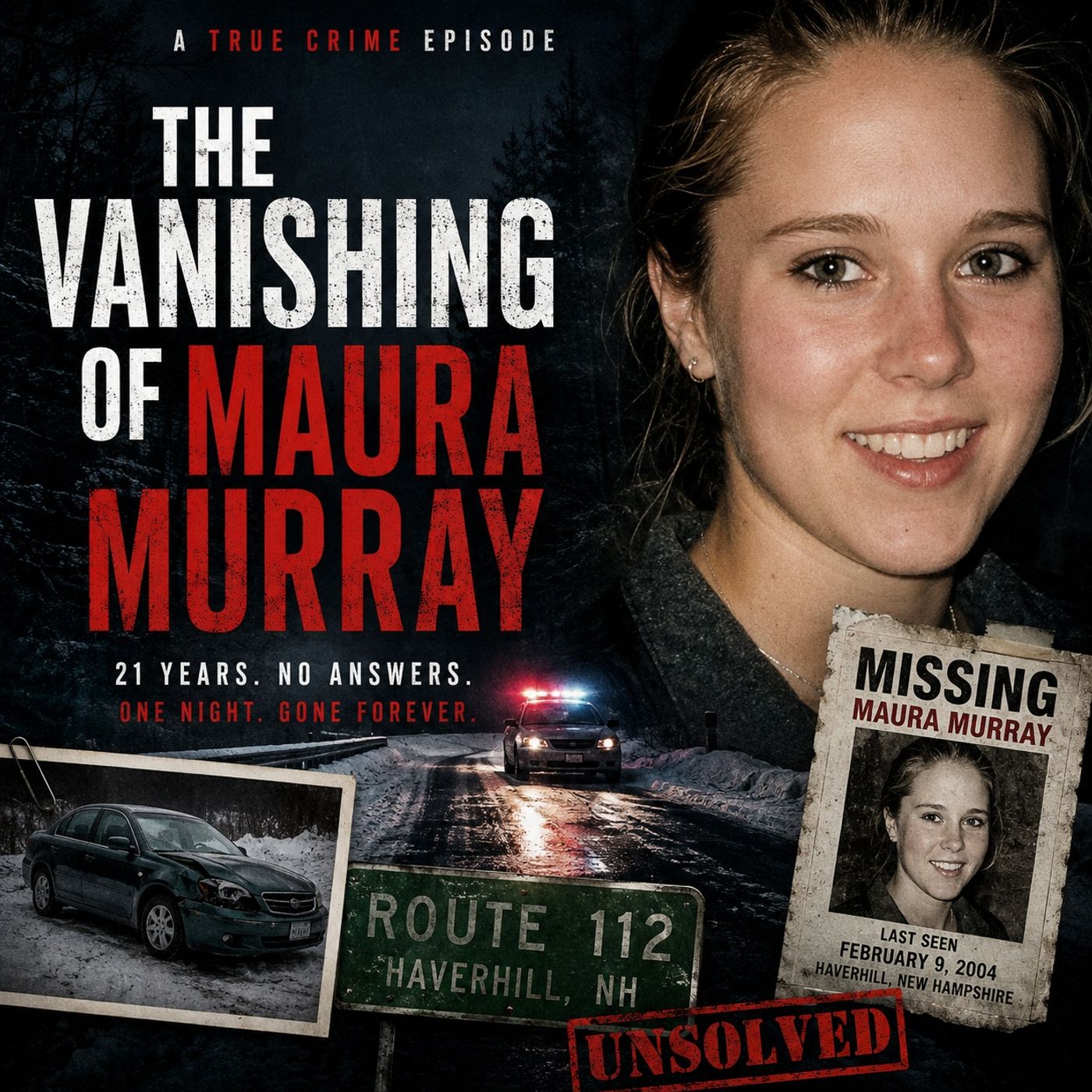
Missing: Maura Murray
The Story
On a cold February night in 2004, 21-year-old Maura Murray crashed her car on a lonely New Hampshire road. Minutes later, she vanished without a trace. More than two decades later, investigators still don't know what happened. In this episode, we explore the evidence, the timeline, the leading theories, and one of America's most baffling unsolved disappearances.Become a supporter of this podcast: https://www.spreaker.com/podcast/dark-american-crime--7005371/support.
Thanks for listening to Dark American Crime. The next episode is coming soon.
This episode includes AI-generated content.
On the evening of February ninth, two thousand and four, a dark stretch of road in the small town of Haverl became the center of a mystery that, more than two decades later, still has no definitive answer. There were no screams, no witnesses to an abduction, no ransom note, no confirmed sighting after that night, just a crashed car, a few scattered belongings, and a twenty one year old college student who seemed to vanish into thin air. Her name was Maa Murray. Born on May fourth, nineteen eighty two.
Maa grew up in Hanson. She was known as intelligent, athletic, and fiercely determined. Her father, Fred Murray, encouraged his children to excel in sports and academics. Mara quickly developed a reputation as a gifted long distance runner. Friends described her as quiet but warm, someone who preferred a small circle of close friends rather than large social gatherings. She graduated from high school with strong grades and initially enrolled at the United States Military Academy. It was a remarkable achievement, but after disciplinary issues, she transferred to the University of Massachusetts Amherst, where she studied nursing.
Her future appeared promising. Yet in the weeks leading up to her disappearance, several troubling events began piling up. Friends later recalled that Mora seemed increasingly stressed. She balanced demanding nursing classes with work and personal responsibilities. There were also problems in her personal life. She had recently been involved in a minor car accident while driving her father's vehicle after attending a party. Although no one was seriously injured, the incident left her shaken. Only days later, another strange event occurred while she was working a security shift on campus.
A supervisor reportedly found her visibly upset and unresponsive. When asked what was wrong, she reportedly muttered only one sentence, my sister. No further explanation was given. On February ninth, Mora made several unexpected decisions. She emailed professors saying there had been a death in her family and that she would be away for about a week. Investigators later determined that no such death had occurred. She also emailed her employer with a similar explanation. Then she searched online for directions to northern New Hampshire and Vermont.
She looked at hotel and condominium listings. She withdrew nearly all the money from her bank account, purchased alcohol from a local liquor store, packed clothing, toiletries, school books, and other personal items into her black saturn s series. She left campus alone. She told no one exactly where she was going. Hours later, as darkness settled over rural New Hampshire, Mora drove along Route one twelve, a winding road surrounded by forests and mountains. At approximately seven twenty seven p m.
A local resident heard a loud thud outside. Looking through the window, they saw a dark colored saturn that had crashed into a snow bank near a sharp curve known locally as the weathered Barn Corner. A school bus driver named Butch Atwood stopped to help. He later told investigators that Mora appeared shaken, but not seriously injured. He offered to call the police. According to his account, she politely declined. She reportedly told him she had already contacted roadside assistance, but Atwood knew there was almost no cell phone service in that area.
Something didn't add up. Still respecting her wishes, he returned home and called nine one one himself. Only minutes passed before the first police officer arrived. The Saturn was still there, its air bags had deployed. There were signs that someone had been inside, but Mara Murray was gone. No footprints leading into the deep snow, no confirmed sightings, no trace. It was as if she had disappeared between the moment the bus driver drove away and the moment police arrived. That tiny window of time, estimated to be only a few minutes, would become one of the greatest mysteries in modern true crime.
When the first responding officer arrived at the crash scene on Route one to twelve, the flashing blue lights illuminated an unsettling sight. The Saturnest series sat partially off the road, its front end heavily damaged after striking a snowbank. The engine was no longer running. The driver's side airbag had deployed. One headlight was broken, but there was no driver, no passenger, no sign of Mora Murray. The officer began examining the vehicle. Inside, several unusual items were found. There were textbooks and nursing materials, clothing packed into bags.
A box of wine had broken during the crash, leaving red stains inside. The police also recovered bottles of alcohol that Mora had purchased earlier that day. Her ATM withdrawal receipt was still inside. Maps and handwritten directions suggested she had been traveling toward the White Mountains. Nothing inside the car immediately explained why she had vanished. Investigators spoke with the most important witness, butch Atwood. Atwood explained that he had driven past the crash Saturn, only minutes after the accident.
He stopped his school bus and asked whether the young woman needed help. According to him, she appeared cold, but not seriously injured. He later described her as polite, calm, and eager to avoid involving the police. She reportedly insisted she had already called for roadside assistance, knowing there was little or no cell service in that area. Atwood found the statement unusual. After returning to his nearby home, he called nine one one. By the time officers arrived a few minutes later, she had disappeared.
The timeline immediately became the biggest mystery. From the moment Atwood left the crash site until police arrived, only a very short period had passed. What could have happened during those few minutes. Did Mora walk away from the crash, did someone stop and offer her a ride, or was someone already waiting near by? No one could answer. Officers searched the immediate area with flashlights. Fresh snow covered the ground. If Mora had run into the woods, investigators expected to find footprints, but they found none that clearly led away from the road.
Searchers walked along both sides of the highway. Nothing no discarded clothing, no backpack, no signs of a struggle. The silence of the winter night made the absence of evidence even more unsettling. The next morning, the search expanded dramatically. Police were joined by firefighters, volunteers, and trained search teams. Tracking dogs were brought in. One dog was given a scent article believed to belong to Mora. The dog reportedly followed her scent for a short distance east along the road before abruptly stopping.
Two investigators. That suggested one possibility. If the tracking was accurate, Maura may have entered another vehicle near the crash scene. But sent evidence has limitations and cannot by itself establish exactly what happened. It became one clue among many not a definitive answer. As words spread that a young nursing student had vanished without a trace, concern quickly turned into alarm. Her family rushed to Haverl to assist the search. Her father, Fred Murray, could not understand why his daughter had been traveling alone or why she had disappeared after what initially appeared to be a relatively minor crash.
The search was only beginning. Over the coming days, investigators would uncover new clues about Mora's final known movements, but every answer seemed to create even more questions. As the search entered its second day, the disappearance of Mara Murray shifted from a missing person report to a full scale investigation. The forests surrounding Haveril were covered in deep snow, temperatures dropped below freezing at night. If Mora had wandered into the wilderness after the crash, time was running out.
Search teams moved quickly. Police requested assistance from the New Hampshire Fish and Game Department. Experienced search and rescue personnel combed the area around Route one twelve. They searched fields, wooded trails, frozen streams, and abandoned structures helicopters flew overhead when weather permitted, Volunteers formed long search lines, carefully scanning every section of snow covered ground. Despite the massive effort, they found nothing. No footprints leading deep into the forest, no backpack, no jacket, no indication that Morea had collapsed nearby.
It was as if she had vanished from the roadside without leaving a trace. Investigators then turned their attention to Mora's final days before she left the University of Massachusetts Amherst. The timeline they reconstructed raised several questions. On the morning of February ninth, Mora had searched online for lodging in northern New Hampshire and Vermont. She had emailed professors claiming there had been a death in her family. Investigators confirmed that no family member had died. Why had she invented the story?
Was she planning a short getaway, trying to escape stress, or meeting someone she never told anyone about no one knew. Detectives also reviewed surveillance footage from the liquor store she had visited before leaving town. The video showed Mora calmly purchasing several alcoholic drinks. Nothing about her behavior appeared unusual. She then withdrew nearly all the money from her bank account, just under three hundred dollars. It wasn't a large sum, but it represented almost everything she had available.
To some investigators it suggested she intended to be away only briefly. To others, it hinted at careful planning. Another focus of the investigation was Mora's personal life. She had been dating Bill Roche, an officer in the US Army station hundreds of miles away. Phone records showed they had spoken frequently in the days before her disappearance. Friends described the relationship as serious, though not without challenges. After learning Mora was missing, Bill immediately traveled to New Hampshire to join the search.
Investigators interviewed him extensively and examined his whereabouts. No evidence placed him near the crash scene on the night Mara disappeared. Meanwhile, police appealed to the public. Did anyone drive a long route one twelve that evening? Had anyone picked up a young woman walking beside the road? Did anyone see another vehicle stopped near the saturn? Several people came forward with possible sightings. Some believed they had seen a woman walking east along the road. Others thought they had noticed a dark suv parked nearby.
None of the reports could be confirmed. The timeline remained frustratingly incomplete. As days turned into weeks, hope slowly gave way to uncertainty. Search teams had covered miles of rugged terrain, Investigators had interviewed witnesses and reviewed every available lead, Yet the most important question remained unanswered. Where was Mora Murray. The mystery was growing deeper, and soon investigators would uncover details from Mora's past that would generate even more theories about why she left and whether someone was waiting for her when she disappeared.
As investigators continued searching for Mora Murray, they began looking beyond the crash scene. To understand where she had gone, they first needed to understand why she had left. The answer proved far more complicated than anyone expected. Friends described Mora as intelligent, disciplined, and caring. She was studying nursing at the University of Massachusetts Amherst, balancing difficult coursework with part time work and family responsibilities. But beneath the surface, the weeks before her disappearance had been unusually stressful, investigators learned that only a few days before vanishing, Mora had been involved in a car accident while driving her father, Fred Murray's new vehicle.
She had attended a party, and while driving home in the early hours of the morning, she struck a guardrail. Fortunately, she was not seriously injured. The car, however, suffered significant damage. Fred later said he was disappointed, but primarily relieved that his daughter was alive. To outside observers, it seemed like an unfortunate accident, but detectives wondered if it had contributed to the emotional strain she appeared to be experiencing. They also revisited an unusual incident that had occurred several days earlier.
While working a late night security shift at her campus job, Mora had reportedly become visibly upset. A supervisor found her sitting quietly staring into space. When asked what was wrong, she reportedly said, only my sister. The supervisor asked whether she needed medical help, Mora declined. Later, her family explained that her sister had been struggling with personal issues, and they believed Mora had been emotionally overwhelmed. After speaking with her, still, investigators questioned whether there was more to the story.
Police then examined Mara's computer records. Her searches revealed directions to locations in the White Mountains. She had looked at hotel, accommodations, and vacation rentals. She appeared to be planning a short trip, yet she made no confirmed reservation. If she had a destination, she either planned to find lodging upon arrival or intended to meet someone. No evidence conclusively supported either possibility. The mystery deepened when detectives reviewed her phone records. They found calls to family members, calls to friends, calls with Bill Roche, but nothing clearly explained why she had suddenly packed her belongings withdrawn nearly all her cash, and driven north without telling anyone exactly where she was going.
There was no farewell message, no diary entry explaining her plans, no confirmed meeting, just silence. As weeks passed, rumors spread across the internet. Some claimed Mora had intentionally disappeared to begin a new life. Others believed she had become lost in the woods after fleeing the crash. Still others suspected she had accepted a ride from a passing motorist and become the victim of a violent crime. Investigators examined every possibility. They found evidence supporting none of them conclusively.
Each theory had strengths, each also had serious weaknesses. For Mora's family, the uncertainty became unbearable. Every unidentified person, every reported sighting, every discovered set of remains anywhere in the region brought a mixture of hope and fear. Her father refused to stop searching. He returned to New Hampshire again and again, convinced that someone knew what had happened that winter night. As the investigation continued, detectives would begin examining individuals who lived near the crash site, people who might have seen something, heard something, or perhaps knew much more than they had ever admitted.
As investigators reconstructed Mara Murray's final known hours, one fact became increasingly important. Mara had not simply left campus on an ordinary drive. She appeared to have prepared for a short trip. She packed clothes, school books, toiletries. She withdrew almost all the cash from her bank account, She bought alcohol, She emailed professors saying there had been a death in the family. Then she drove north without telling anyone exactly where she intended to go. Every one of those actions raised new questions.
Investigators focused closely on the drive itself. Using receipts, phone records, and witness statements, they traced Mora's route from University of Massachusetts Amherst toward northern New Hampshire. She appeared to be traveling alone. There was no evidence that another person had been inside her saturness Series before the crash, but detectives could not determine whether she intended to meet someone after arriving. That possibility remained open. The crash scene itself became the center of intense forensic examination.
Police photographed the damaged saturn from every angle. Inside, they found broken glass from a box of wine. Some of the wine had spilled throughout the vavehicle after the collision. Investigators also recovered personal belongings, maps, and printed directions. Nothing immediately suggested violence had occurred inside the car. Instead, the evidence indicated that Mara had been in the vehicle alone shortly before it struck the snowbank. Detectives also considered Mora's behavior after the crash.
According to butch Atwood, she declined his offer of assistance and insisted she had already called for roadside help. Investigators found this statement unusual because cell phone coverage in that area was extremely limited. Did Mora mistakenly believe her phone had connected, or was she trying to avoid having the police called because she feared getting into trouble after another accident. That question has never been answered. Meanwhile, emergency dispatch records showed that only a few minutes passed between Atwood's nine to one point one call and the arrival of the first responding officer.
By then, Mara had vanished. Searchers examined the roadway in both directions. They looked for footprints leading into the woods. They searched nearby properties. Despite fresh snow covering much of the area, investigators found no clear trail showing where she had gone. The lack of physical evidence puzzled everyone involved. As news of the disappearance spread across New England, local residents began calling police with possible sightings. Some believed they had seen a young woman walking along Route one twelve.
Others remembered passing a dark vehicle parked near the crash scene. Every report was investigated, Some appeared promising, most could not be verified. The investigation was beginning to reveal a troubling pattern. Each new lead seemed to create more questions than answers, and with every passing day, the possibility of finding Mora alive grew more uncertain. By the spring of two thousand and four, investigators had interviewed dozens of residents living a long route one twelve. Every house near the crash site was revisited, Every possible witness was questioned again.
Some residents remembered seeing the damaged saturness series, others recalled flashing police lights. A few reported noticing another vehicle in the area that evening, but none of the accounts explained what happened to Mora Murray during the brief window between the school bus driver's departure and the arrival of law enforcement. That tiny gap in time remained the most critical mystery in the entire case. One of the earliest and most important witnesses, butch Atwood continued to cooperate with investigators.
He consistently maintained that Mora had declined his offer of help. According to him, she did not appear seriously injured, but she seemed determined to avoid contact with the police. He later said he believed she feared getting into trouble after crashing her car. Investigators never identified any evidence showing that Atwood harmed Mara, and he consistently denied any involvement in her disappearance. Even so, because he was the last known person to speak with her, his account remained central to the investigation.
Attention also turned to passing motorists. Could someone have driven along the road seen Maura standing beside her disabled car and offered her a ride, so who was that person? Was the offer made out of kindness or did Mara unknowingly enter a vehicle with someone who intended to harm her. Police appealed repeatedly for anyone who had traveled through the area that evening to come forward. Several people reported possible sightings of different vehicles. Some mentioned a pickup truck, others recalled a dark suv.
None of the reports could be confirmed through physical evidence. Investigators also considered another possibility, perhaps Mora had walked away from the crash scene to avoid police, intending to return later. If that were true, she might have become disoriented in the freezing darkness. The forests surrounding Haveril are dense, rugged and difficult to navigate even during daylight. In February, deep snow and sub freezing temperatures made conditions especially dangerous. Search teams revisited nearby woods multiple times over the years.
Despite those efforts, no confirmed trace of Mora was ever found. As months turned into years, the investigation expanded beyond New Hampshire. Leads arrived from across the United States. Some callers claimed they had seen Mora alive, others suggested she had started a new life under another identity. Investigators followed countless tips. Most were quickly ruled out. A few seemed promising, but ultimately led nowhere. The sheer number of false leads consumed enormous investigative resources while providing few concrete answers.
For Mora's family, Every passing year became another reminder of the uncertainty they faced. They organized searches, distributed flyers, spoke with journalists, appeared in documentaries, refused to let the case disappear from public attention. Her father, Fred Murray, remained convinced that someone knew the truth and had simply never come forward. As the mystery grew, so did public fascination. The disappearance evolved from a regional missing person case into one of America's most discussed unsolved mysteries.
The next chapter would explore the major theories investigators have examined and why each one remains both compelling and deeply flawed. As the years passed, the disappearance of Mara Murray generated countless theories. Some came from experienced investigators, others came from journalists, online communities, and amateur detectives. Each theory attempted to answer the same haunting question, what happened during those few minutes after Morris Carr crashed. Despite decades of investigation, no single explanation has been proven.
The first major theory was that Mora became lost in the wilderness. Supporters of this idea believe she left the crash scene to avoid police because she feared getting into legal trouble after the accident. They argue that she walked into the woods, became disoriented in the freezing temperatures, and died from exposure. On the surface. The theory seems plausible. It was dark, snow covered the ground, the temperature was dangerously low. However, investigators have repeatedly pointed to one major problem.
Extensive searches of the surrounding area failed to locate convincing evidence that she had traveled deep into the forest. No confirmed belongings, no confirmed remains, no clear trail leading away from the road. A second theory suggests that Mora accepted a ride from a passing motorist. This possibility is supported in part by the short sent trail reportedly followed by a tracking dog before it ended along the roadway. If Mora entered another vehicle, it could explain why search teams found no footprints leading into the woods.
The identity of that potential driver, however, remains completely unknown. Was the person simply trying to help or was Maura taken by someone with criminal intentions. Without eyewitnesses or physical evidence, investigators have never been able to answer that question. Another theory is that Mara intentionally disappeared. Some observers point to the emails she sent claiming there had been a death in the family, her withdrawal of nearly all the money in her bank account, and her search for lodging in northern New Hampshire.
To them, these actions suggest planning. Perhaps she simply wanted to escape the pressures of school and life. Perhaps she intended to begin again somewhere else. Investigators have found no verified evidence that she successfully started a new life or remained alive after the night of her disappear. Appearance, years of financial, digital and identity checks have not produced proof supporting that theory. A more troubling possibility is that Mora became the victim of a violent crime. Some investigators believe someone driving along Route one twelve may have encountered her shortly after the crash.
If she entered a stranger's vehicle willingly or was forced inside, it could explain why she vanished so quickly. Over the years, police have examined individuals who lived near the area, as well as known offenders. No one has ever been charged in connection with Mara's disappearance. No suspect has been publicly identified based on sufficient evidence. For her family, the theories matter less than the unanswered questions. They have always maintained that Mora deserves answers, whether she died in the woods, accepted a ride, or became the victim of foul play.
They believe someone knows what happened that winter night. Every anniversary of her disappearance brings renewed hope that a witness a forgotten clue or a breakthrough in forensic technology may finally reveal the truth. But as the mystery enters its third decade, Mara Murray remains missing and the case continues to stand as one of America's most perplexing unsolved disappearances. As public interest in Moa Murray's disappearance continued to grow, so did the investigation. Detectives refused to let the case go cold.
Every few years, they reopened files, reviewed witness statements, and re examined evidence collected from the night of February nine, two thousand four. Advances in forensic science offered new hope. Items recovered from Morris Saturness series were reviewed again. Investigators looked for anything that earlier technology might have missed. Despite these efforts, no breakthrough emerged. Searches also continued. Volunteers, professional search and rescue teams, and private investigators returned repeatedly to the area surrounding Haveril.
Dense forests were searched using modern equipment. Ground penetrating radar was used in selected locations. Cadaver dogs were brought in on multiple occasions. Nearby properties were examined when new information surfaced. Each search renewed hope. Each search ended without finding Mora. The rise of the Internet transformed the case. Online forums became filled with discussions about every detail. People analyzed maps, weather reports, witness statements, and timelines. Some Internet investigators uncovered useful public records, others promoted speculation unsupported by evidence.
For Mora's family, the widespread attention was a double edged sword. Kept the case alive in the public eye, but it also led to rumors, misinformation, and accusations against people who were never charged with any crime. Law enforcement repeatedly urged the public to distinguish between verified facts and online theories. The confirmed facts remained limited. Mara left the University of Massachusetts Amherst on February ninth, two thousand and four. She crashed her car on Route one twelve. She spoke briefly with butch Atwood.
Police arrived minutes later, she was gone. Everything after that remains uncertain. That uncertainty has allowed countless theories to flourish. Her father, Fred Murray, never stopped searching. He returned to New Hampshire year after year. He walked the roads himself, He met with investigators, He spoke to the media whenever possible. His message remained consistent. Someone knows what happened, someone has information they have never shared, even the smallest detail he believed could finally solve the mystery.
As the twentieth anniversary of Mora's disappearance approached, the case remained officially open. Investigators continued accepting tips, journalists revisited the evidence. True crime podcasts and documentaries introduced the mystery to new audiences around the world. More than twenty years after a young nursing student disappeared on a snowy New Hampshire road, the silence surrounding her final moments remained unbroken. The next chapter will examine the most significant investigative leads that have surfaced over the years, why none has solved the case, and how each brought investigators both hope and disappointment.
As the investigation entered its second decade, detectives knew that solving Moraa Murray's disappearance would likely depend on one of three things, a new witness, a major forensic breakthrough, or someone finally deciding to tell the truth. Until then, every lead, no matter how small, had to be investigated. Over the years, police received thousands of tips. Some came from people who believed they had seen Mara in another state. Others claimed she had been living under a different identity. Several callers insisted they had information about a possible abduction.
Each report was carefully reviewed. Investigators interviewed witnesses, compared timelines, and checked available records. Almost every lead eventually reached a dead end. None produced verifiable evidence that explained what happened after the crash. Attention also turned to properties near the crash site. Whenever a homeowner reported unusual information or investigators received a credible tip, search teams returned, cadaver dogs were deployed, Excavations were conducted in selected locations.
Old buildings, wells, and wooded areas were examined. In several instances, investigators believed they might finally be close to discovering an important clue. Each time the searches ended without locating Mora or uncovering evidence that conclusively explained her disappearance, private investigators became deeply involved as well. Some worked with Mora's family, Others pursued their own independent inquiries. They reinterviewed witnesses, reconstructed timelines, and examined details that had received little attention.
In the early days of the investigation. While some uncovered useful background information, none found definitive proof supporting a single theory. Their work highlighted just how challenging the case remained. The case also attracted national media attention. Television documentaries, investigative series, and true crime podcasts examined the evidence from every angle. Some emphasized the possibility that Moura voluntarily left the scene. Others focused on the chance encounter theory that she accepted a ride from someone she believed was helping her.
A few explored the possibility of foul play by an unknown offender. Importantly, many of these programs presented theories rather than established conclusions. Investigators have never publicly announced evidence sufficient to confirm anyone explanation. For Fred Murray and the rest of Morri's family, the passage of time brought both frustration and determination. Birthdays passed, holidays came and went, Anniversaries of her disappearance arrived each February. Still, they continued speaking publicly, hoping someone who had remained silent for years might finally come forward.
Their belief never changed. Someone somewhere knows more than they have ever admitted. As the mystery stretched beyond twenty years, it became clear that solving the case would require more than speculation. It would require evidence, and until that evidence emerged, the disappearance of Mora Murray would remain one of the most haunting unsolved mysteries in modern American history. By the time the case reached its twentieth anniversary, the disappearance of Mora Murray had become one of the most extensively discussed missing person investigations in the United States.
Thousands of articles had been written, countless hours of documentaries and podcasts had explored every known detail. Yet investigators were still confronted with the same fundamental mystery that began on the night of February nine, two thousand and four. A young woman had vanished within minutes of a minor car crash, no verified sightings, no confirmed contact, no definitive evidence explaining where she went. Over the years, law enforcement repeatedly emphasized that the case remained active.
Evidence was carefully preserved. New forensic techniques were applied whenever possible. Investigators continued reviewing old witness statements, hoping that modern analysis might reveal overlooked details. Cold case investigations often succeed because a seemingly insignificant clue takes on new meaning years later. That possibility kept the investigation alive. One of the greatest challenges was the absence of physical evidence. Unlike many HUMA side investigations, there was no confirmed crime scene beyond the crash site, no confirmed blood evidence indicating violence, no verified location where Mora was known to have gone after leaving her vehicle.
Without those crucial pieces, investigators were forced to build theories from an incomplete timeline. Every scenario contained unanswered questions. Technology also changed dramatically after two thousand and four. Cell Phone analysis improved, digital mapping became more sophisticated, DNA testing advanced significantly. Unfortunately, many of those tools could not fully compensate for the lack of evidence from Mora's final known movements. If she entered another vehicle, investigators never identified it.
If she walked away alone, no confirmed trail has ever been found. The critical minutes after the crash remain almost entirely undocumented. Despite the uncertainty, one thing never changed. Morri's family continued searching. They organized public awareness campaigns, participated in interviews, worked with journalists and investigators. Each new documentary or podcast brought renewed public attention and with it new tips. Most of those tips proved unreliable, but the family believed that eventually one would matter.
One witness, one forgotten memory, one piece of evidence. That was all it could take. Today, investigators continue asking the public to come forward with information, no matter how small it may seem. Cases like Mora Murray's have been solved decades later because someone finally chose to speak. Until that day comes, her disappearance remains an open investigation and one of the most perplexing mysteries in modern true crime. With five parts remaining, the final chapters will explore the enduring public fascination with the case, the strongest investigative theories, and why Moraa Murray's disappearance continues to haunt investigators, her family, and millions of people around the world.
Two decades after Maura Murray disappeared, investigators continued to return to one question, what happened during those seven to ten minutes between the crash and the arrival of police. Everything in the case revolves around that brief window of time. If Mara left the area on foot, where did she go, If she accepted a ride who was driving, the foul play occurred, when and where did it happen. Those unanswered questions have shaped every stage of the investigation. As interest in the case grew, several experienced investigators reviewed the original evidence from a fresh perspective.
They compared witness statements, reconstructed timelines, and revisited locations around haverl. Some believed the original search of the surrounding woods made it less likely that Mora had simply wandered into the forest near the crash site. Others cautioned that rugged to rain, heavy snowfall, and changing environmental conditions mean that searches can never completely eliminate every possibility. As a result, investigators have not ruled out either an accidental death in the wilderness or foul play.
The case also highlighted how memories can change over time. Witnesses interviewed years after the disappearance sometimes recalled details differently than they had in two thousand and four. That is common in long running investigations. Detectives therefore placed greater weight on statements recorded close to the time of the disappearance, while still following up on new information when it appeared credible. Separating reliable evidence from fading memories became an increasingly difficult task.
Meanwhile, advances in forensic science continued to offer hope. Evidence preserved from the investigation remained available for future testing as technology improved. Cold cases across the United States have been solved decades later because of new DNA techniques, digital analysis, or witnesses finally deciding to come forward. For that reason, investigators have repeatedly emphasized that Mora's case is not closed. Any credible new information could still change the direction of the investigation.
For Mora's family, the emotional toll has never disappeared. Every birthday is another reminder of the years that have passed. Every anniversary brings renewed media attention and another wave of public interest. Through it all, Fred Murray and other family members have continued asking for one thing, the truth, not speculation, not rumors, just the truth about what happened on that cold February night. Today, the disappearance of Mara Murray is studied not only because it remains unsolved, but because it demonstrates how a case can persist despite extensive searches, public attention, and decades of investigation.
It serves as a reminder that even in an age of advanced technology. Some mis reas endure not because investigators stop looking, but because the evidence needed to answer them has yet to be found. By the twenty twenties, the disappearance of Mara Murray had become one of the most recognized missing person cases in America. University students studied it in criminal justice courses, Experienced detectives cited it when discussing cold case investigations. True crime authors and documentary filmmakers continued to revisit the evidence, hoping a fresh perspective might uncover something everyone else had overlooked.
Yet, despite all the attention, the central mystery remained exactly as it had on February ninth, two thousand and four, Mora disappeared. No one has been able to explain with certainty what happened next. One reason the case continues to fascinate investigators is the absence of a clear narrative. Many unsolved cases eventually point strongly in one direction. This one does not. The evidence can support several possible but it does not conclusively establish any of them. Did Mara leave the road on her own, did she willingly enter another vehicle?
Did she encounter someone with criminal intent. Each possibility has been examined extensively. None has been proven. That uncertainty has kept the investigation open for more than two decades. Law enforcement has continued to encourage anyone with information to come forward, even if the detail seems insignificant. Investigators know that memories fade, but they also know that people sometimes decide to speak years later. A conversation overheard, a vehicle noticed on the road, an unusual event that once seemed unimportant.
Any of those details could become meaningful when combined with other evidence. History has shown that cold cases are sometimes solved because one witness finally decides that the time has come to tell investigators what they know. For Mora's family, the search has no never truly ended. They have organized awareness campaigns, participated in interviews, and worked closely with investigators to keep the case in the public eye. Their goal has always been the same, to ensure that Mora is remembered not simply as the subject of an unsolved mystery, but as a daughter, a sister, a friend, and a nursing student whose future was suddenly interrupted.
Behind every theory is a real person whose family continues to seek answers. The case has also influenced the true crime community. It demonstrates the importance of distinguishing between verified facts and speculation. Over the years, online discussions have produced hundreds of theories. Some are thoughtful and evidence based, Others rely on assumptions unsupported by the investigation. Responsible true crime reporting requires acknowledging the difference. The confirmed facts are limited, everything beyond those facts must be treated with appropriate caution.
More than twenty years after a young woman vanished from a snowy road in Haveril, investigators are still searching for the answer that has eluded them since the beginning. Somewhere the truth exists, whether it is hidden in an overlooked clue, an undiscovered piece of evidence, or the memory of someone who has remained silent, no one can yet say. Twenty one years after Mora Murray disappeared, investigators still described the case as one of the most frustrating missing person investigations they have ever encountered, not because there was a lack of effort, but because every promising lead eventually seemed to disappear.
Every new search brought hope, every interview suggested possibilities, yet none produced the single piece of evidence needed to solve the mystery. Cold case investigators often explain that successful investigations rely on three things. Evidence, witnesses, time. In Morri's case, time has been both an enemy and an ally. As the years passed, memories faded, witnesses moved away, physical evidence became more difficult to recover. At the same time, advances in forensic science created opportunities that did not exist in two thousand and four.
Modern DNA analysis, digital mapping, and improved investigative techniques continue to offer hope that a breakthrough remains possible. One lesson repeatedly emphasized by law enforcement is the importance of preserving evidence. Items recovered from Morris saturn S series have been carefully maintained so they can be re examined as technology improves. In many cold cases across the United States, evidence collected decades earlier has ultimately identified offenders through new scientific methods.
Investigators hope the same could one day happen here. The disappearance also changed how many agencies approach missing person cases. Modern investigations often move more quickly to preserve servi valance footage, digital records, and witness statements. Technology available today, including smartphones, GPS data and widespread security cameras was far less common in two thousand and four. Had the same disappearance occurred today, investigators might have had access to entirely different types of evidence.
That reality has made the Murray case an important point of discussion in law enforcement training and cold case reviews. For the public, More's story has become more than an unsolved mystery. It has become a reminder of how quickly ordinary life can change. One afternoon, she attended classes and ran errands. That evening, she was driving through rural New Hampshire within minutes of a minor car crash. She vanished. No confirmed phone calls, no verified sightings after the crash, no explanation.
That sequence of events continues to challenge both investigators and the public. More than two decades later, one truth ro remains unchanged. Mora Murray has never been found, Her family continues to hope for answers, Investigators continue to accept and evaluate new information, and every February, as another anniversary arrives, people return to the same stretch of road asking the same question, what really happened on that cold winter night. More than twenty years have passed since Mora Murray disappeared, yet her case continues to generate new discussions every year.
Unlike many investigations that gradually fade from public memory, More's story has endured. It has become one of the defining missing person cases in modern American true crime, not because investigators know what happened, but because they still do not. Today, detectives continue to review new tips whenever they are received. Most turn out to be misunderstandings or information that cannot be verified. Occasionally, however, a lead appears promising enough to justify another search. Those searches are conducted with the hope that modern technology or a witness who finally decides to speak, might reveal what decades of investigation have not.
Law enforcement has repeatedly emphasized that the case remains open and that no credible lead is ignored simply because of the passage of time. For More's family, the years have been marked by perseverance. Her father, Fred Murray, spent years organizing searches, speaking with investigators, and encouraging the public not to forget his daughter. Other family members also work to keep attention on the case, believing that continued awareness increases the chance that someone with information will eventually come forward.
Their determination has ensured that Moore's name remains known to investigators, journalists, and true crime audiences around the world. The case has also become a lesson in responsible true crime reporting. Many theories have been proposed over the years. Some are grounded in available evidence, others rely heavily on speculation. Investigators have consistently reminded the public that theories are not facts. The confirmed evidence establishes only what happened up to the point where Mara disappeared from the crash scene.
Everything after that remains uncertain. Recognizing that distinction is essential to understanding the case. Perhaps the greatest tragedy is not only that Mara vanished, but that those who loved her have lived for more than two decades without certainty, without knowing whether she suffered an accident, without knowing whether she encountered someone who intended to harm her, without knowing whether answers remain hidden somewhere in the forests of New Hampshire, in forgotten evidence, or in the memory of a witness who has never spoken.
That uncertainty is one of the hardest burdens any family can carry. As investigators continue their work, hope has never completely disappeared. Cold cases have been solved after thirty, forty and even fifty years. A single overlooked detail, a new forensic technique, a witness finally deciding to tell the truth. Any one of those developments could transform the investigation overnight. For now, however, the disappearance of Moraa Murray remains one of America's most enduring mysteries. On the evening of February ninth, two thousand and four, Mora Murray drove north through the snow covered roads of New Hampshire.
Hours later, her Saturness series was found crashed along Route one to twelve. A local residence spoke with her, police arrived only minutes later she was gone. That simple sequence of events has become one of the most perplexing mysteries in modern American history. Over two decades have passed. Investigators have searched forests, rivers, abandoned buildings, and private properties. Thousands of tips have been reviewed, witnesses have been interviewed and reinterviewed. Evidence has been examined using advancing forensic techniques.
Journalists, authors, and documentary filmmakers have analyzed nearly every known detail. Yet the central question remains unanswered what happened to Mora Murray. Unlike many famous true crime cases, this story has no confirmed ending. There has been no arrest, no verified suspect, no discovery that explains exactly what happened after Mora left her vehicle. Several theories remain possible, but none has been established by the available evidence. That uncertainty is what continues to draw investigators and the public back to the case yeer after year.
For Mora's family, however, this is not a mystery to be debated. It is a deeply personal loss. Every birthday, every holiday, and every anniversary serves as another reminder that a daughter, sister, and friend disappeared without explanation. Their persistence has kept the investigation alive, ensuring that new generations learn her story and that investigators continue to receive fresh tips. Their hope has always remained the same, that one day someone will provide the information needed to finally reveal the truth.
The disappearance of Mora Murray has also influenced how missing person cases are investigated. It highlights the importance of acting quickly, preserving evidence, documenting witness accounts, and revisiting unsolved cases. As technology advances. It reminds investigators that even the smallest overlooked detail can become the key to solving a decade's old mystery. And it reminds the public that responsible true crime should prioritize verified facts over sensational speculation. Today, the case remains officially open.
Law enforcement continues to encourage anyone with credible information to come forward. Cold cases have been solved after many decades, often because of which finally chose to speak, or a new scientific method revealed evidence that had previously gone unnoticed. For that reason, investigators have never stopped believing that Mora's case can still be solved. Perhaps that is why the story continues to resonate around the world. It is not simply about a missing person. It is about unanswered questions, about a family searching for certainty, about investigators refusing to give up, and about the hope that even after more than twenty years, the truth is still waiting to be discovered.
Until that day comes. The disappearance of Mora Murray remains one of the most haunting and enduring unsolved mysteries in American true crime, a case that reminds us that sometimes the most unsettling stories are not those with shocking endings, but those that have no confirmed ending at all.
 Apple Podcasts
 Castbox
 Castro
 Goodpods
 Moon FM
 Overcast
 Pocket Casts
 Podbean
 Podcast Addict
 Podcast Republic
 Spotify