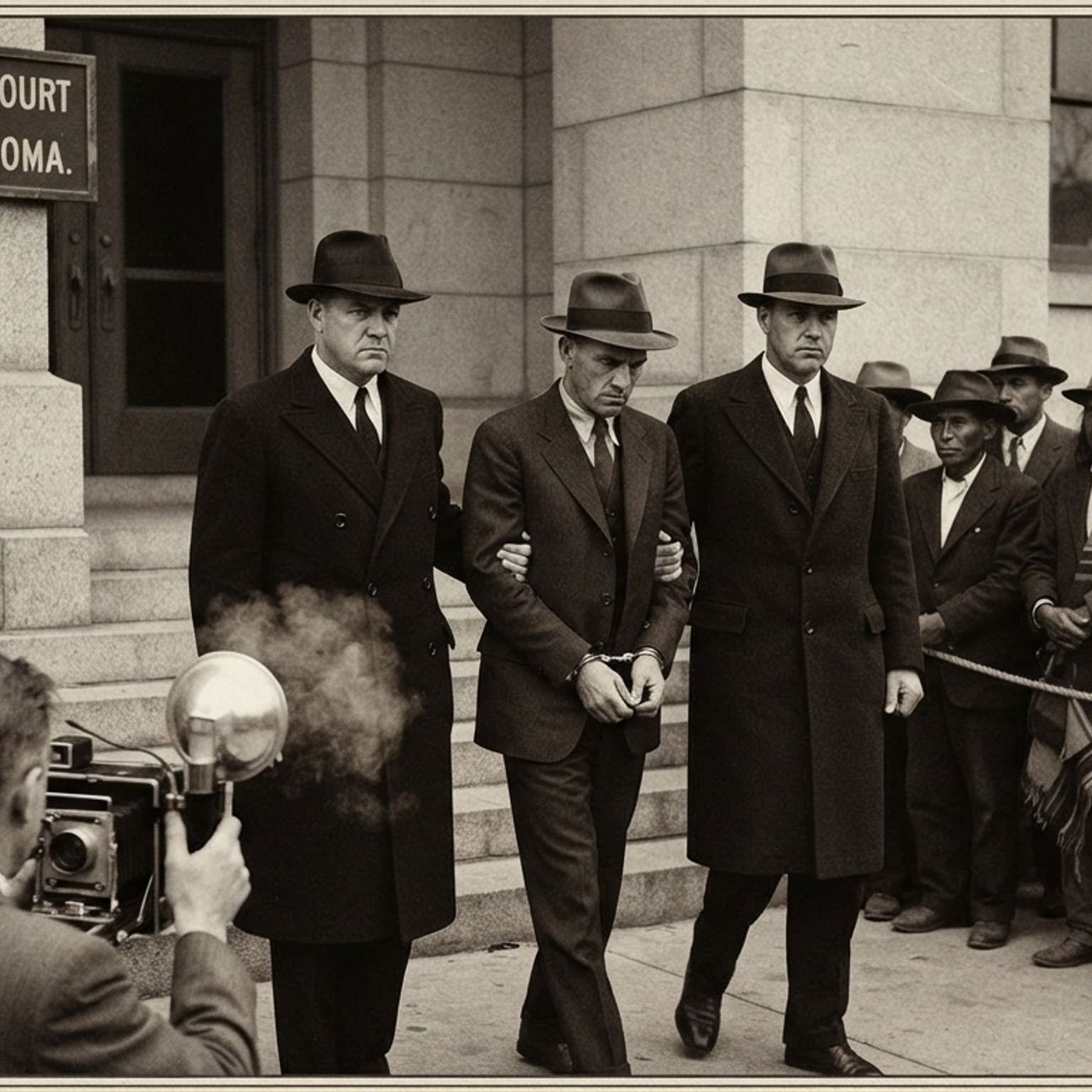
Osage: A Stolen Fortune
The Story
They were the richest people per capita in the world, living on land teeming with 'black gold.' But for the Osage Nation, the oil beneath their feet became a death warrant. From the boardrooms of Washington to the dusty plains of Oklahoma, uncover the chilling conspiracy of greed and murder that sparked the birth of the FBI. This is the dark, true story of the Osage Reign of TerrorBecome a supporter of this podcast: https://www.spreaker.com/podcast/dark-american-crime--7005371/support.
Thanks for listening to Dark American Crime. The next episode is coming soon.
This episode includes AI-generated content.
The land of the Osage. The story of the Osage nation is one of unimaginable prosperity followed by a calculated descent into darkness. It begins at the close of the nineteenth century, when the Osage were forcibly removed from their ancestral lands in Kansas to a new reservation in northeastern Oklahoma. At the time, this land was considered undesirable, rocky, rugged, and hidden within the rolling hills, But it would become the site of a transformation that the world had never seen. The Osage were a people of profound resilience, having survived forced migration and the constant pressure of external cultural erosion.
They rebuilt their society with a focus on their traditions and their own internal governance. They were a sovereign people, and they treated their new Rocky reservation as a sanctuary. But beneath that rocky exterior lay the true reason the land had been ignored by settlers for so long. It sat upon one of the most massive oil reservoirs in the American West. In an extraordinary turn of legal foresight, the Osage had retained mineral rights to their entire reservation, Unlike other tribes who had lost their subterranean wealth to the federal government or private interests.
The Osage ensured that every member of the tribe held a head right an inalienable share of the oil royalties. By the early nineteen twenties, the change was absolute. The O Sage became the wealthiest population per capita on the planet. The visual contrast was striking. Traditional tribal members wearing woolen blankets and intricate beadwork, were seen stepping out of chauffeur driven gold plated luxury automobiles. They built sprawling mansion style homes in the heart of the prairie, filled with fine art, pianos, and imported furniture.
However, this wealth did not go unnoticed by the outside world. It acted like a beacon, drawing in not only merchants and workers, but also an army of opportunists, hustlers, and criminals who viewed the Osage not as people, but as a resource to be harvested. The federal government, claiming a desire to protect the Osage from their own wealth, implemented a corrupt and paternalistic system of guardianship. Under this law, O Sage citizens deemed incompetent by local courts, a label applied to many simply because they were Osage were assigned white guardians, usually local businessmen, lawyers, or politicians.
These guardians were granted complete control over the o Sage members' bank accounts and estates. In practice, this was a legalized mechanism of theft and systemic exploitation. These guardians manipulated financial records, overcharged for basic necessities, and funneled oil royalties into their own pockets. The Osage were slowly being stripped of their autonomy, their money, and their voices as a predatory culture took root around them. By nineteen twenty three, the air in Osage County had changed.
The app mosphere was no longer defined by the celebration of wealth, but by a rising palpable sense of fear. The influx of outsiders, who had initially arrived as service workers or laborers, had evolved into a more sinister element. They understood that the shortest route to that black gold was not through honest business, but through coercion, marriage into Osage families, and eventually more permanent methods of removal. The oil derricks continued to pump filling the coffers of the nation, but the dark clouds were gathering over the hills.
The Osage had moved from being a neglected people to being the most envied and ultimately the most hunted people in America. They were standing on the edge of what would become a devastating, decade long reign of terror, though at this moment many were still living in the blissful illusion that their fortune was a blessing rather than a death warrant the head rights. To understand the mechanics of the impending tragedy, one must look closely at the head right, the single most volatile piece of paper in Oklahoma.
A head right was not merely a financial instrument. It was a birthright that granted each member of the O Sage Nation an equal share of the tribe's collective mineral wealth. Because the Osage had wisely insisted on retaining the mineral rights to their entire reservation before it was allotted, these head rights were held in common, yet the payments were distributed individually. The head rights were inalienable, meaning they could not be sold or traded by the individuals who held them. This was intended as a safeguard, a way to ensure that the O sage would remain wealthy for generations to come.
However, this legal protection became the very thing that made them targets for a new, more lethal breed of criminal. Because a head right could not be legally purchased, it could only be transferred through inheritance to a predator. This meant that the only way to acquire that wealth, to secure the oil royalties for themselves, was to ensure the death of the person who owned it. This realization fundamentally altered the dynamic between the osage and the outsiders who had flooded into the county.
The guardians, who were already systematically siphoning money through inflated fees and fraudulent accounting, suddenly had a much stronger incentive to see their wards pass away. If a war died, the head right would pass to their heirs. If those heirs could be manipulated, married, or murdered, in turn, the wealth would ultimately funnel toward the very people who were supposed to be protecting them. The system of guardianship created a bizarre and terrifying reality where your own protector was incentivized to wish for your demise.
Guardians controlled everything from the clothing and Osage citizen bought to the food on their table and the medical care they received, they held the power of the purse, and in a society where justice was often bought and sold, they held the power of the law as well. The Osage, deeply rooted in their communal traditions, struggled to combat a system that was built on the cold, individualistic logic of modern capitalism and criminality. They were navigating a world where the laws designed to protect them were being used as weapons against them.
The head right, which should have been their legacy of prosperity, was becoming a ticking clock. Every dollar earned from the oil beneath their feet was another reason for a greedy neighbor, a corrupt guardian, or a predatory suitor to start looking at their calendar and wondering when the next accident could be arranged. The stage was being set for a systematic dismantling of families, where the inheritance of a head right often meant the inheritance of a death sentence the first victim. The descent into the reign of terror began not with a sudden explosion of violence, but with a quiet, unsettling disappearance that would soon reveal a much darker reality.
Anna Brown, a young Osage woman, was a vibrant member of the community. She was intelligent, outgoing, and, like many of her peers, possessed a significant fortune thanks to her head rights. She lived with her family and enjoyed the lifestyle that the oil wealth had afforded them. Yet she was also acutely aware of the shifting tides within Osage County. In May nineteen twenty one, Anna Brown simply vanished. Her absence was initially treated as a personal matter, perhaps a temporary journey or an impulsive trip to one of the nearby cities, which was not uncommon for the wealthy Osage.
Her family and friends grew increasingly anxious as the days turned into weeks without a word. There were no phone calls, no letters, and no sightings of her in the places she frequented. The unease began to spread through the community, a feeling that something was fundamentally wrong. Eventually, searchers discovered her body in a remote, steep sided ravine in a desolate part of the county. The initial assessment by local authorities was hasty and dismissive. They concluded that she had wandered off while intoxicated and died of exposure or had simply fallen.
The case was quickly closed and her death was labeled an accident. However, for those who knew Anna, this explanation felt impossible. She was not a woman who would wander into the wilderness alone, nor was she known for the kind of reckless behavior that would lead to such a fate. As whispers began to circulate throughout the community, a different narrative started to form. It was becoming clear that Anna Brown's death was not a tragedy of chance, but a deliberate act. Her passing marked the end of the relative peace that had once defined the Osage Reservation.
It was the first time that the accident narrative, a tool that would later become a recurring theme in the wave of murders, was applied to an Osage death. The local investigators, many of whom were beholden to the same powerful interests that controlled the guardianship system, seemed all too eager to look away. Anna Brown had become the first victim of a conspiracy that was reaching out from the shadows, and for the o Sage Nation, the true horror had only just begun. The realization that their own neighbors, the people they saw in town every day, could be capable of such calculated cruelty, was a cold awakening truth that would haunt them for years to come.
Pattern of tragedy. Following the discovery of Anna Brown's body, the atmosphere in Osage County shifted from uneasy suspicion to paralyzed fear. It soon became apparent that her death was not an isolated incident. Within months, other members of the Osage community began to meet similar violent ends, often under circumstances that were conveniently labeled as accidents or natural causes by local authorities. The pattern was chilling. Just like Anna, those who died were often young, healthy, and crucially possessed valuable head rights.
As the death toll rose, the Osage people began to realize they were witnessing a systematic campaign of elimination. The local law enforcement, which should have been the first line of defense, remained suspiciously silent or actively obstructive. It became clear that the predators were not just outsiders. They were embedded within the community, acting with an impunity that suggested they had the protection of the very institutions meant to enforce the law. The community's grief was quickly eclipsed by a growing desperate need for answers.
Every funeral became a reminder of the fragility of their existence. Families began to watch each other with growing paranoia, wondering who would be next, and whether the person they trusted, a guardian, a business partner, or even a spouse was actually an architect of their destruction. The accidents became so frequent that the term lost all meaning, becoming a grim punchline for a nightmare that refused to end. What made the situation even more devastating was the cold, clinical nature of the targeting.
This was not a random crime wave. It was a focused, ruthless extraction of wealth. By removing the individuals who had held the head rights, the perpetrators were systematically moving the oil royalties into their own hands. As the death count mounted, it became obvious that they were dealing with a conspiracy of profound depth, one that operated with a chilling indifference to human life and a terrifying clarity of purpose. The Osage were no longer just living on their land. They were fighting for their survival against an invisible enemy.
That knew exactly how to dismantle a society from within the house of poison. The conspiracy's focus soon tightened around the Burkhart and Kyle families, a targeted campaign that remains one of the most harrowing chapters of the Reign of Terror. This was not a random series of crimes. It was a systematic, intimate dismantling of a household. Lizzie Q. Kyle, Anna Brown's mother, and her daughters, became the primary targets, their lives methodically stripped away by those they had trusted most. The terror began to take a more insidious turn with the lingering, painful illness of Lizzie herself.
She suffered from a wasting sickness that baffled local doctors, a slow, agonizing decline that many later realized was the result of systematic poisoning. While Lizzie lay dying, the pressure on her remaining family members intensified. It became clear that the killers were not just looking to eliminate individuals. They were looking to consolidate the family's entire estate by picking off every legal heir one by one. The situation reached a fever pitch when Anna's sister Rita Smith and her husband Bill were targeted in a final explosive act of violence in nineteen twenty three.
Their home was destroyed in a massive bomb blast while they slept. The sheer brutality of the act was designed to be a message not just to the oce Age, but to anyone who dared to look too closely at the rising body count. Rita died in the explosion, and Bill, who was critically injured, succumbed to his wounds shortly thereafter this, the House of Poison Phays demonstrated the absolute depravity of the conspirators. They were willing to use any means necessary, from slow, invisible poisons to blatant public explosions to secure the head rights that were rightfully held by these families.
The proximity of the attackers to their victims was the most chilling aspect. These were individuals who had sat at the same tables, attended the same events, and professed friendship while orchestrating the deaths of their hosts. The sense of security within the Osage home had been completely shattered, replaced by the realization that their own threshold had been breached by a predator who had no intention of stopping until every member of the blood line was gone. Fear in the air. By nineteen twenty three, the atmosphere in Osage County had curdled into a suffocating, pervasive dread.
The string of accidental deaths and the horrific bombing of the Smith residents had shattered the community's sense of reality. The Osage people, once known for their vibrant, celebratory gatherings and communal strength, were now living in a state of constant, high alert isolation. Doors were locked, shutters were drawn, and the previously familiar open door policy of their culture was replaced by a rigid, fearful suspicion of any outsider, and even of neighbors who had once been considered friends.
The terror was not just physical, it was psychological. The conspirators had created an environment where the truth was a dangerous commodity. Local law enforcement, ranging from county sheriffs to town marshals, appeared either completely incompetent or more likely, wilfully complicit. In many instances, evidence at crime scenes was ignored, vital witnesses were intimidated into silence, and official death certificates were brazenly falsified to list illness or accident when foul play was obvious.
The realization that the justice system was not just failing them, but was actively working against them left the Osage feeling utterly defenseless. This period was marked by the politics of silence. Wealthy o Sage members found that their guardians, the very men legally tasked with protecting their interests, were often the loudest voices, dismissing the murders as mere tragedy or bad luck. For the Osage, every trip into town to handle financial business became a gamble with their lives. They had to navigate a minefield of predatory solicitors, doctors who provided treatments that looked more like slow motion executions, and businessmen who pressured them into signing documents they barely understood.
The cumulative effect was a community held hostage. The Osage knew that their wealth was their vulnerability, yet they had no way to divest themselves of it, nor could they easily flee the trap that had been set around them. They were targets in their own homes, watching their families be dismantled piece by piece. The psychological toll of the reign of terror cannot be overstated. It was a methodical erosion of spirit, designed to make the O Sage feel that their destruction was inevitable, authorized, and completely unpunished.
The air was thick with the weight of unvoiced grief and the terrifying knowledge that in this county, justice had been completely abandoned seeking justice. By late nineteen twenty three, the O Sage Tribal Council realized that their appeals to local law enforcement were not just falling on deaf ears, they were effectively being funneled directly to the architects of the conspiracy. Every time an O Sage leader reported a suspicion or questioned to death, the information seemed to vanish, or worse, resulted in further threats against their own families.
The local sheriff's department, the county coroners, and the regional courts were so thoroughly compromised by the oil money and the influence of the Guardians that seeking justice within Oklahoma had become a lethal pursuit. Driven by desperation and the gut wrenching site of their community being hollowed out, the Tribal Council made a bold and dangerous decision they would buy passed the local and state authorities entirely. They began to pool their own resources to hire private investigators, hoping that an objective, outside perspective might finally break through the wall of silence.
These private detectives, however, quickly found themselves outmatched. Some were intimidated, others were bribed, and a few simply disappeared, proving that the conspiracy had tentacles that extended far beyond the local town limits. With their private efforts failing, the Osage took their fight to the highest level. They sent a delegation to Washington, d c. To petition the federal government directly. It was a perilous journey, both physically and politically. They arrived in the capital to present a harrowing dossier of death names, dates, and documented financial irregularities that pointed toward a systemic, genocidal effort to strip them of their head rights.
The delegation's plea was simple but urgent. They were American citizens, they were being hunted, and their low local government was not just failing to protect them, it was part of the problem. They demanded a federal intervention, knowing that if the US government ignored them, their entire nation could face total eradication. This act of defiance was a turning point. By bringing their plea to Washington, the Sage shifted the narrative from a series of unfortunate local accidents to a national crisis that the federal government could no longer pretend to ignore.
They were no longer just begging for help. They were forcing the federal government to confront the rot within its own borders. The seeds of the investigation had been planted in the halls of Congress, and for the first time, a flicker of hope. However, faint began to appear amidst the darkness of the reign of terror the young director. While the Osage delegation was fighting for their lives in Washington, the federal agency that would eventually take up their cause was in the midst of a radical transformation.
At the center of this change was a young, ambitious, and meticulously organized bureaucrat, j Edgar Hoover. In nineteen twenty four, Hoover had recently been appointed the acting director of what was then known as the Bureau of Investigation BOI. At the time, the Bureau was a bloated, inefficient department plagued by political patronage, a reputation for incompetence, and a lack of clear federal authority to tackle the types of crimes occurring in Oklahoma. Hoover viewed the Bureau not as it was, but as it could be.
A modern, scientific, and highly disciplined national police force. He was obsessed with order, hierarchy, and above all, the accumulation of intelligence. When the reports of the Osage murders began to land on his desk, he saw more than just a series of heinous crimes. He saw the perfect opportunity to prove the necessity and the power of a centralized federal investigative body. However, Hoover was also a pragmatist who understood the political pitfalls of such a volatile case. He knew that if the Bureau sent agents into Osage County, they would be walking into a hornet's nest of local corruption, where sheriffs, judges, and town officials were deeply entrenched in the conspiracy.
He needed someone who could navigate this dangerous landscape without being compromised, someone who was not just a desk investigator, but a veteran of the frontier who understood the language of violence and the nuances of the West. Hoover began to construct a strategy that would prioritize absolute discretion and the gathering of undeniable forensic evidence. He understood that in a place like Osage County, a badge meant nothing if the people carrying it were bought and sold. He began to hand pick a team of agents who were not the typical bureaucratic g men he was training in Washington, but seasoned professionals who could go undercover, infiltrate the social fabric of the county, and gain the trust of a terrified population.
This was the beginning of the Bureau's evolution from an obscure department into the powerhouse that would eventually become the FBI. For the o Sage, Hoover was an unknown entity, a distant figure in Washington. They had no way of knowing that their plea had landed in the hands of a man who was using their tragedy to build the very institution that would eventually define American justice. The wheels of the federal machine had finally begun to turn, but they were still far removed from the dust and blood of Oklahoma.
Tom White's team. To lead the investigation into the Osage murders, j Edgar Hoover turned to a man who represented the old guard of frontier law enforcement. Tom White. White was a former Texas ranger, a man whose career was built on grit horse tracking and the kind of rugged independence that defined the American West before the rise of the modern suit in Tibureau, Hoover needed someone who could bridge the gap between the Bureau's new scientific approach to investigation and the dangerous, volatile reality of Osage County.
Tom White was a deliberate choice. He was soft spoken, methodical, and possessed an integrity that seemed almost archaic in the face of the corruption he was about to confront. Unlike the typical federal agents of the era, White understood that solving the Osage conspiracy required more than just paperwork. It required the ability to move through the shadows of a community that had learned to stay silent to survive. White assembled a small, hand picked team of undercover operatives. These were not men who would walk into a town flashing federal badges.
They were trained to disappear into the background. His team included a diverse group of specialists, including a former undercover agent with a knack for playing the part of a catleman, and another skilled in the art of building informants from the ground up. Their mission was clear, but the implementation was incredibly hazardous. White instructed his agents to move into Osage County under false pretenses. One posed as a traveling insurance salesman, another as an itinerant worker looking for odd jobs, and yet another as a doctor.
By adopting these roles, they could enter the homes and social circles of the very people who were potentially involved in the murders without raising immediate suspicion. For Tom White, this was more than just a job. It was a test of the Bureau's legitimacy. He knew that the local law enforcement was not just incompetent, it was a labyrinth of collusion where the conspirators knew every move the law made before it happened. By keeping his team strictly isolated from the local authorities, White ensured that the investigation remained untainted as they began to fan out across the Oklahoma Plains.
The Bureau's quiet, methodical invasion of Osage County began. The predators who had felt invincible in their reign of terror, had no idea that they were finally being hunted by men who were justice patient and far more lethal than themselves infiltrating the frontier. With the arrival of Tom White and his hand picked agents, Osage County began to witness a silent, methodical shift. The investigators understood that in a place where the local sheriff, the county attorney, and the doctors were all potential participants in the conspiracy, there was no such thing as a reliable local partner.
Consequently, the bureau team operated in total isolation, communicating through a tightly controlled secure channel that kept their findings hidden even from the local postmasters and telegraph operators, who were often suspected of tipping off the conspirators. Each agent leaned into their assigned cover story with clinical precision. The insurance man, one agent, began traveling from house to house, using the guise of selling insurance policies to gain entry into homes, start conversations, engage the fear levels of the Osage residents.
The cattleman, another operative, immersed himself in the local ranching culture, spending his days at the stockyards and his evenings in the local taverns, listening for whispers about land deals and head right transfers the itinerant worker. By working odd jobs on ranches and around the town, an agent was able to witness the casual cruelty and the blatant disregard for law that had become normalized in the county. The primary goal during this phase was not to make immediate arrests, but to map the vast, interconnected web of relationships that held the conspiracy together.
They spent months documenting who was meeting with whom, which guardians were visiting which osage families, and how the money was moving through local banks. They realized that the accidents were almost always preceded by changes in guardianship status or the sudden arrival of a new suitor. This was a painstaking, often demoralizing process. The agents had to witness the daily suffering of the Osage without being able to intervene, knowing that in premature move would alert the mastermind and result in the destruction of evidence or the murder of more witnesses.
It was a high stakes game of shadows, where a single slip up could cost an agent his life. However, bit by bit, the team began to build a profile of the man at the center of the web, the King of the Osage Hills, and the system of corruption that allowed him to believe he was untouchable. The hunt was no longer theoretical, it was personal, and the net was finally beginning to tighten the puppet master. As Tom White's agents delve deeper, the desperate threads of the conspiracy finally began to weave together, pointing toward one man, William Kay Hale, known locally as the King of the Osage Hills.
Hale was not an outsider hiding in the shadows. He was a pillar of the community. He was a wealthy cattleman, a reserved deputy sheriff, and a man who projected the image of a benevolent guardian of the Osage people. Hale's power was built on a foundation of cultivated relationships and calculated intimidation. To the Osage he appeared as a helpful mentor, someone who assisted them with business dealings and offered protection in an increasingly hostile environment. However, the investigation revealed this to be a carefully constructed mask.
Hale was the architect of the reign of terror, using his influence to insert his own hand picked cronies into positions of power, including local law enforcement and the court system. The agents discovered that Hale's primary weapon was his ability to manipulate the guardianship system. He would identify wealthy o Sage individuals, arrange for them to be placed under the guardianship of his associates, and then isolate them from their families. Once they were under his control, the accidents would begin.
Hale was not just an opportunist. He was a puppet master who had convinced himself that the wealth of the Osage was rightfully his to claim, viewing the murders not as crimes but as a necessary means of business expansion. What made Hale particularly formidable was his outward respectability. He participated in community events, spoke at church, and maintained friendships with the very people he was secretly orchestrating to destroy. By the time the Bureau began to close in, they realized they were not just fighting a criminal.
They were fighting a man who had successfully convinced an entire county that he was their greatest ally. Understanding the true nature of William Hale was the breakthrough the investigation needed but it also made the mission exponentially more dangerous, as they now knew they were taking on the most powerful man in the region. The betrayal. The most agonizing discovery of the investigation was that the conspiracy was not just an external force attacking the Osage. It was a rot that had been allowed to spread into the very heart of the victim's own families.
As Tom White's team meticulously mapped the web of relationships, they uncovered a truth that left even the most hardened federal agents shaken. The betrayal was deeply personal. The investigators discovered that William Hale had orchestrated a systematic campaign to infiltrate the households of his targets. This was most evident in the case of Ernest Burkhart, a young white man who had married Molly Burkhardt, an Osage woman and sister to the murdered Anna Brown. On the surface, Ernest appeared to be a devoted husband and a member of the community.
In reality, he was a key operative in Hale's web, acting as a trojan horse within his own wife's family. It was revealed that Ernest was not just aware of the plot, he was an active participant, helping to monitor his wife's health and family finances while Hale pulled the strings. The betrayal was absolute. Every meal, every shared moment, and every expression of concern in the Burkhart household was potentially tainted by the cold, calculating greed of a man who was quietly waiting for his wife to become the next victim.
This revelation changed the entire scope of the case. The agents realized that the conspirators had used the most sacred bonds of human connection, marriage, family, and trust as tools for murder. This was not a crime of strangers. It was a crime of intimacy. The victims were being betrayed by those they slept next to, ate with, and trusted with their lives. The discovery that that the king of the Osage Hills had successfully corrupted the family units themselves highlighted the sheer, nauseating depth of the conspiracy.
It forced the agents to confront a dark reality in a world where greed had become the highest currency, even the most intimate bonds of love were considered expendable. Turning the tide, the investigation reached a critical inflection point when the Bureau began to break the wall of silence that had protected William Hale for years. Tom White and his agents knew that they could not rely on the local judicial system to provide convictions, so they focused on the most fragile link in the conspiracy, the people Hale had used to commit the dirty work.
The agents began a high stakes campaign of interrogation, using the overwhelming evidence they had gathered to turn lower level conspirators against their master. This was a psychological battle. The agents understood that the men who helped Hale were often just as frightened of him as the Osage were. By offering the possibility of of leniency and the protection of the federal government, they slowly convinced accomplices to flip. It was a terrifying prospect for these individuals. They were being asked to betray a man who held total control over their lives, their finances, and their safety.
However, as the agents presented the undeniable proof of their crimes, the realization began to set in that the King of the Osage Hills was not as invincible as he had once appeared. The strategy worked with surgical precision. One by one, the conspirators started to talk They revealed the details of the plots, the secret meetings in the hills, the systematic poisoning of the Burkhardt family, and the cold blooded coordination of the accidents. Each testimony acted like a domino, knocking down the next layer of Hale's protective shield.
The turning of these witnesses was the most dangerous phase of the investigation. Every time a new accomplice turned state's evidence, the risk of retaliatory violence spike. The agents had to secure these witnesses in hidden locations, constantly fearing that Hale's reach would extend even into the federal holding facilities. Yet with every confession, the case against William Hale grew more solid. The fear that had once paralyzed the community began to transform into a quiet, simmering resolve as more people realized the truth was finally coming to light, The tide of the reign of terror had crested, and the momentum of justice was finally beginning to flow toward the conspirators.
The trial of the century. The legal proceedings that followed were nothing short of a reckoning. When William Hale and his co conspirators were finally brought to justice, It was not in the local courthouse, where they had once exerted total control, but in federal court, far removed from their network of influence. The trial became a national sensation, drawing journalists and public observers from across the country who were eager to see if the King of the Osage Hills would truly be held account.
The trial was a masterclass in forensic persistence. Tom White and his team presented a meticulously documented case, laying out the timeline of deaths, the financial records of the guardianship, thefts, and the damning testimonies of the accomplices who had finally turned against Hale For the first time. The details of the reign of terror were laid bare in the public record. The defense, as expected, fought with everything they had, attempting to discredit witnesses, challenge the federal jurisdiction, and paint Hail as a victim of a government frame up, but the sheer weight of the evidence proved insurmountable.
Yet the court room battles were only half the story. The trial exposed the rot that had permeated the justice system itself. It revealed how easily the law could be perverted when fueled by greed and racial prejudice, and how vulnerable the Osage had been in a legal environment where they were viewed as incompetent to manage their own lives. Watching the proceedings, the Osage people experienced a complex mix of catharsis and agonizing grief. While the convictions of Hale and his associates provided a measure of formal justice, the trials could never undo the profound trauma or bring back the family members who had been so callously destroyed.
The verdict was a landmark victory for the Bureau of Investigation, effectively cementing its reputation as a formidable federal force. But for the Osage, the trial's conclusion was not a neat happily ever after. It was the final somber chapter of a period that had permanently scarred their nation. The trial did, however, succeed in one final crucial way. It forced America to acknowledge the systemic murder of the Osage people. The truth, which had been buried in the ravines and the falsified death certificates of Oklahoma, was finally brought out into the light, ensuring that the victims would not be erased by the very machine that had tried to eliminate them, the lingering shadow.
The conclusion of the trials brought a formal end to the reign of terror, but the shadow it cast over the Osage nation would persist for generations. While the federal intervention succeeded in dismantling the specific conspiracy led by William Hale, the damage to the Osage community was profound and permanent. The wealth that had once promised a golden era had been tainted by blood, and the trust that had once defined their society had been replaced by a deep generational wariness of the outside world.
Many of the survivors were left to pick up the pieces of shattered families and broken lives. The systemic theft of their assets, the loss of their loved ones, and the psychological weight of surviving a targeted campaign of murder left wounds that no court verdict could fully heal. The Osage had shown incredible resilience in the face of an existential threat, but the tragedy had fundamentally changed their nation's trajectory. The legacy of this period eventually reached far beyond Oklahoma. It forced a national reckoning regarding the treatment of Native American nations and highlight the devastating consequences of systemic corruption and institutionalized racism.
The Bureau of Investigations success in this case became a cornerstone of its own history. But for the Osage, the story remained one of a people who stood on the precipice of annihilation and refused to disappear, even when the world around them seemed intent on their destruction. Today, the story of the Osage is remembered not just as a historical case file, but as a testament to the enduring strength of a people. Their fight for justice ultimately laid bare the reality of their suffering and ensured that their history could not be erased.
The Reign of Terror remains a haunting reminder of the darkness that can take root in the pursuit of wealth, but it also stands as a powerful testament to the resilience of those who, against all odds, insisted on the truth. The shadow may linger, but the story is now part of a collective memory that serves as a permanent cautionary warning for the future.
 Apple Podcasts
 Castbox
 Castro
 Goodpods
 Moon FM
 Overcast
 Pocket Casts
 Podbean
 Podcast Addict
 Podcast Republic
 Spotify