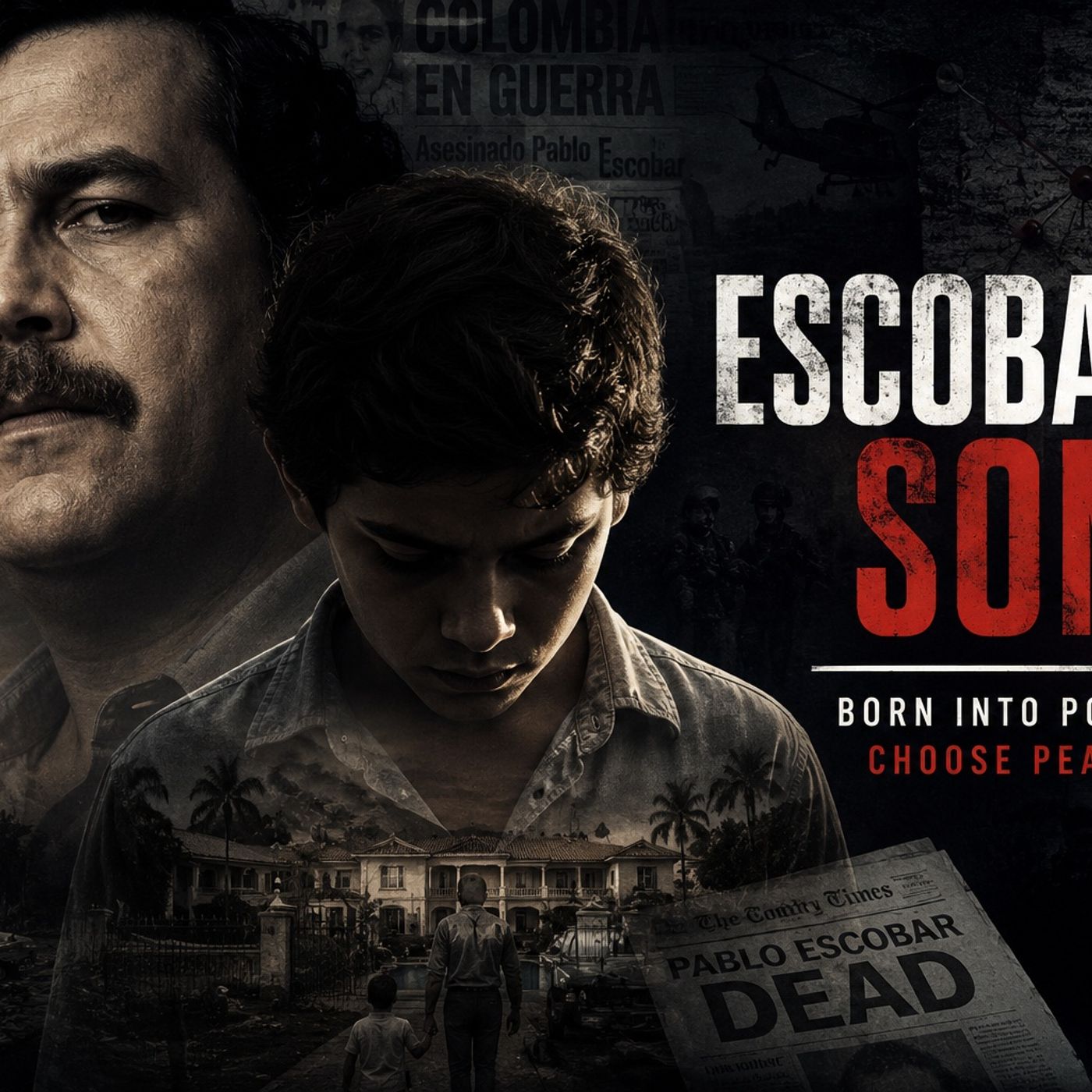
Pablo Escobar’s Son: A Story of Escape
The Story
Born into one of the most feared criminal empires in history, Juan Pablo Escobar grew up as the son of Pablo Escobar—surrounded by unimaginable wealth, violence, and global notoriety. After his father’s death, he was forced to confront a legacy built on fear and bloodshed.Instead of continuing the cycle, he chose a different path—leaving behind revenge, crime, and power to rebuild his identity in peace. This is a powerful story of survival, identity, and the struggle to live beyond a name the world will never forget.
Become a supporter of this podcast: https://www.spreaker.com/podcast/dark-american-crime--7005371/support.
Thanks for listening to Dark American Crime. The next episode is coming soon.
This episode includes AI-generated content.
At just sixteen years old, Juan Pablo Escobar watched his world collapse. In a single afternoon, news crackled through police radios across Columbia. His father had been shot dead on a rooftop in Mediine. To the rest of the world, the man lying lifeless on those red tiles was Pablo Escobar, the most feared drug kingpin on earth, hunted for years by the DEA, the Colombian government, rival cartels, and vigilante groups. But to Juan Pablo, he was simply Dad, and that made everything far more complicated.
For nearly two decades, Pablo Escobar had built an empire soaked in blood. At the height of his power during the nineteen seventies and nineteen eighties, his median cartel flooded the United States with cocaine and generated unimaginable wealth over one hundred and forty million dollars in cash every single day. Entire warehouses overflowed with money. Rubber bands used to stack the bills reportedly cost thousands monthly, yet every dollar came with violence attached to it. Escobar's rise began in poverty.
Born into a struggling family in Colombia, he became obsessed with escaping hardship. School meant nothing to him, quick money meant everything. He started small, stealing tombstones and selling them illegally, robbing businesses, running petty scams. But crime alone wasn't enough. Pablo discovered something else gave him power fear. Soon he was extorting businessmen, offering protection, kidnapping wealthy figures for ransom, and murdering anyone who resisted. One of his earliest notorious crimes involved the kidnapping of politician Diego at Chiavaria.
Even after receiving ransom money, Escobar killed him anyway. Violence became his language. By the late nineteen eighties, Columbia had become a war zone. Judges, police officers, journalists, politicians, anyone who threatened Pablo Escobar risk death. Entire families were wiped out, our bombs exploded in crowded streets. Innocent civilians became collateral damage in a war they never asked to be part of. In nineteen eighty nine, Escabar ordered the bombing of a commercial airliner because he believed a political enemy was aboard.
The target never boarded the plane, but one hundred ten innocent people still died. A few years later, another bomb meant for a government official exploded near a school bus stop. Twenty one civilians were killed, many of them children. To the world, Pablo Escobar was a monster, but inside his own home, he was something entirely different. Juan Pablo remembered a father who hugged him, constantly, played games with him, spoiled him with gifts, and spent time with his family. The Escobar estate looked like paradise to a child.
Private zoos, exotic animals, motorcycles, football fields, pools, endless luxury. Juan Pablo once received more than thirty motorcycles from his father alone. I received a lot of love from him. He later admitted. That was the contradiction of Pablo Escobar. To grieving families across Columbia, he was a ruthless killer. To the poor communities of Mediine, he was a hero who built homes, hospitals, football pitches, and entire neighborhoods. Many saw him as a robin hood figure, a criminal who stole from the rich and gave to the poor.
And to his son, he was simply the man who loved him. As a child, Juan Pablo had little understanding of what his father truly did. When Pablo disappeared suddenly after major assassinations, he explained it away in simple terms. Once, after murdering a government minister and fleeing to Panama, Escobar told his seven year old son that he was merely being persecuted. How could a child judge the man who tucked him into bed every night. Even when Juan Pablo grew older and slowly discovered the horrifying truth, hatred never came easily.
He understood the destruction his father caused, but emotionally, he still remembered the warmth, the affection, and the feeling of safety Pablo gave him as a father. Yet cracks in Pablo's personality appeared everywhere. He hated losing, whether playing soccer or monopoly, He cheated constantly, games only ended when he won. Juan Pablo remembered him hiding monopoly money, changing rules, and refusing defeat like an oversized child obsessed with dominance. Beneath the family man image was the same controlling force that terrorized Columbia.
Still, Juan Pablo never followed his father into crime. That single decision would save his life. On December second, nineteen ninety three, everything ended. After sixteen months on the run, Pablo Escobar was finally tracked to a safe house in Mediine. Ironically, it was a phone call to his son that exposed his location. Colombian forces closed in. Gunfire irrupted across the rooftops. Then came the famous radio message, long live Columbia, We've killed Pablo Escobar. At that exact moment, sixteen year old Juan Pablo was already under police protection alongside his mother, Maria Victoria Now and his sister Manuela Escobar.
When he heard the news, rage consumed him for ten minutes. He wanted revenge. He wanted everyone responsible for his father's death to suffer. But then something changed. Instead of continuing the cycle of violence, Juan Pablo made a decision that stunned Columbia. He publicly announced he would never follow in Pablo Escobar's footsteps. No revenge, no cartel, no bloodshed piece At sixteen years old, he chose peace over war. But choosing peace did not save the Escobar family from destruction. The moment Pablo died, everything vanished.
Rival cartels seized properties, authorities confiscated assets. Former allies disappeared, The millions hidden underground could no longer protect them. Overnight, the family went from unimaginable wealth to poverty and fear. Death Threats flooded in daily. Hotels became temporary prisons guarded by armed security. No country wanted to accept them. Airlines refused to sell them tickets simply because they carried the Escobar name. Even organizations like the United Nations and the Vatican reportedly refused assistance.
The family became untouchable, so they disappeared. Juan Pablo Escobar abandoned his identity and became Sebastian marro Keen. His mother and sister changed their names too. With new passports and hidden identities, they fled to Argentina in search of survival. The transformation was surreal. One day they were royalty in Columbia, the next they were anonymous refugees hiding from the world. But even in Argentina, the Escobar shadow fire. The Sebastian was arrested multiple times over accusations tied to his father's legacy, money laundering, kidnapping, blackmail.
None of the charges stuck. He had committed no crimes, yet merely being Pablo Escobar's son was enough to make authorities suspicious. His sister suffered deeply from anxiety and depression. Years of fear and trauma consumed her. The luxurious childhood they once knew became a distant memory, replaced by paranoia, isolation, and emotional collapse. Ironically, the very fortune Pablo Escobar built to protect his family ultimately destroyed their lives. Still, Sebastian refused to become another version of his father.
Instead, he rebuilt himself Slowly. He became an architect, a writer, public speaker. He began speaking openly about the horrors of cartel violence and the damage caused by idolizing criminals like Pablo Escobar. He warned people not to romanticize them drug world, because behind the myths and Netflix style legends were thousands of corpses. Sebastian himself estimated that his father was responsible directly or indirectly for around three thousand deaths, and perhaps the most shocking part of his story is this he forgave.
Rather than hunting down those who betrayed or killed his father, Sebastion dedicated himself to meeting victim's families and asking for forgiveness. He openly condemned his father's crimes while still admitting he loved him as a father. That contradiction never disappeared. I'm not proud of his violence, he once said, but I am proud of his love for me. Today, he no longer hides behind the name Sebastian Marroken. He openly uses his identity as Juan Pablo Escobar because he no longer wants to live in fear.
He believes he should not carry guilt for crimes he never committed, and maybe that is the greatest lesson hidden within the Escobar story. A child does not choose their parents parrance. Juan Pablo Escobar grew up under the roof of one of history's most feared criminals. He could have inherited the empire. He could have chosen revenge. He could have embraced violence the same way his father did. Instead, he walked away from it all. In a family built on fear, he chose forgiveness, in a legacy soaked in blood, he chose peace.
And perhaps that choice was the one thing Pablo Escobar himself could never understand.
 Apple Podcasts
 Castbox
 Castro
 Goodpods
 Moon FM
 Overcast
 Pocket Casts
 Podbean
 Podcast Addict
 Podcast Republic
 Spotify