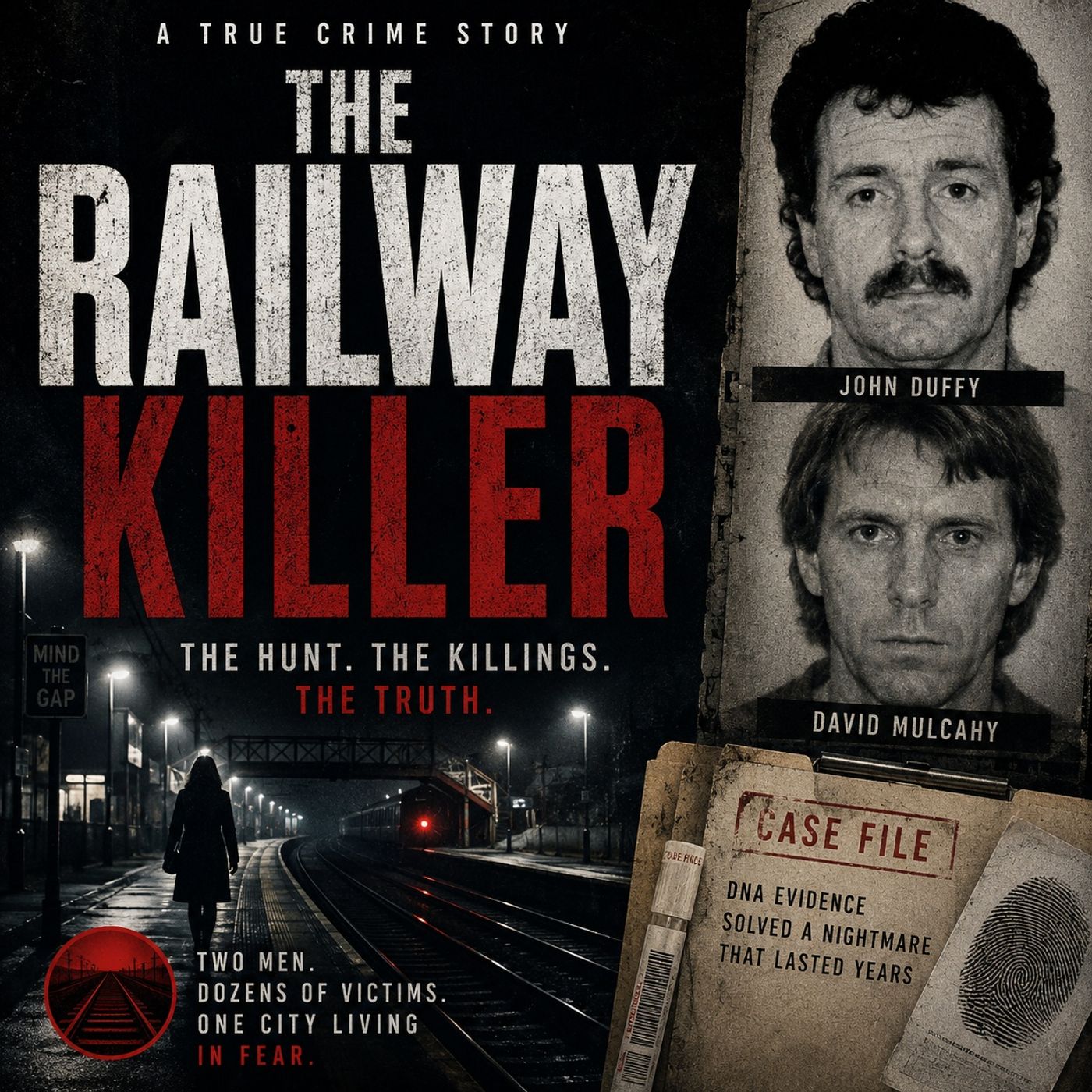
The London Railway Killer
The Story
For years, two predators stalked London's railway lines, targeting women walking home alone under the cover of darkness. As fear spread across the city, detectives launched one of Britain's biggest manhunts—one that would ultimately be solved by groundbreaking DNA evidence. This is the chilling true story of the Railway Killer case and the hunt that changed criminal investigations forever.Become a supporter of this podcast: https://www.spreaker.com/podcast/dark-american-crime--7005371/support.
Thanks for listening to Dark American Crime. The next episode is coming soon.
This episode includes AI-generated content.
On the morning of May fifth, nineteen eighty three, commuters passing through a quiet neighborhood in Southgate, North London noticed an unusual sight. Parked along the curb was a white van. It had been sitting there for hours. No one paid much attention. Delivery vans were common in the area and people assumed the driver would return, but as the day wore on, the vehicle never moved. By evening, a resident contacted the police. When officers arrived, they forced open the back doors. Inside they found the body of a young woman.
She was wrapped in a blanket, Her hands were tied behind her back. There were no signs of life, no identification, no obvious clues pointing to who she was or who had left her there. The crime scene immediately puzzled investigators. The van had been deliberately abandoned in a residential neighborhood where it would eventually attract attention. Whoever had left it behind hadn't attempted to burn it or destroy evidence. Instead, it was almost as though they wanted the body to be found. Within hours, detectives identified the victim.
She was Linda Mann, a twenty nine year old mother who had disappeared months earlier, after leaving a pub one winter evening, her family had searched desperately for her. Now they knew the truth. The post mortem examination revealed something horrifying. Linda had been brutally assaulted before being murdered. The killer had shown extraordinary violence, but very little emotion. There were no signs of robbery, no evidence suggesting she knew her attacker. It appeared to be the work of a complete stranger.
Police launched one of the largest murder investigations North London had ever seen. Hundreds of local men were questioned, thousands of witness statements were collected, Every possible suspect was examined. Yet weeks turned into months and detectives remained no closer to identifying the killer. Then, just as the investigation began losing momentum, another woman vanished. She disappeared under eerily similar circumstances. Like Linda, She had simply been walking home. Like Linda, she never arrived.
Her body would soon be discovered, bearing disturbing similarities to the first murder. Investigators could no longer dismiss the possibility they were hunting a serial killer. But they had no name, no face, and no idea that the man responsible was quietly living an ordinary life while preparing to kill again. The newspapers would eventually give him a chilling nickname, one that would become known around the world, the Railway Killer. The discovery of a second victim transformed the investigation overnight.
What had first appeared to be an isolated murder was now something far more terrifying. Detectives began laying photographs, witness statements, and forensic reports side by side. The similarities were impossible to ignore. Both women had disappeared after traveling alone at night. Both had been sexually assaulted. Both had been left in locations connected by railway lines that cut through North London. The killer wasn't choosing his victims at random. He understood the area intimately. He knew the hidden footpaths that ran beside the tracks.
He knew where lighting was poor. He knew which shortcuts people used to get home after dark. Police soon realized they were dealing with someone who hunted, patiently, watching from the shadows until the right opportunity appeared. As investigators retraced the victim's final movements, fear spread rapidly across North London. Women who regularly walked home alone began changing their routines. Some refused to travel after sunset. Others insisted friends or family meet them at train stations. Railway workers reported seeing frightened passengers waiting together rather than walking isolated paths alone.
Newspapers seized on the growing panic. Headlines warned readers about a predator stocking neighborhoods connected by Britain's railway network. Before long, the unknown offender had earned a chilling nickname, the railway Killer. Behind closed doors, detectives formed a dedicated task force. Hundreds of officers were assigned to the case. Thousands of local men were interviewed. Known violent offenders were questioned. Surveillance operations were launched near railway stations and isolated footpaths.
Every promising lead eventually collapsed. Meanwhile, the attacks continued. Some women survived and described terrifying encounters. They spoke of a man who appeared suddenly from the darkness, overpowering them with astonishing speed. He rarely spoke. When he did, his voice remained calm and controlled. His confidence suggested this was not his first attack. Each survivor added another piece to the growth owing psychological profile. The offender appeared organized, patient, comfortable operating at night, and frighteningly familiar with the maze of railway embankments that crossed North London.
Yet despite the increasing number of attacks, police remained one step behind. Unknown to investigators, they were searching for only part of the truth, because the crimes were not always being committed by one man alone. Hidden behind the investigation was a partnership that would remain undiscovered for years. Two childhood friends, two violent minds, working together in ways detectives had not yet imagined. And while police searched desperately for one predator, another was walking beside him.
As investigators expanded the inquiry, they began mapping every attack across North London. Pins covered the map, railway stations, footbridges, footpaths, hidden behind rows of houses, overgrown embankments. Again and again, the same pattern emerged. The offender seemed to know exactly where people would be isolated. He struck quickly, often within minutes, before disappearing into the darkness. Detectives believed they were hunting a single predator who had spent years perfecting his methods. What they didn't know was that two men had grown up together only a few miles away.
Their names were John Duffy and David mulcahey. As boys, they were close friends. They shared an obsession with violence, domination, and frightening other people. Teachers remembered them as troublesome. Police had encountered them for petty crimes, but no one imagined the path they were beginning to follow. As adults, both men drifted through low paying jobs and unstable relationships. On the surface, they looked ordinary. They blended into crowds neither stood out, But behind closed doors, their conversations became increasingly disturbing.
They spoke about women as though they were prey. They fantasized about power and control. Those fantasies slowly evolved into reality. Late at night, the pair would drive or walk through neighborhoods surrounding railway stations, watching commuters leave the platforms. They weren't looking for someone they knew. They were looking for someone who was alone, someone whose routine made her predictable, someone who would have little chance of escaping. Sometimes they would follow a potential victim for several streets before deciding whether to attack.
Other times, they simply disappeared back into the darkness. Waiting for another opportunity. That patience made them incredibly difficult to catch. To police, the attacks appeared random. To the killers, Every movement was calculated. Every railway bridge became a hiding place, Every poorly lit path became part of a hunting ground. They knew better than anyone else. As public fear intensified, detectives increased patrol around stations and launched appeals asking women not to walk home alone after dark.
The warnings were well intentioned, but they made little difference. The attackers simply adapted. They changed locations, they varied their routines, and when the pressure became too intense in one area, they moved to another. The investigation continued to grow, yet the killers remained invisible. Before long, their violence would escalate even further, and one survivor would provide investigators with the first real glimpse into the minds of the men responsible. The breakthrough investigators had been waiting for almost came by chance.
One cold evening, a young woman was walking home from a railway station after finishing work. She noticed footsteps somewhere behind her, but every time she glanced back, she saw nothing except empty streets and long shadows. Cast by the street lights. She kept walking. The footsteps grew closer, Then, without warning, a man lunged from the darkness. Before she could scream, another figure appeared from behind. She suddenly realized there were two attackers. They forced her toward a secluded area beside the railway line, far from passing traffic.
One kept watch while the other threatened her, speaking in a calm, chilling voice that suggested they had done this before. But something went wrong. A passing train roared by, its lights, briefly illuminating the area. The distraction lasted only seconds. It was enough. The woman broke free and ran with everything she had. The attackers chased her for a short distance before disappearing back into the darkness. Unwilling to risk being seen. Shaking and terrified, she reached safety and immediately contacted police for detectives.
Her statement was invaluable. Until then, many investigators had been convinced they were hunting alone predator. Now, for the first time, there was evidence suggesting there were two men involved. She described them as calm, organized and working together with frightening coordination. One appeared to take the lead, the other watched, blocked escape routes, and stepped in whenever needed. Detectives immediately revised their investigation. Composite sketches were prepared, patrols were increased.
Undercover officers were deployed near railway stations and isolated footpaths throughout North London. Thousands of copies of the sketches were distributed. The media warned the public that more than one offender might be responsible. Despite the massive operation, no arrests followed. The attackers seemed to sense the increased police presence. For a time, the assaults became less frequent. Investigators wondered if the publicity had finally driven them away. It hadn't. The pair were simply waiting, watching, choosing the right moment to strike again, and when they were turned, their attacks became even more violent than before.
The investigation was about to enter its darkest chapter, with more victims, more fear, and a hunt that would stretch on for years before science finally uncovered what traditional detective work could not. As the months turned into years, the fear gripping North London refused to fade. Women changed their routines, Friends waited together on train platforms until everyone had a safe ride home. Parents warned daughters never to walk alone after dark. Taxi companies reported increased demand from people who no longer trusted the quiet footpaths that cut alongside the railway lines.
Behind the scenes, detectives were working around the clock. Every new attack was compared with the previous ones. Crime scene photographs were spread across conference tables, maps covered entire walls. Forensic specialists searched desperately for a mistake the offenders might have made, but the killers were careful. They struck quickly, they chose isolated locations, and they vanished before police could arrive. As investigators pieced together the timeline, one disturbing pattern became impossible to ignore.
The attacks weren't simply acts of opportunity. They were becoming increasingly confident. The offenders appeared to enjoy the hunt as much as the violence itself. Survivors described being watched before the attack. Some remembered seeing a man lingering near station exits. Others recalled footsteps that seemed to follow them for several minutes before the assault began. The offenders were studying their victims, learning their routines, waiting until they were completely alone. Police responded by forming larger task forces and increasing surveillance around railway stations across North London.
Hundreds of officers worked under cover, thousands of local men were interviewed again, every known violent offender in the area was re examined. Still, the attacks continued. Each new crime placed enormous pressure on the investigation. The newspapers criticized police daily, families demanded answers. The public wanted to know why one of Britain's biggest man hunts seemed unable to stop two men who appeared to strike whenever they wanted. Unknown to everyone, one of the offenders had already begun drifting away from the partnership.
Their friendship was changing. The crimes they committed together would eventually become crimes committed separately, But that separation would not bring an end to the violence. Instead, it would make the investigation even more confusing. Detectives were unknowingly chasing two dangerous predators whose paths were beginning to diverge, leaving behind a trail of victims that would take years to fully understand, and it would ultimately be a breakthrough in a brand new form of forensic science. Not a witness, not a confession, and not an informant that would finally begin unraveling the mystery.
By the mid nineteen eighties, the investigation had become one of the largest and most frustrating criminal inquiries in Britain. Detectives had interviewed thousands of people, hundreds of statements filled filing cabinets. Every assault, attempted, murder and murder believed to be connected to the railway killer was carefully analyzed, yet the offender or offenders remained invisible. Then something extraordinary happened. Forensic scientists began turning to a relatively new technique that most investigators had never relied upon before.
It wasn't fingerprints, it wasn't handwriting, it wasn't a witness testimony. It was DNA. At the time, the science was still in its infancy. Very few criminal investigations had successfully used genetic profiling. But detectives realized the biological evidence collected from multiple crime scenes might finally answer a question that had haunted them for years. Were all these attacks being committed by the same person or were there multiple effec When scientists compared the samples, the results surprised investigators.
Some attacks were linked to one DNA profile, others were not. The evidence strongly suggested that more than one man had been involved during different stages of the crime spree. The survivor's account from years earlier suddenly made perfect sense. The investigation shifted dramatically. Instead of hunting a single serial predator, detectives now believed they were searching for at least two men whose criminal partnership had eventually fractured. One name soon rose to the top of the suspect list, John Duffy.
He had lived in the areas where many of the attacks occurred. He knew the railway network intimately. Most importantly, his past revealed a disturbing pattern of violence against women. Even so, suspicion alone wasn't enough. Detectives needed proof. They quietly began monitoring Duffy's movements, interviewing people who knew him, and collecting every possile piece of evidence that could legally connect him to the crimes. As pressure mounted, another name resurfaced from Duffy's past, David Mulcahy.
The two men had grown up together. They had remained close for years. Investigators began wondering whether the partnership described by the surviving victim had been these two childhood friends, but there was still one obstacle. Neither man had confessed, and despite the growing forensic evidence, detectives needed one final breakthrough before they could bring the investigation to an end. That breakthrough would come through DNA, a scientific advance that would forever change criminal investigations around the world and finally begin exposing the men who had terrorized North London's railway lines for years.
As detectives closed in on John Duffy, they knew they couldn't afford a mistake. Years had passed since the first attacks. Witnesses memories had faded, physical evidence had deteriorated, but DNA did not forget. Investigators obtained a sample from Duffy and sent it for comparison against the biological evidence preserved from multiple crime scenes. The weight felt endless. When the laboratory results finally arrived, they confirmed what detectives had long suspected. The DNA matched for the first time, investigators had irrefutable scientific evidence linking John Duffy to a series of brutal attacks and murders that had terrorized North London for years.
Duffy was arrested. During questioning, he denied everything. He remained calm insisting the police had the wrong man, but detectives continued, presenting the evidence piece by piece, witness statements, crime scene findings, and finally the DNA profile. The scientific evidence was overwhelming, Still, Duffy refused to confess. As investigators dug deeper into his past, they uncovered his close friendship with David Mulcahy. The two had grown up together, they had spent countless hours roaming the same railway lines where many of the attacks later occurred.
Detectives became convinced they had found the partnership described by survivors years earlier. However, proving mulcahy's involvement would prove far more difficult. Unlike Duffy, there was not enough forensic evidence to immediately charge him with every suspected crime. The investigation continued. Meanwhile, prosecutors prepared one of the most important criminal cases Britain had ever seen. The public followed every development closely. For years. Fear had haunted commuters across North London.
Now one of the men believed responsible was finally facing justice, but investigators believed they still hadn't uncovered the full truth. They suspected there were more victims than anyone realized, and they believed only one man knew exactly how many. That man was John Duffy, yet he remained silent. The ANSWER's investigators desperately wanted would eventually come not from Duffy, but from the man who had hunted beside him for years. David mulcahey was about to make a decision that would expose crimes hidden for more than a decade.
John Duffy's trial became one of the most closely watched criminal proceedings in Britain. Four years, the public had followed every twist in the railway killer investigation. Now they finally watched as prosecutors laid out a case built not only on witness testimony, but on something that was transforming criminal investigations forever, DNA evidence. The prosecution described a predator who had stalked women along railway lines, waiting patiently for moments when they were isolated and vulnerable.
Survivors took the stand. Some spoke through tears as they recalled the terrifying attacks they had endured years earlier. Others described the lasting trauma that had followed them long after their physical injuries had healed. For many in the court room. Their testimony was heartbreaking. Duffy's defense challenged the process execution's case, but the forensic evidence proved difficult to overcome. The DNA links connected him to multiple attacks with a level of certainty that had been almost impossible in earlier decades.
After hearing weeks of evidence, the jury returned its verdict. John Duffy was found guilty of numerous violent offenses, including murders and attacks connected to the railway killer investigation. He received multiple life sentences. For many families, the verdict brought relief, but detectives were not celebrating. Something still didn't fit. The pattern of attacks suggested more crimes than Duffy alone could fully explain. Several investigators remained convinced another offender had been involved during the earlier years of the crime spree.
Their attention returned once again to David mulcahey. Unlike Duffy, Mulcahey had managed to stay out of the spotlight. There wasn't enough evidence at the time to prosecute him for the full extent of what detectives suspect. Yet investigators refused to close the file. They continued reviewing old witness statements re examining forensic evidence and comparing timelines from dozens of unsolved attacks years past. Then, unexpectedly, the investigation took a dramatic turn. David Mulkayhee began talking.
What he revealed would shock even the detectives who had spent years working the case. His admissions painted a far darker picture than anyone had imagined. The railway killer investigation had never been the story of one violent man. It had always been the story of two, and Mulkayhee was finally about to explain how that deadly partnership began and just how many lives it had destroyed. For years, David Mulkayhee had remained in the background of the investigation while John Duffy became the face of the railway killer case.
Mulkayhee lived with the knowledge that investigators still suspected his involvement. Detectives believed he held the missing pieces of a puzzle that had haunted Britain for more than a decade. Eventually, those suspicions proved correct. During extensive interviews, mulcahey began revealing details that had never been made public. He admitted that he and John Duffy had spent years prowling the railway network together, deliberately searching for vulnerable women walking home alone. Their attacks were not spontaneous.
They planned them. They drove through neighborhoods, watched railway stations, and waited patiently until they found someone isolated. Sometimes they abandoned a potential victim if the surroundings were too busy. Other nights, they followed women for several streets before making their move. The railway lines offered everything they wanted, darkness, escape routes, and long stretches where cries for help might never be heard. Mulcahey described how the pair encouraged each other's violence. What began as disturbing fantasies gradually escalated into real attacks.
Each success dustful assault seemed to erase another moral boundary. The crimes became more brutal, the confidence grew, and with every attack they escaped, they believed they were untouchable. Detectives listened carefully as Mulkayhey recounted incidents that matched unsolved case files dating back years. Many of the details he described had never appeared in newspapers and were known only to investigators. His statements allowed police to revisit attacks that had remained mysteries for decades.
For victims and their families, the admissions were devastating. Some finally learned who had been responsible for crimes that had changed their lives forever. Others were forced to relive memories they had spent years trying to bury. Mulcahy's cooperation also confirmed something detectives had long suspected. The railway killer investigation had never been a straightforward serial murder case. It had been the work of two men whose friendship fed their violence until they eventually drifted apart, leaving investigators to untangle which crimes belonged to whom.
But even with those admissions, one difficult task remained. The courts still had to determine responsibility for each individual offense, and that process would reveal the staggering scale of the terror the two childhood friends had unleashed across North London. As prosecutors reviewed David Mulcahy's admissions, investigators reopened dozens of old case files that had gathered dust for years. Each confession was carefully compared against forensic evidence, witness statements, and police reports.
Detectives couldn't simply accept Mulcahy's word, every detail had to be verified. To their astonishment, many of the facts he provided matched evidence that had never been released to the public. He described isolated railway embankments where attacks had taken place. He remembered the clothing some victims had been wearing. He recalled escape routes that only the offenders or investigators could have known. The admissions gave police the com confidence to charge him with numerous serious offenses.
The court proceedings that followed revealed the horrifying extent of the partnership between Mulkayhee and John Duffy. Prosecutors argued that the two men had spent years terrorizing women across North London, treating the railway network as their personal hunting ground. Survivors once again took the witness stand. Some had waited more than a decade for this moment. They spoke about the fear that never completely disappeared. Many admitted they still avoided walking alone at night, even years after the attacks.
The psychological scars had lasted far longer than the physical injuries. As the evidence mounted, it became increasingly clear that the crimes had affected far more people than investigators had first realized. There were murders. There were attempted murders. There were sexual assaults. There were violent attacks where victims survived only through extraordinary courage or sheer luck. The scale of the offending stunned the public. These were not isolated incidents. They were part of a prolonged campaign of violence that had spread fear across an entire region.
When the verdicts were finally delivered, David Mulkayhee was convicted of multiple counts connected to the attacks. Like John Duffy, he received life sentences that ensured he would spend the rest of his life behind bars. For many families, the convictions represented justice, but justice could never restore the lives that had been taken, nor could it erase years of fear endured by countless women who had unknowingly crossed paths with two of Britain's most dangerous predators. The railway killer investigation would go on to become one of the most significant criminal cases in British history, not only because of the brutality of the crimes, but because it demonstrated the revolutionary power of DNA evidence.
A scientific breakthrough had succeeded where thousands of interviews and years of detective work alone could not yet even after the convictions, one haunting question remained exactly how many victims had John Duffy and David mulkayhey left behind. Some investigators believed the true number might never be known. With both John Duffy and David mulcahey behind bars, investigators finally had time to look beyond the court room and ask a troubling question, could there be more victims? The official convictions covered numerous murders, attempted murders, rapes, and violent assaults, But detectives knew that not every victim reports an attack, and not every case leaves enough evidence to secure a conviction.
Cold case files were reopened, boxes of aging documents were carried out of storage. Investigators compared old witness statements with Mulcahy's admissions, searching for attacks that had once seemed unrelated but now fit the same disturbing pattern. Some cases could finally be explained, others remained unresolved. For the families of the murdered women, the convictions brought a measure of justice, but not peace. Many had spent years waiting for answers. Some parents had died before seeing those responsible brought before a court.
Others sat through every day of the trials, determined that their daughters would not be forgotten. The survivors carried a different burden. Many had rebuilt their lives, started families, and established careers, yet the memories of those terrifying nights never completely disappeared. Several later spoke publicly about the lasting effects of trauma. Simple routines walking home after dark, waiting alone on a train platform hearing footsteps behind them could still trigger overwhelming fear. Years later.
Their courage in coming forward helped investigators understand the true impact of the crimes. The case also forced police forces across Britain to examine how they investigated serial violent offenders. Communication between departments improved patterns linking attacks across different jurisdictions began receiving greater atas investigators became more willing to consider that crimes occurring miles apart could still be connected by the same offender. Perhaps the greatest legacy of the investigation, however, was the growing importance of forensic science.
The successful use of DNA profiling demonstrated that biological evidence could identify offenders with remarkable accuracy, even years after a crime had been committed. What had once seemed like an impossible investigation had ultimately been solved through a combination of determined detective work, survivor testimony, and advances in science. Yet one reality remained impossible to ignore. For years, two ordinary looking men had blended effortlessly into society. They held jobs, they maintained friendships.
They appeared unremarkable to those around them. Behind that ordinary appearance, however, they had carried out a campaign of violence that left lasting scars on victims, families, and an en higher city. As the years passed, the railway killer case became one of Britain's defining true crime investigations, a reminder that some of the most dangerous predators are not easily recognized until it's far too late. Years after the convictions, the railway killer investigation was studied by police academies, forensic experts, and criminal psychologists across Britain.
It had become more than a murder case. It was now a lesson in how serial offenders could exploit routine geography and opportunity to remain hidden. For years, investigators retraced the timeline of the attacks, trying to understand how two men had managed to evade capture for so long. One answer was painfully clear. The crimes had unfolded over many years across different police divisions, each initially treating attacks as isolated incidents. Only when the evidence was brought together did the full picture emerge.
Psychologists who examined John Duffy and David mulcayhee noted the disturbing dynamic between them. Together, they reinforced one another's violent fantasies. Each attack strengthened their confidence, each escape convinced them they were untouchable. Eventually, their partnership fractured, but the damage had already been done. The victims came from different backgrounds. Some were students, some were professionals returning from work. Others were simply trying to get home after an ordinary evening.
They had no connection to one another. Their only common thread was that they crossed paths with two men who viewed strangers as targets rather than human beings. As the years passed, memorials and anniversaries reminded the public that behind every headline was a real person with a family, dreams, and a future that was stolen. The survivors also became an important part of the story. Many chose to speak publicly about resilience, helping others understand the lifelong effects of violent crime. Their willingness to testify VII had not only secured convictions, but also inspired changes in how victims of sexual violence were treated by the justice system.
The investigation's greatest legacy, however, reached far beyond North London. DNA profiling, once considered experimental, became one of the most powerful tools in modern policing. Cold cases that had seemed impossible to solve were reopened. Offenders who believed they had escaped justice for decades suddenly found themselves facing arrest. The railway killer case had changed policing forever, but for the detectives who had worked it, one thought never disappeared. Had DNA profiling existed years earlier, how many lives might have been saved.
It was a question with no answer, one that would continue to haunt everyone who had witnessed the investigation from beginning to end. As the years passed, the names John Duffy and David Mulkayhey became synonymous with one of Britain's longest and most disturbing serial crime investigations. For detectives who had worked the case from the beginning, the convictions brought satisfaction, but not celebration. They often reflected on the victims they had met, the families they had comforted, and the years spent chasing men who always seemed one step ahead.
Retired investigators later admitted that there were moments when they feared the case would never be solved. The lack of reliable witnesses, the scarcity of forensic technology in the early years, and the offenders careful planning had made the investigation extraordinarily difficult. Everything changed when science caught up with the crimes. DNA profiling didn't just identify a suspect, it rewrote the future of criminal investigations. Police forces across the United Kingdom began preserving biological evidence more carefully, knowing that advances in forensic science could one day solve cases that seemed impossible at the time.
The case also reshaped public awareness. Railway stations improved lighting and security in many areas. Local councils cleared overgrown footpaths and installed emergency telephones in isolated locations. Public safety campaigns encouraged commuters to report suspicious behavior rather than dismiss it. These changes came too late for the victims of the railway Killer, but they helped protect countless others. For the families, however, every anniversary reopened old wounds, birthdays passed, holidays came and went empty.
Chairs remained at dinner tables where daughters, sisters, and loved ones should have been sitting. No conviction could restore what had been taken from them. John Duffy would spend the rest of his life behind bars. David Mulkayhee received multiple life sentences for his role in the attacks and murders. Neither man would ever again walk freely through the railway stations that had once served as their hunting grounds. Yet one final chapter remained. It was not about the killers. It was about the lasting legacy of the investigation and the unforgettable lessons it left for detectives, forensic scientists, survivors, and an entire nation that had lived in fear for years.
By the time the Railway Killer investigation was finally over, it had become one of the most significant criminal cases in British history. Its impact reached far beyond the court room. Police forces across the country began re examining how they investigated serial violent offenders. Information sharing between departments improved, and detectives became far more alert to patterns that stretched across different jurisdictions. The case also cemented the importance of preserving forensic evidence.
Items that might once have been overlooked were now carefully stored, sometimes for decades, because investigators understood that future scientific advances could reveal answers unavailable at the time of the crime. Forensic DNA profiling, still a relatively new technique when it helped identify John Duffy, became a cornerstone of modern criminal investigations. Cases once considered unsolvable were reopened, and offenders who believed they had escaped justice found themselves identified years later.
The survivors also left a lasting legacy. Many demonstrated extraordinary courage by testifying in court despite the immense emotional toll. Their willingness to relive traumatic experiences helped secure convictions and highlighted the need for better support systems for victims of sexual violence. Meanwhile, the memories of the murdered women continued to be honored by their families and communities. They were remembered not as names in a case file, but as daughters, sisters, friends, co workers, and mothers whose ordinary lives were stolen by extraordinary cruelty.
For detectives, one truth remained painfully clear. John Duffy and David mulcahey had looked like ordinary men. They blended into society, They worked regular jobs. They lived among neighbors who had no idea what they were capable of after dark. That ordinary appearance was perhaps the most frightening part of the entire case. It served as a reminder that some of the world's most dangerous criminals hide behind lives that appear completely unremarkable. As both men grew old behind prison walls, they lost the freedom they had once used to terrorize countless victims.
But even their imprisonment could never erase the fear they had spread or the lives they had permanently changed. Only one final chapter remained, the closing of their stories and the enduring lessons left behind by one of Britain's most infamous serial crime investigations. The final chapter of the railway killer case was written not in a court room, but in the quiet lives that continued long after the headlines disappeared. For the families of the murdered women. Justice was never the same as closure.
A conviction could explain who committed the crimes, could never explain why birthdays came and went without daughters returning home. Children grew up without mothers, parents grew old carrying grief that never truly faded. The survivors faced a different battle. Many rebuilt their lives with remarkable courage, but the memories of those nights remained. The sound of footsteps behind them, the sight of a dimly lit railway platform, or the feeling of walking alone after sunset could bring everything rushing back.
Their strength in speaking to investigators and testifying in court became one of the most important reasons the offenders were finally held accountable. John Duffy would spend the remainder of his life in prison, serving multiple life sentences for the murders and violent attacks that terrorized North London. David Mulkayhee was also sentenced to life imprisonment for his role in the crimes. His admissions helped investigators understand how the partnership had operated, but they could never undo the devastation it had caused.
The Railway killer investigation became a landmark case in British policing. It demonstrated the extraordinary power of DNA profile, proving that even years after a crime, science could uncover the truth when traditional methods had failed. It also changed how police investigated, link defenses, preserved forensic evidence, and shared intelligence across jurisdictions, changes that have helped solve countless other cases since. Yet, perhaps the most enduring lesson was a simple and unsettling one.
Monsters do not always look like monsters. Sometimes they wear ordinary clothes, they hold ordinary jobs, They smile at neighbors, ride the same trains, and disappear into crowds without attracting a second glance. For years, John Duffy and David mulcahey hid behind that ordinary appearance while carrying out acts of unimaginable violence. Eventually they were exposed, not because they chose to confess, but because persistence, science and the courage of survivors finally caught up with them. Their names are now remembered not for the lives they lived, but for the suffering they inflicted.
The victims, however, are remembered for something far more important. They are remembered because their stories changed policing, advanced forensic science and ensured that future investigations would be better equipped to stop predators who believed they could hide forever. And that is the lasting legacy of the railway killer case, a reminder that justice may sometimes take years, even decades, but when determination meets truth, even the darkest secrets can eventually come to light.
 Apple Podcasts
 Castbox
 Castro
 Goodpods
 Moon FM
 Overcast
 Pocket Casts
 Podbean
 Podcast Addict
 Podcast Republic
 Spotify