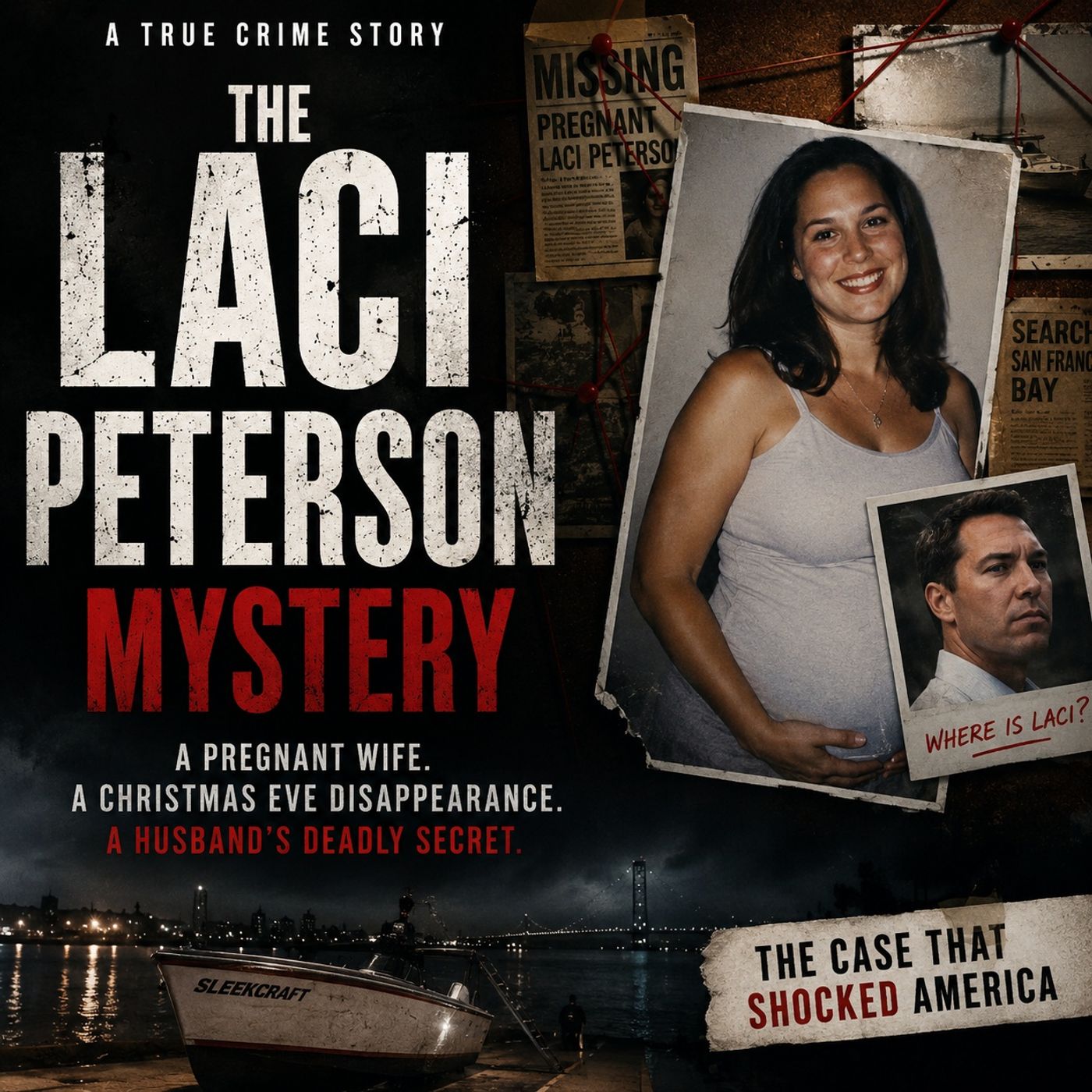
The Laci Peterson Mystery
The Story
Dive into the chilling case of Laci Peterson, a pregnant woman who vanished on Christmas Eve 2002. From a desperate search to a gripping murder trial built on circumstantial evidence, this episode unravels one of America's most infamous true crime cases and the questions that continue to spark debate today.Become a supporter of this podcast: https://www.spreaker.com/podcast/dark-american-crime--7005371/support.
Thanks for listening to Dark American Crime. The next episode is coming soon.
This episode includes AI-generated content.
The murder of Lacy Peterson. On the morning of December twenty fourth, two thousand and two, Christmas Eve settled gently over the quiet city of Modesto, California. Streets were decorated with twinkling lights, Families hurried through last minute holiday preparations, and the air carried the excitement of a celebration only hours away. For most residents, it promised to be an ordinary Christmas, filled with warmth, gifts, and family gatherings. But before the day was over, a mystery would begin that would haunt America for years.
Inside a comfortable home on Cavina Avenue, twenty seven year old Lacey Peterson the American dream. Her husband, Scott Peterson, seemed equally successful. A fertilizer salesman with an easy smile, Scott was known as polite and friendly. Neighbors saw a young, married couple building a future together. There were no loud arguments, no obvious signs of violence, and nothing that suggested tragedy was only our away that morning. Scott later told investigators that he planned to spend part of Christmas Eve fishing alone at the Berkeley Marina, nearly ninety miles from their home.
According to him, Lacey intended to stay behind, mop the floors, bake cookies, and take the family dog, Mackenzie, for a walk before preparing for relatives arriving the next day. The plans sounded ordinary. Ordinary plans often become the foundation of extraordinary mysteries. According to Scott, he left the house sometime after nine thirty am. He kissed Lacey goodbye before loading fishing equipment into his truck and driving away. It would be the last time he claimed that he ever saw his wife alive.
Hours later, the neighborhood remained peaceful. Christmas music drifted from nearby homes. Children rode bicycles along the sidewalks. Nothing appeared unusual until Mackenzie, the Peterson's golden retriever, was found wandering alone with his muddy leash still attached. A neighbor discovered the dog near the Peterson home around ten eighteen am. Believing the dog had escaped, the neighbor returned Mackenzie to the backyard and closed the gate. It seemed like a small act of kindness. No one realized it might become one of the most discussed moments in the investigation.
As the afternoon turned into evening, Scott returned home from his fishing trip. He later told police the house was empty. Lacey's car was still parked in the driveway, her purse remained inside, her keys were there. Nothing appeared stolen, he said. He searched briefly before becoming worried. Soon, phone calls were made to family members. Nobody had seen Lacey. Concern quickly transformed into panic. Friends rushed to the Peterson home. They searched nearby parks and streets, calling Lacey's name repeatedly.
Family members contacted hospitals, hoping she had suffered an accident and simply hadn't been identified. There was no trace. As darkness settled over Modesto, officers from the police department arrived to begin what initially appeared to be a missing person investigation. They carefully examined the house. There were no signs of forced entry, no evidence of a violent struggle, no blood, no broken furniture. Nothing immediately suggested that a crime had taken place. Investigators questioned Scott about his day.
He calmly explained that he had gone fishing at the Berkeley Marina because he wanted to test a new boat he had recently purchased. The explanation surprised some detectives. Christmas Eve seemed like an unusual day for a solo fishing trip, especially with a wife who was eight months pregnant. Still, unusual does not automatically mean criminal. Police documented every detail. Scott described what Lacy had been wearing, He explained their plans, He answered questions for hours. Meanwhile, volunteers began organizing search parties.
Hundreds of people joined the effort. Flers bearing Lacey's smiling face appeared throughout California. Television stations interrupted holiday programming to report that a pregnant woman had vanished without explanation. Within days, the case exploded into national headlines. The image of Lacey smiling while gently holding her pregnant belly appeared on newspapers across America. The public immediately connected with the story. A young mother, a missing unborn child Christmas Eve, a husband claiming he had simply gone fishing.
Questions multiplied faster than answers. Detectives started building a timeline, minute by minute. Who had seen Lacey after Scott left? Did anyone notice suspicious vehicles? Could someone have abducted her during a morning walk? Every possible theory remained open. Search teams combed parks, canals, farmland and neighborhoods. Divers entered nearby water. Helicopters scanned open fields. Nothing. Then investigators discovered something unexpected. Scott had purchased the small fishing boat only weeks before Lacey disappeared.
Very few people knew he even owned it. Why had he bought it without telling family members? The question alone proved nothing, but detectives wrote it down. Every unexplained detail mattered. As media attention intensified, another revelation quietly emerged, one that would soon transform the investigation completely. Unknown to nearly everyone searching for Lacey, Scott Peterson had been living a secret life, a life built on lies, a life that, once exposed, would permanently change how investigators viewed the disappearance.
That secret was about to surface, and when it did, the search for a missing woman would become one of the most controversial murder investigations in American history. Christmas came and went, but there was no celebration inside the Peterson family home. Instead of preparing for the arrival of baby Connor, family members spent every waking hour searching for Lacey. Volunteers gathered each morning, distributing flyers across Modesto and neighboring communities. Churches organized prayer vigils, while local businesses displayed posters with Lacey's photograph in their windows.
The disappearance had become more than a local mystery. National television networks broadcast the story around the clock. Reporters camped outside the Peterson home, hoping for updates. Every new development was scrutinized by millions of viewers. At first, investigators treated Scott Peterson as a grieving husband. They encouraged him to participate in search efforts and media appeals. He spoke briefly to reporters, asking anyone with information about Lacey to come forward. His words sounded sincere, but some people noticed that his emotions seemed strained, while everyone reacts differently to trauma.
Detectives quietly began observing his behavior more closely. The police assembled a detailed timeline of Christmas Eve. They interviewed neighbors, delivery drivers, postal workers, and anyone who might have seen Lacey. After Scott claimed he had left for Berkeley Marina. Several witnesses believed they had seen a pregnant woman walking a golden retriever that morning. Each sighting was carefully documented. At first, these reports gave investigators hope that Lacey had indeed left the house after Scott departed.
However, as detectives compared times and locations, many of the accounts conflicted with one another. Some witnesses disagreed about what the woman was wearing, Others couldn't be certain of the exact time they had seen her. Memory detectives knew could become unreliable after a highly publicized event. Meanwhile, forensic specialists examined the Peterson home inch by inch. They searched for fit, finger prints, biological evidence, and any indication of violence. The house appeared remarkably ordinary.
Christmas decorations remained untouched. Wrapped gifts sat where they had been placed. There were no signs of forced entry or an obvious struggle. Scott willingly answered more questions. He explained that he had decided to fish for sturgeon at the Berkeley Marina. Detectives found the trip unusual because the marina was nearly ninety miles from Modesto. They also learned that Scott had purchased a small aluminum fishing boat only weeks earlier. Family members told investigators they had never known he owned one.
The discovery wasn't evidence of a crime, but it raised questions why had he kept the boat a secret? Why choose Christmas Eve for a fishing trip. Detectives visited the marina and retraced Scott's movements. They confirmed that he had launched his boat there during the day. Receipts, parking records, and witness statements generally supported that he had been at the marina for at least part of the afternoon. Still, something didn't sit right. As investigators continued interviewing people close to Scott, they uncovered information that changed the direction of the case.
Just weeks before Lacey disappeared, Scott had begun a romantic relationship with another woman. Her name was Amber Fry. Amber lived hundreds of miles away and had no idea Scott was married. When detectives contacted her, she was stunned. Scott had introduced himself as a successful single man. He spoke about his future, He took her on dates, he met members of her family. There was no mention of a pregnant wife waiting for him at home. The deception shocked investigators, but what truly alarmed them was the timing.
Amber told detectives that in early December, weeks before Lacey vanished, Scott had made an extraordinary statement. He claimed this would be his first Christmas without his wife. At the time time, Amber believed he meant his wife had died years earlier. She had no reason to question the story. Now, hearing that Lacey had disappeared just weeks later, those words took on a chilling new meaning. Realizing the potential importance of this information, Amber agreed to cooperate fully with law enforcement.
Working closely with investigators, she began recording her phone conversations with Scott. The recordings would become some of the most closely examined evidence in the entire case. As police listened, they heard Scott continuing to deceive Amber. Even after Lacey's disappearance dominated national news. He maintained the illusion that he was traveling, working, or spending time in places where he was not. In one conversation, while search teams desperately looked for his missing wife, Scott claimed to Amber that he was celebrating New Year's Eve in Paris.
In reality, detectives knew he was standing at a candlelight vigil in Modesto honoring Lacey. The contradiction deeply troubled investigators. To them, it suggested a man capable of maintaining elaborate lies even under extraordinary circumstances. The public's perception of Scott began to shift dramatically. News outlets reported on the affair, and sympathy that had once surrounded him quickly faded. People questioned why a husband with a missing, pregnant wife had concealed such a significant part of his life.
Still, suspicion alone was not enough. Detectives needed evidence. Without Lacy or physical proof linking Scott to a crime, they could not make an arrest. The investigation entered a new phase. Every movement Scott made was monitored, Every phone call was analyzed, Every statement was compared against known facts. Investigators believed the truth was hidden somewhere within the growing web of contradictions, But the most devastating discovery in the case was still months away. It would emerge not from an interrogation room, but from the cold waters of the San Francisco Bay.
As January two thousand and three unfolded, the search for Lacy Peterson intensified rather than faded. More than a month had passed since Christmas Eve, yet there had not been a single confirmed sighting of her. Every reported lad eventually ended in disappointment. Investigators followed hundreds of tips from across the country, but none brought them any closer to finding the missing mother to be. The Peterson family remained in the public eye. Lacey's parents and siblings pleaded with anyone who might know something to come forward.
They organized search efforts, attended vigils, and continued speaking to the media in the hope that someone somewhere had seen something important. Scott Peterson also remained visible. He appeared at press conferences and occasionally joined search efforts. He thanked volunteers for their support and insisted that he wanted nothing more than to bring Lacey home safely. Yet detectives were paying less attention to what he said publicly and more attention to what he did privately. Investigators had now begun conducting surveillance.
Unmarked vehicles followed Scott's movements. His phone records, financial activity, and daily routines were carefully documented. Detectives wanted to determine whether his behavior matched that of a desperate husband searching for his missing wife, or someone trying to protect a secret. The recorded phone calls between Scott and Amber Fry became increasingly important. Amber continued cooperating with law enforcement, speaking to Scott while investigators listened in real time. During the conversations, Scott often sounded calm and affectionate.
He rarely spoke about Lacy unless Amber asked. Instead, he continued pretending that his life was normal. In one conversation, he described sightseeing and travel that detectives knew were completely fictional. While television cameras showed him at tending events related to the search for his wife, he told Amber he was in Europe enjoying romantic scenery. To investigators, the lies were striking. They didn't directly prove murder, but they demonstrated a pattern of deception. Meanwhile, forensic experts examined Scott's truck, boat, clothing, and home using advanced laboratory techniques.
They searched for blood, fibers, hair fingerprints, and any trace evidence that could indicate foul play. The results were frustrating. No obvious forensic evidence connected Scott to Lacy's disappearance. The small aluminum fishing boat also yielded little. There were no signs of a violent struggle, no blood, no unmistakable evidence that a crime had occurred aboard the vessel. Without a body, prosecutors faced an enormous challenge. A murder case built entirely on circumstantial evidence would require a compelling narrative supported by many small pieces, rather than one decisive discovery.
As detectives reconstructed Scott's activities before Christmas Eve, another detail emerged. He had made unusual Internet searches in the weeks leading up to Lacy's disappearance, including searches related to tides, currents, and boating locations around the San Francisco Bay. Individually, these searches could have been consistent with someone preparing for a fishing trip, but when viewed alongside everything else, the secret boat, the affair, the lies, and the timing, they became part of a much larger picture investigators were assembling.
The media coverage intensified. Television commentators debated Scott's innocence almost nightly. Some believed he was being unfairly judged because of his affair. Others argued that while infidelity was morally wrong, it did not make someone a murderer. Public opinion became sharply divided. Outside the Peterson Home, reporters gathered every day, hoping to get even the smallest development. Helicopters hovered overhead during search operations. Newspapers published timelines, maps, and analyzes of Scott's statements.
The case had become one of the most closely followed criminal investigations in America. Despite months of searching, there was still no sign of Lacey. Winter slowly gave way to spring. Investigators knew that time was working against them. Then, in April two thousand and three, nearly four months after Lacey disappeared, an unexpected phone call reached authorities. A person walking along the shoreline near the San Francisco Bay had discovered what appeared to be human remains. The location immediately caught investigator's attention.
It was not far from the same body of water where Scott claimed he had gone fishing on Christmas Eve. Police rushed to the scene. The discovery was disturbing. The remains were badly decomposed, making immediate identification in possible. Before investigators had finished processing the area, another shocking discovery was made nearby. Additional human remains had washed ashore. This second discovery would transform the investigation forever. Within days, forensic experts began the painstaking process of determining the identities of both sets of remains.
The entire nation waited. If the remains belonged to Lacey and her unborn son, the case would no longer be a missing person investigation. It would become a homicide investigation, and the focus would fall more heavily than ever on Scott Peterson. In the days following the grim discoveries along the shoreline of the San Francisco Bay, forensic experts worked around the clock. The remains had been exposed to the elements for months, making identification difficult. Every bone, every fragment of clothing, and every piece of physical evidence was carefully documented.
The first set of remains was identified as those of an infant. Medical examiners concluded that they were consistent with Connor, the unborn son that Lacy Peterson had been carrying when she disappeared. The finding stunned investigators and devastated both families. Not far away, the second set of remains was identified as those of Lacy Peterson. After nearly four months of desperate searching, the heartbreaking truth had emerged. Lacey had not disappeared voluntarily. She was dead. The investigation officially shifted from a missing person case to a double homicide.
Detectives immediately returned to every piece of evidence they had collected over the previous months. They compared witness statements, reviewed surveillance records, and analyzed Scott Peterson's movements. Once again, one fact stood out more than ever. The place where Lacey and Conner's remains were found was in the same general area of the San Francisco Bay where Scott said he had gone fishing alone on Chris Wave. By itself, that fact did not prove guilt. The bay is vast and currents can carry objects over great distances.
Still, investigators believed the location was too significant to ignore. The news spread across the country within hours. Television stations interrupted regular programming, newspapers printed special editions. People who had followed the story since Christmas Eve were now confronted with the tragic ending they had feared. Outside the Peterson home, flowers, candles, and handwritten messages accumulated on the sidewalk for Lacy's family, Hope had been replaced by grief. For detectives the case entered its most critical phase.
They now had to determine who was responsible. Attention quickly turned back to Scott Peterson. Investigators examined his statements from the beginning of the case. They looked for inconsistencies, comparing what he had said in December with what they had learned in the months since his affair with Amber Fry had already damaged his credibility. The recorded phone calls showed a man who continued lying about his life even while his wife was missing. Now, prosecutors believed they had enough circumstantial evidence to argue that Scott had carefully concealed the truth from the very beginning.
Scott maintained his innocence through his attorneys, he denied any involvement in Lacy's death. He insisted that he loved his wife and had nothing to do with what happened to her. His defense argued that investigators had become so focused on Scott that they overlooked other possible suspects and alternative explanations. Meanwhile, law enforcement quietly intensified surveillance. Detectives believed there was a possibility Scott might try to flee their concerns grew as they monitored his behavior in the days after the remains were identified.
Then, on April eighteen, two thousand and three, officers moved in Scott Peterson was arrested near a golf course in southern California. Authorities announced that he had been taken into custody on suspicion of murdering Lacy and Connor. The arrest instantly became international news. Television cameras followed every development. Commentators debated whether the prosecution had enough evidence to secure a conviction. There was still one major obstacle despite months of investigation. Prosecutors had no eye witness to the killings, no confession, no murder weapon, no clear forensic evidence showing exactly how Lacy had died.
The case against Scott would depend almost entirely on circumstantial evidence, a collection of facts that, when viewed together, prosecutors believed pointed to only one conclusion. The trial promised to become one of the most closely watched in modern American history. Both sides began preparing for a court room battle that would captivate millions. Every lie, every phone call, every receipt, every mile driven, every minute of Christmas Ey would soon be examined before a jury. Scott Peterson's arrest marked the beginning of one of the most anticipated criminal trials in the United States.
Although he had been charged with the murders of Lacy and Connor, the legal process was only beginning. Prosecutors now faced the challenge of convincing a jury beyond a reasonable doubt that Scott had intentionally killed his wife and unborn son, Even though there were no eye witnesses, no confession, and no definitive murder weapon. The case attracted extraordinary media attention. Television networks broadcast updates daily. Legal experts debated the strength of the evidence, while newspapers analyzed every detail that had emerged since Lacy's disappearance.
Public interest was so intense that finding an impartial jury in Modesto became increasingly difficult. Concerned that widespread publicity could affect the fairness of the trial, the judge agreed to move the proceedings to Redwood City, California. The change of venue was intended to give both the prosecution and the defense a better chance at selecting jurors who had not already formed strong opinions about the case. Even With the trial moved, the courthouse was surrounded by reporters every day.
Families of both Lacey and Scott sat on opposite sides of the court room. The emotional weight was unmistakable. Lacey's family hoped the trial would finally bring answers. Scott's family believed he had been wrongly accused. As jury selection began, attorneys questioned hundreds of potential jurors. Many admitted they had followed the case closely on television or in newspapers. Some believed Scott was guilty before hearing any evidence. Others believed the media had unfairly portrayed him as a murderer.
Selecting twelve impartial jurors took weeks. Finally, opening statements began. The prosecution told the jury that this was a case built on deception, motive, and calculated actions. They argued that Scott no longer wanted the responsibilities of marriage and impending fatherhood. According to prosecutors, he had secretly decided to eliminate his wife while maintaining the appearance of a grieving husband. They pointed to several key facts, Scott's affair with Amberfry, his repeated lies to Amber his secret purchase of the fishing boat, his Christmas Eve fishing trip to the San Francisco Bay, and the eventual discovery of Lacy and Conner's remains in the same body of water where Scott admitted he had been that day.
Individually, prosecutors acknowledged none of these facts proved murder. Together, they argued they formed a compelling picture. The defense offered a very different story. Scott's attorneys reminded the jury that suspicion was not evidence. They argued that the prosecution had built its entire case on assumptions rather than direct proof. No witness had seen Scott kill Lacey, no forensic evidence placed her body inside his boat, no murder weapon had ever been found. The defense also suggested that Lacy could have encountered danger after Scott left home, possibly while walking the family dog.
They pointed to reports of a burglary in the neighborhood around the time of her disappearance, and argued that investigators had focused on Scott too early, failing to fully explore other possibilities. The trial then moved into witness testimony. One of the first major witnesses was Amber Fry. She walked into the court room, carrying the burden of having unknowingly become part of one of America's most infamous criminal cases. Speaking calmly, Amber described how she met Scott in late two thousand and two.
He had introduced himself as a single man. He never mentioned having a wife. He never mentioned that he was expecting a child. She explained how their relationship developed and how shocked she was when detectives informed her that Scott was married and that his pregnant wife had disappeared. Then came the recordings. Jurors listened as Amber's secretly recorded phone conversation with Scott were played in court. In one recording, Scott claimed he was celebrating New Year's Eve in Paris. Jurors already knew he had actually been attending a candlelight vigil for Lacey in California.
The court room fell silent. The recordings revealed a man capable of maintaining elaborate lies under extraordinary circumstances. Still, the defense reminded jurors that lying about an affair, even repeatedly, did not automatically make someone a murderer. The central question remained unanswered. What had happened to Lacy Peterson on Christmas Eve, and could the prosecution prove that Scott Peterson was responsible. As the trial continued, prosecutors prepared to present scientific evidence and expert testimony that they believed would strengthen their case.
Each witness would bring the jury one step closer to a verdict that would determine Scott Peterson's future. The trial entered its next phase, prosecutors turned from Scott Peterson's personal life to the physical evidence. They knew the case depended on convincing the jury that dozens of seemingly ordinary facts, when combined, pointed to one conclusion. The prosecution called detectives who had investigated the disappearance from the very beginning. They described the condition of the Peterson home on Christmas Eve.
There were no signs of forced entry, no indication of a violent struggle, and nothing to suggest that Lacey had packed her belongings or intended to leave voluntarily. Investigators also testified about Scott's actions in the days after Lacy vanished. They acknowledged that he had spoken with police and allowed searches of his home, but they also pointed to inconsistencies in his statements and his failure to disclose his relationship with Amber Fry until detectives confronted him with the evidence.
Next came experts who explained the geography of the San Francisco Bay. Using maps, charts, and tie data. They described how currents moved through the bay. The prosecution argued that the location werehere Lacey and Conner's remains were found was consistent with the area where Scott admitted launching his boat on Christmas Eve. The defense challenged that conclusion. Their experts testified that ocean currents are unpredictable and that it was impossible to determine exactly where the bodies had entered the water.
They argued that the prosecution's theory relied on probability rather than certainty. The jury listened carefully. Both sides presented scientific explanations, but neither could offer absolute proof. Another significant piece of testimony involved the boat itself. Investigators explained that Scott had purchased the small aluminum fishing boat only weeks before Lacey disappeared, and had stored it in a warehouse. They testified that many of Lacey's family members and friends had been unaware that he owned it.
The prosecution suggested the secrecy surrounding the boat was suspicious. The defense disagreed. They argued that buying a small fishing boat without telling extended family was unusual, perhaps, but not criminal. The court room was reminded repeatedly that suspicion alone could not replace evidence. Prosecutors then introduced evidence about homemade concrete anchors. According to investigators, Scott had purchased materials used to make concrete anchors for fishing. They alleged that only one anchor was recovered from his boat, and argued that additional anchors may have been used to weigh down Lacey's body before it was placed in the bay.
The defense strongly disputed this claim. They argued there was no physical evidence proving multiple anchors had ever existed, nor was there evidence that any anchor had been attached to Lacey. Again, the jury was left to weigh competing interpretations. Throughout the trial, Scott sat quietly beside his attorneys, taking notes and occasionally speaking with them during breaks. He showed little visible emotion, something that had already fueled public speculation outside the courtroom. The judge repeatedly instructed jurors to ignore or media coverage and decide the case only on the evidence presented in court.
That would become increasingly difficult. News organizations dissected each day's testimony. Legal analysts debated whether the prosecution had presented enough evidence to establish guilt beyond a reasonable doubt, or whether the defense had successfully exposed reasonable doubt. Then came one of the most emotionally powerful moments of the trial. Medical experts testified about the recovery and identification of Lacy and Connor. They explained the painstaking forensic process used to identify the remains and discuss the limitations caused by months in the water.
They could not determine the exact cause of Lacey's death for the prosecution. That uncertainty did not change the central argument for the defense. It highlighted the absence of direct proof. As the testimony concluded, both sides knew the trial was approaching its most critical stage. Closing arguments were drawing near. The jurors would soon have to answer a question that had divided the nation for nearly two years. Did the circumstantial evidence tell the complete story or did it leave enough unanswered questions to prevent a conviction.
The time both sides had finished presenting witnesses. The courtroom had heard testimony from investigators, forensic experts, friends, family members, and Amber Fry. Hundreds of exhibits had been introduced into evidence, and every significant event from the weeks before Lacy Peterson's disappearance had been examined in remarkable detail. Now the trial entered one of its most important phases, closing arguments. The prosecution stood before the jury and carefully connected the evidence piece by piece.
They reminded the jurors that criminal cases are not always solved by a confession or a single piece of forensic evidence. Sometimes, they argued, the truth emerges from a chain of facts that, taken together, point to only one reasonable conclusion. Pecutors emphasized Scott Peterson's affair with Amber Fry. They argued that Scott had created a double life, presenting himself as an unmarried man while his wife was nearing the birth of their first child. They reminded the jury of the recorded phone calls in which Scott lied about being in Paris while he was actually attending a vigil for Lacey.
To the prosecution, those lies demonstrated not just infidelity, but a willingness to deceive everyone around him. They also returned to the timing of Scott's fishing trip. According to the prosecution, it was no coincidence that Lacy's and Conner's remains were eventually found in the San Francisco Bay, the same body of water where Scott admitted he had been on Christmas Eve. They argued that the evidence, viewed as a whole, showed planning, opportunity, and motive. Then it was the defense's turn.
Scott's attorneys reminded the jury that the burden of proof rested entirely with the prosecution. They argued that throughout the trial, prosecutors had asked jurors to connect dots without ever presenting direct evidence that Scott killed Lacey. No eyewitness, no murder weapon, no confession, no forensic evidence placing Lacey's body inside the boat. The defense argued that a person's a moral behavior, such as having an affair or lying about it, did not prove murder. They also criticized investigators for focusing on Scott almost immediately, suggesting that other leads were not pursued with equal determination.
The jury listened intently. The trial had lasted for months now. The decision rested with twelve ordinary citizens The judge instructed the jurors on the law, emphasizing that Scott Peterson was presumed innocent unless the prosecution had proved his guilt beyond a reasonable doubt. The jury retired to deliberate. Outside the courthouse, reporters waited around the clock. Television crews broadcast live updates. Families of both Lacey and Scott anxiously awaited the outcome. Inside the jury room, deliberations stretched over several days.
Jurors reviewed testimony, They examined photographs, They replayed portions of recorded phone calls. They debated the meaning of the circumstantial evidence. At times they requested clarification from the judge on legal instructions. The weight of the decision was enormous. A guilty verdict could result in the death penalty. An acquittal would mean Scott Peterson would walk free. Finally, after days of careful discussion, the jury reached a verdict on November twelfth, two thousand and four. The court room was filled to capacity.
Scott Peterson stood as the clerk began reading the decision. The jury found him guilty of the first degree murder of Lacy Peterson and guilty of the second degree murder of Connor Peterson. The court room erupted with emotion. Some members of Lacey's family wept quietly, others embraced one another. Scott showed little visible react as the verdict was announced. For the Peterson family, The verdict marked the end of one chapter, but not the end of the legal process. The same jury would now enter a separate penalty phase to determine whether Scott Peterson should receive a sentence of life imprisonment without parole or the death penalty.
The battle inside the court room was not yet over. It was about to enter its most consequential stage. With the guilty verdict delivered, the trial moved into the penalty phase. The question before the same jury was no longer whether Scott Peterson had committed the murders. Instead, they had to decide what punishment he should receive. Under California law. At the time, the jury had two options for someone convicted of these crimes death life imprisonment without the possibility of parole. The prosecution argued that the murders involved exceptional cruelty and planning.
They told the jury that Scott had not only taken Lacy's life, but had also ended the life of their unborn son, Connor, just weeks before he was due to be born. Lacey's family members gave emotional testimony about the devastating impact of her death. They described Lacey as a loving daughter, sister, and friend who had been excited to become a mother. They spoke of baby Connor, whose life had been taken before he had the chance to experience the world. Their statements brought many people in the court room to tears.
The defense meanwhile presented evidence about Scott's background. Family members and friends testified that he had no history of violence and described him as a caring son and brother. They pleaded with the jury to spare his life, arguing that a sentence of life without parole would still ensure he would never again live as a freeman. For days, the jury listened carefully, Every word carried enormous weight. Eventually they returned with their decision. The jury recommended that Scott Peterson be sentenced to death.
A short time later, the judge formally imposed the sentence. Scott was transferred to California's death row. The verdict made headlines around the world. To many, the case appeared to be over, but in reality, it was entering another long chapter. Scott's legal team immediately filed appeals, arguing that mistakes had been made during the trial. They claimed that extensive media coverage had made it difficult to seat an impartial jury and challenged several rulings made by the court. Years passed while Scott remained in prison.
Appellate courts carefully reviewed thousands of pages of trial transcripts and legal arguments. The appeals process moved slowly, as is common in capital cases. Then, in twenty twenty, a significant development occurred. The Supreme Court of California upheld Scott Peterson's murder convictions, meaning the court did not overturn the jury's finding that he was guilty of killing Lacy and Connor. However, the court found that errors had occurred during jury selection in the penalty phase. As a result, Scott's death sentence was overturned.
Importantly, his convictions for murder remained in place. The case returned to the lower court for further proceedings regarding sentencing. In twenty twenty one, prosecutors chose not to seek the death penalty again. Instead, Scott Peterson was re sentenced. He received life imprisonment without the possibility of parole, plus an additional consecutive sentence for the second conviction. That sentence means he will remain in prison for the rest of his life unless his convictions are somehow overturned through future legal proceedings.
Even after the resentencing, Scott continued to maintain that he was innocent. His attorneys continued pursuing post conviction legal challenges, arguing that additional evidence and issues deserved further review. Supporters believe he was wrongly convicted based on circumstantial evidence. Others believe the jury reached the correct verdict after considering all the facts. The debate has continued for years, making the case one of the most discussed and analyzed criminal prosecutions in modern American history.
But beyond the legal arguments and courtroom battles, one fact has never changed. A young woman who was preparing for motherhood lost her life, an unborn child never had the chance to be born, and two families were forever changed by what happened during that Christmas season in two thousand and two. Even after Scott Peterson was convicted, the case refused to fade from public attention, unlike many criminal cases that gradually disappear from the headlines after a verdict. This one continued to spark debate among legal experts, journalists, and the public.
One reason was the nature of the evidence. There had never been a confession, there had never been a murder weapon, there had never been eyewitnesses who claimed to have seen Lacy killed. Instead, the prosecution had relied on a web of circumstantial evidence, a collection of facts that, when viewed together, ca convinced the jury that Scott was guilty beyond a reasonable doubt. For many legal scholars, the case became a textbook example of how circumstantial evidence can be powerful enough to support a murder conviction.
Others questioned whether every possible alternative explanation had been fully investigated. Scott Peterson's defense team continued filing appeals. They argued that potential juror misconduct, media publicity, and other legal issues had affected the fairness of the trial. Courts reviewed these claims carefully, examining thousands of pages of transcripts and evidence. Some requests were denied, others led to further hearings, But throughout these proceedings, Scott's convictions for the murders of Lacy and Connor remained in effect outside the court room.
Documentaries, books, podcasts, and television specials examined the case from every angle. Some focused on the prosecution's theory, others explored the defense's arguments. Some interviewed detectives who believed they had solved the crime. Others featured commentators who questioned whether enough evidence existed to eliminate all reasonable doubt. The case became one of the most analyzed true crime stories in American history. One issue that received frequent attention was the burglary reported near the Peterson home around the time Lacey disappeared.
The defense argued that this incident deserved greater scrutiny and suggested it could have been connected to her disappearance. Investigators, however, concluded that the burglary occurred after Lacey had already gone missing, and found no evidence linking the burglars to her death. That disagreement has remained one of several points debated by people who continued to study the case. Another topic was Scott's behavior after Lacey disappeared. Prosecutors argued that his affair, repeated lies, and conduct after the disappearance demonstrated consciousness of guilt.
The defense responded that immoral behavior and dishonesty did not prove murder. Those competing interpretations have fueled discussion for years. Despite ongoing debate, one legal fact remained unchanged. The courts consistently upheld the juries, finding that the evidence was sufficient to support Scott Peterson's convictions. As years passed, the Peterson case influenced discussions about media coverage of criminal investigations. Television networks had covered nearly every development. Live commentators offered opinions before the trial had even begun.
The case raised important questions about whether intense publicity can shape public perception long before a jury hears the evidence. Law schools frequently used the case to discuss circumstantial evidence, jury selection, and the challenges of conducting a high profile criminal trial for Lacey's family. However, these legal debates were deeply personal. Every documentary, every appeal, every headline reopened painful memories. They continued to honor Lacey and Connor while expressing hope that the legal process had delivered justice.
More than two decades after Lacy vanished on Christmas Eve, her story continues to resonate. It is remembered not only because of the courtroom drama that followed, but because it began with a young woman eagerly awaiting the birth of her first child, a future that was tragically cut short. The final chapters of the story explore the lasting impact of the case, the lessons it left behind, and why it continues to fascinate investigators, legal experts, and true crime audiences around the world. More than twenty years after Lacy Peterson disappeared, investigators and legal experts still revisit the case, not because the verdict continues to change, but because it raises difficult questions about criminal investigations, evidence, and the justice system.
The investigation itself became a model for how law enforcement handles high profile missing person cases. In the early days, detectives pursus dued hundreds of leads. They interviewed neighbors, friends, co workers, and complete strangers. Every reported sighting of Lacey was logged and investigated. Search teams combed parks, rivers, fields, and neighborhoods for months. As public attention grew, investigators faced another challenge, separating credible information from rumor. Thousands of phone calls poured into the tip line.
Some callers genuinely believed they had seen Lacy. Others reported suspicious vehicles or unidentified people. Many tips turned out to be mistakes, caused by media coverage and fading memories. Detectives later explained that high profile cases often generate an overwhelming number of false leads, making it even harder to identify the few that might actually matter. The Peterson investigation also demonstrated how modern technology had begun changing criminal cases. Investigators examined cell phone records, financial transactions, computers, searches, receipts, travel records, voting information.
Each digital record helped reconstruct Scott Peterson's movements before and after Christmas Eve. Although none of these records alone proved murder, prosecutors argued they formed part of a consistent timeline. Another major lesson involved media attention from the moment Lacey disappeared. Television networks covered nearly every development. News helicopters flew over search areas. Reporters broadcast live outside the Peterson home. Legal commentators debated evidence before it had even been presented in court.
Some observers praised the coverage for keeping Lacey's case in the public eye. Others argued that constant media attention risked influencing public opinion. Long before the trial began. The case became a frequent subject in journalism and law schools, where students discussed the responsibilities of reporters covering active criminal investigations. Attention also focused on Amber Fry. When she first learned that Scott was married, she immediately contacted investigators and agreed to assist them.
Rather than hiding her relationship with Scott, she cooperated fully recording phone conversations at the request of law enforcement. Many investigators later set her willingness to help strengthen the investigation by providing insight into Scott's conduct during the search for Lacey. The Peterson case also highlighted the emotional toll of long term investigations. Detectives spent months following every possible lead, Volunteers searched in difficult conditions. Families endured constant media attention while coping with unimaginable grief.
For Lacey's loved ones, every new headline reopened old wounds. For Scott's family, the conviction created a different kind of pain, as they continued to believe in his innocence despite the jury's verdict. The case divided public opinion in a way. Few criminal investigations have believe the verdict was fully supported by the evidence presented at trial. Others continue to question whether the absence of direct physical evidence should have created reasonable doubt. These differing views have kept the case in public discussion for decades.
One fact, however, remains undisputed. Lacy Peterson never returned home connor never had the chance to be born. A family expecting to celebrate its first Christmas with a child instead became part of one of the most heartbreaking criminal cases in American history. As the story continues, the final chapters will examine the lasting legacy of the case, its influence on future investigations, and the enduring questions it leaves behind. As the years passed, the case of Lacy Peterson became more than a criminal investigation.
It became a case study in courts, universities, police academies, and journalism schools across the United States. Detectives, prosecutors, defense attorneys, and law students examined the investigation to understand both its strengths and its challenges. One of the most discussed aspects of the case was the role of circumstantial evidence. Many people mistakenly believe that circumstantial evidence is weaker than direct evidence. In reality, courts recognize that both types of evidence can be persuasive.
A fingerprint at a crime scene, for example, is circumstantial evidence that can strongly connect a person to an event. In Scott Peterson's trial, prosecutors argued that no single piece of evidence proved guilt on its own. Instead, they presented numerous facts that, when viewed together, formed a consistent narrative. Among the circumstances the prosecution relied on were Scott's undisclosed affair with Amberfry, his false statements to Amber after Lacey disappeared, his Christmas Eve fishing trip to the San Francisco Bay, the discovery of Lacey's and connors remains in the same general body of water where he had been boting his conduct before and after Lacy's disappearance.
The defense, however, urged the jury to examine each of those points individually. They argued that affairs are not murder, lying about an affair is not murder, going fishing is not murder, and being near the place where remains are later discovered is not by itself proof of murder. Their position was that the prosecution had asked the jury to connect unrelated facts into a story that could not be proven beyond a reasonable doubt. That disagreement has continued long after the verdict. The case also highlighted the importance of preserving evidence.
Every receipt, every phone record, every interview, every search warrant, every laboratory report each became part of a detailed record reviewed repeatedly during appeals. Because of the intense public interest, investigators documented nearly every step of their work with exceptional care. The appeals that followed the conviction demonstrated another important feature of the justice system. Even after a guilty verdict, defendants have the right to challenge legal errors. Those appeals do not determine whether someone is innocent or guilty all over again.
Instead, appellate courts examine whether the trial was conducted fairly and in accordance with the law. In Scott Peterson's case, the courts ultimately upheld his murder convictions while overturning only his death sentence, leading to his resentencing to life without the possibility of parole. The story also changed how many police departments approached missing person investigations involving adults. Investigators emphasized the value of acting quickly, coordinating with volunteers, preserving potential evidence, and carefully managing media attention.
For many families of missing persons, Lacy Peterson became a symbol of the importance of never giving up hope during the search, even when the outcome is uncertain. Meanwhile, documentaries, books, and podcasts continued introducing the case to new audiences. Each generation of viewers and listeners encountered the evidence for themselves, often reaching different conclusions about what happened. Some focused on the emotional tragedy, others examined the legal arguments. Still others analyzed the investigative techniques used throughout the case.
More than two decades later, the questions surrounding motive, behavior and evidence continued to be discussed, but one reality has never changed. A young woman and her unborn son lost their lives. Whatever debates continue about the investigation or the trial, nothing can undo that loss. In the next chapter, we'll explore how the Peterson case influenced future true crime reporting and why it remains one of the most enduring criminal cases in modern American history. By the time the legal proceedings had largely concluded, the case of Lacy Peterson had become deeply embedded in American culture.
It was no longer just the story of a missing woman or a murder trial. It had become one of the defining true crime cases of the twenty first century. News organizations continued revisiting the case on major anniversaries. Television networks produced documentaries, journalists published long form investigations. Podcast creators devoted entire seasons to examining the evidence. Each new production introduced the story to people who had been too young to remember the events of two thousand and two and two thousand and four.
The case also transformed the way many media outlets covered missing person investigations. When Lacy first disappeared, coverage focused on finding a missing, pregnant woman. As the investigation progressed, the story evolved into a criminal inquiry, with reporters following every search, interview, and court hearing. The enormous public interests demonstrated the power and the risks of continuous media coverage. Orders of the coverage argued that it kept attention on the investigation and encouraged witnesses to come forward.
Critics argued that constant speculation could shape public opinion before all the evidence was presented in court. The Peterson case is now frequently cited in discussions about balancing the public's right to know with a defendant's right to a fair trial. For law enforcement, the investigation reinforced the importance of methodical case building, Rather than relying on a single dramatic breakthrough, Detectives assembled a timeline from countless small details, phone records, financial transactions, witness interviews, search histories, boat records, surveillance observations, recorded conversations.
Each element by itself was limited. Together, prosecutors argued they formed a coherent picture of what had happened. The defense maintained the opposite. They argued that a series of suspicious facts should never replace direct proof. That disagreement remains one of the reasons the case is still discussed by legal professionals today. The tragedy also left a lasting mark on Lacey's family. They have continued to honor Lacey and Connor through memorial events and public advocacy, remembering them not as symbols of a famous court case, but as beloved members of their family whose futures were stolen.
Scott Peterson meanwhile remains incarcerated, serving a sentence of life without the possibility of parole. He has continued to maintain his innocence through public statements made by his legal team, and has pursued additional legal avenues seeking review of aspects of his case. The existence of those ongoing legal efforts has kept public interest alive. Every new filing, every hearing, every documentary, every interview reopens discussion about the evidence and the verdict. Yet despite the continuing debate, the central facts remain unchanged.
Lacy Peterson disappeared on Christmas Eve in two thousand and two, while eight months pregnant. Months later, the remains of Lacey and her unborn son, Connor, were recovered near the San Francisco Bay. Scott Peterson was tried before a jury, convicted of their murders and is serving a life sentence after his death. Sentence was later overturned on sentencing related grounds. For many people, the case serves as a reminder that criminal investigations are rarely as straightforward as they appear in movies.
They require patients, careful evidence collection, legal scrutiny, and ultimately the judgment of a jury applying the law to the evidence presented in court. The final three chapters will reflect on the lasting legacy of the case, revisit the investigation from beginning to end, and examine why the story continues to captivate audiences around the world more than two decades later, more than two decades after Lacy Peterson vanished, the case continues to occupy a unique place in true crime his way.
It is remembered not only because of the verdict, but because nearly every stage of the investigation unfolded in public view. From the first missing person report on Christmas Eve to the final days of the trial, millions of people followed the case almost as it happened. Television broadcasts, newspaper front pages, radio discussions, and later documentaries ensured that each new development reached a nationwide audience. The story also changed the way many people viewed the importance of the first forty eight hours in a missing person investigation.
When Lacey was reported missing, detectives had very little to work with. There was no obvious crime scene, no clear suspect, no ransom demand, no witnesses who could explain where she had gone. Investigators were forced to begin with ordinary police work. They interviewed family members, spoke with neighbors, collected surveillance footage where available, reviewed receipts, and phone records, followed every credible lead. Many of those leads ultimately went nowhere. Some witnesses sincerely believed they had seen Lacey walking her dog after Scott left home.
Others reported suspicious vehicles or unfamiliar people in the neighborhood. Each report had to be investigated carefully. As weeks passed, detectives gradually shifted their attention towards Scott Peterson, not because of one dramatic discovery, but because multiple pieces of information appeared to fit together. His undisclosed affair, his misleading statements to Amber Fry, his unusual fishing trip on Christmas Eve, the eventual recovery of Lacey's and Connor's remains in the San Francisco Bay.
The prosecution argued that these facts formed a consistent narrative. The defense argued that they did not eliminate every reasonable doubt. Those competing interpretations continue to be debated today. The case has also become an example of how public opinion can differ from legal standards. Many people form strong views based on media reports long before the trial began. Inside the court room, however, the jurors were instructed to decide the case only on the evidence presented under oath. That distinction remains one of the most important lessons from the Peterson trial.
Public suspicion is not the same as legal proof. Likewise, a criminal conviction requires the prosecution to satisfy the burden of proof established by law. The Peterson case is now regularly discussed in legal education because it illustrates the complexity of circumstantial evidence. It also demonstrates how investigators can build a case without eyewitnesses or a confession, while reminding courts of the importance of ensuring a fair trial. Despite intense media attention for Lacey's family, however, the legal discussions have always been secondary.
Their focus has remained on remembering Lacey as a daughter, wife, sister, and expectant mother whose life ended too soon. They have consistently encouraged the public to remember the people behind the headlines, rather than viewing the case solely as courtroom drama. As another anniversary of the case passes each year, Flowers continue to appear at memorials, documentaries continue to revisit the investigation, and new generations continue to learn about one of the most significant true crime cases in modern American history.
The story was never only about a trial. It was about a family shattered by loss, community searching for answers, and an investigation that would leave a lasting impact on American criminal justice. Looking back at the investigation from beginning to end, it is remarkable how an ordinary Christmas Eve transformed into one of the most closely examined criminal cases in American history. On the morning of December twenty fourth, two thousand and two, Lacy Peterson was preparing for the holiday, while eight months pregnant with her son Connor.
Friends and family expected to see her within a day or ti two as Christmas celebrations continued. Instead, she vanished. At first, there was hope. Neighbors searched the surrounding streets. Volunteers distributed thousands of flyers. Police treated the case as a missing person investigation, believing that someone somewhere might have information that would lead them to Lacey. As the days became weeks, investigators followed hundreds of leads, most ended in disappointment. Some witnesses believed they had seen Lacey walking her dog.
Others reported suspicious vehicles. Every report was documented, investigated, and compared against the growing timeline Meanwhile, detectives uncovered Scott Peterson's secret relationship with Amber Fry. That discovery dramatically changed the direction of the investigation. Amber's willingness to cooperate with law enforcement gave detectives valuable insight into Scott's statements and actions after Lacey disappeared. The recorded conversations between Scott and Amber became an important part of the prosecution's case, illustrating his repeated deception about his personal life and whereabouts.
Then came the discovery that changed everything. In April two thousand and three, the remains of Connor were found along the shoreline of the San Francisco Bay. Soon afterward, Lacy's remains were recovered nearby. The search that had begun with hope became a homicide investigation. Prosecutors built their case carefully. They argued that Scott's motive was rooted in his desire to escape his marriage and impending fatherhood. They emphasized his affair, his lies, his fishing trip, and the location where the remains were found.
The defense challenged every point. They argued that there was no direct evidence linking Scott to the murders. They reminded jurors that suspicion could never substitute for proof beyond a reasonable doubt. After months of testimony, the jury weighed both sides. Ultimately, they found Scott Peterson guilty of murdering Lacy and Connor. His death sentence was later overturned because of issues related to the penalty phase of the trial, but his convictions remained intact. He was resentenced to life imprisonment without the possibility of parole.
The Peterson case has since become one of the most analyzed criminal prosecutions in modern history. Legal scholars continue to examine the use of circumstantial evidence. Journalists study the role of media coverage. Investigators review the methods used to reconstruct the timeline. True crime audiences continue debating the evidence years after the verdict. Yet beneath all the legal arguments, one truth remains impossible to ignore. A young woman lost her life, a child never had the chance to be born.
Families on both sides experienced unimaginable grief that continues to this day for many people. The lasting lesson of the Peterson case is that criminal investigations offer unfold through patients, rather than dramatic breakthroughs. The smallest details a receipt, a phone call, a timeline, or a witness statement can become crucial when viewed alongside every other piece of evidence. In the final chapter, we'll conclude the story by reflecting on the enduring legacy of the case, its impact on true crime storytelling, and why the names Lacey and Connor Peterson continue to be remembered more than twenty years later.
The story of Lacy Peterson did not end with a verdict in a court room. For Lacey's family, there was no true ending. There was only the difficult task of learning how to live after an unimaginable loss. Every Christmas carried memories of the day she disappeared. Every family milestone became a reminder of the future that had been taken away. Connor, the little boy whose arrival had been eagerly anticipated, never had the chance to take his first breath, celebrate his first birthday, or grow up surrounded by the people who already loved him.
For investigators, the case became one of the most significant homicide investigations of their careers. Months of interviews, thousands of pages of reports, hundreds of tips, and countless hours of searching had ultimately led to a conviction whether praised or criticized, The investigation became a benchmark for how complex circumstantial cases could be assembled and presented before a jury. For prosecutors, the Peterson case demonstrated that a murder conviction does not always require a confession, eyewitnesses, or a murder weapon.
Sometimes, they argued, a carefully constructed timeline and a network of corroborating evidence can persuade a jury beyond a reasonable doubt. For defense attorneys, however, the case remains an important reminder of the need to challenge every assumption and ensure that circumstantial evidence is tested rigorously in court. That tension, the balance between drawing reasonable inferences and avoiding speculation, is one reason the case continues to be studied by lawyers and law students. Over the years, numerous documentaries, books, and podcasts have revisited the investigation.
Some conclude that the jury reached the correct verdict. Others question aspects of the investigation and argue that alternative theories deserved greater attention. Those differing interpretations reflect the enduring public fascination with the case. Yet, no matter where people stand on those debates, one fact remains beyond dispute. Lacy Peterson and her unborn son, Connor lost their lives. At the center of every legal argument, every documentary, and every podcast are two human beings whose futures were cut short.
That is the tragedy that should never be forgotten. The Peterson case also changed the landscape of true crime reporting. It demonstrated how twenty four hour news coverage could shape public interest in an active investigation. It highlighted both the benefits and the challenges of widespread media attention, and it showed how technology, from phone records to digital evidence, would become increasingly important in criminal investigations. More than two decades later, the names Lacey and Connor Peterson continue to be remembered, not simply because their case became famous, but because their story serves as a reminder of the profound human cost behind every homicide investigation.
Justice in the legal sense may bring accountability, it can never restore the lives that were lost. As the years pass, investigators retire, courtrooms grow quiet, and headlines fade. But for the families who loved Lacy and Connor, the absence remains. The empty chair at family gatherings, the birthdays that never came, the Christmases, forever marked by grief instead of celebration. Their story continues to be told not to sensationalize tragedy, but to remember the victims, examine how the just system responded, and encourage careful, evidence based discussion about one of the most significant criminal cases in modern American history.
And so the case of Lacy Peterson reaches its conclusion not with every question answered to everyone's satisfaction, but with a verdict rendered, a life sentence imposed, and a lasting legacy that continues to influence criminal investigations, legal education, and true crime storytelling around the world after the verdict. Why the Lacy Peterson case still matters Even decades after the investigation, the murder of Lacy Peterson continues to be discussed by investigators, lawyers, journalists, and true crime audiences around the world.
The case remains significant not simply because it attracted enormous media attention, but because it demonstrated how a criminal prosecution can be built almost entirely on circumstantial evidence. Many people assume that a criminal case requires a confession, I, witness testimony, or a murder weapon. In reality, courts often rely on a combination of circumstances that when considered together can establish guilt beyond a reasonable doubt. The Peterson trial became one of the most widely studied examples of this principle, with prosecutors arguing that numerous independent facts pointed toward the same conclusion, while the defense maintained that those facts still left room for reasonable doubt.
The investigation also highlighted the challenge's law enforcement faces in missing person cases. During the first weeks after Lacey disappeared, detectives followed hundreds of tips from members of the public. Many were well intentioned but ultimately incorrect. Every lead had to be documented, investigated, and either confirmed or ruled out. The amount of time and coordination required demonstrated how resource intensive major investigations can become. Another lasting lesson concerns media coverage.
The Peterson case unfolded during a period when twenty four hours or news coverage was becoming increasingly influential. Every search, court appearance, and development was analyzed in real time. While extensive media attention helped keep the case in the public eye, it also sparked ongoing discussions about whether intense publicity can affect public opinion before a trial begins. The case has also become a valuable teaching tool in law schools and criminal justice programs. Students examine the investigation to understand evidence collection, witness interviews, jury selection, appellate review, and the legal standards that govern criminal prosecutions.
Rather than focusing only on the outcome, many educators use the case to illustrate the complexity of balancing public interest with the rights of both victims and defendants. Perhaps the most important lesson, however, is to remember the victims behind every famous criminal case are real people whose lives were forever changed. Lacy Peterson was a daughter, a wife, a friend, and an expectant mother looking forward to welcoming her son Connor. Their story continues to resonate because it reminds us that every headline represents a family experiencing profound loss.
As true crime continues to grow in popularity, cases like this also remind audiences of the importance of approaching real events with care and respect. The goal should not be entertainment alone, but also a deeper understanding of the investigative process, the legal system, and the lasting impact violent crime has on families and communities. Although the legal proceedings have concluded, the case remains one of the most analyzed homicide investigations in modern American history. It continues to shape conversations about criminal investigations, media responsibility, and the pursuit of justice, ensuring that the story of Lacey and Connor Peterson is remembered for years to come.
 Apple Podcasts
 Castbox
 Castro
 Goodpods
 Moon FM
 Overcast
 Pocket Casts
 Podbean
 Podcast Addict
 Podcast Republic
 Spotify