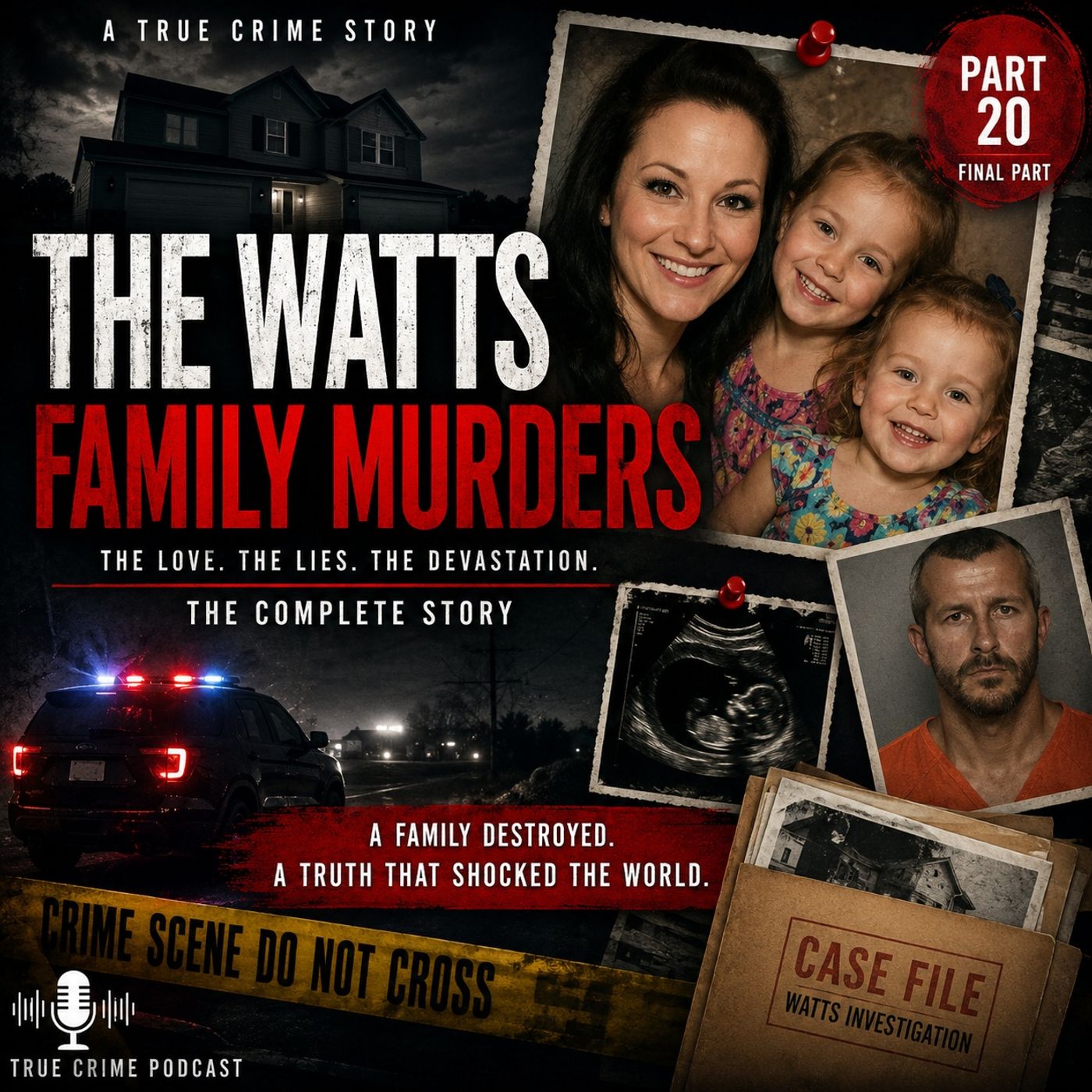
The Watts Family Murders
The Story
In this special closing segment, we go beyond the investigation to explore the lasting lessons of the Watts family murders. From hidden warning signs and the power of forensic science to the importance of communication, compassion, and remembering the victims, this reflection examines what society can learn from one of America's most heartbreaking true crime cases.Become a supporter of this podcast: https://www.spreaker.com/podcast/dark-american-crime--7005371/support.
Thanks for listening to Dark American Crime. The next episode is coming soon.
This episode includes AI-generated content.
The murder of Shawn and Watts and the Watts family the perfect family that wasn't. On the surface, they looked like the perfect American family. A beautiful home in suburban Colorado, two smiling little girls, a husband with a steady job, a wife who regularly shared happy family moments on social media to friends and neighbors. Shawn and Watts and Chris What's appeared to be building the life many people dreamed of. But behind the cheerful photographs and smiling videos, their marriage was quietly falling apart.
No one could have imagined how quickly that ordinary family would become the center of one of the most disturbing murder investigations in modern American history. It was the early hours of August thirteenth, twenty eighteen. The neighborhood of Frederick was silent. Most families were asleep. Street lights cast long shadows across quiet sidewalks. Security cameras recorded nothing unusual. Yet somewhere inside the Watts family home, events were unfolding that would forever change the lives of everyone connected to the family.
By sunrise, three people would be missing. Within days, the entire world would know their names. Thirty four year old. Sean and Watts had spent the weekend on a business trip. Friends described her as energetic, ambitious, and deeply devoted to her daughters. She frequently posted family photographs online, documenting birthdays, vacations, and everyday moments with Bella What's, age four, and Celeste Watt's, age three. The family was also expecting another child, a baby boy they planned to name Nico.
From the outside, the future seemed bright. Chris What's worked for an oil and gas company. Neighbors often described him as quiet, polite, and reserved. He rarely attracted attention. He mowed the lawn, he waved to neighbors. He appeared to be a devoted father. Nothing about his public image suggested that violence investigators would later uncover. In reality, the marriage had become strained. Financial difficulties had created pressure. Communication between the couple had deteriorated. During the summer of twenty eighteen.
Shawnan noticed Chris becoming emotionally distant. He was less affectionate, less engaged. Phone conversations felt cold, messages went unanswered. She confided in close friends that something felt wrong. She feared her marriage was slipping away. While shan Ann was away on her business trip. Chris remained home with their daughters. Unknown to shan And, he had begun a relationship with a coworker. Investigators would later discover that this relationship became a significant part of the timeline they reconstructed.
At the time, however, almost no one knew about it. Friends simply assumed Chris was under stress. In the early morning hours of August thirteenth, shawn And returned home after her flight landed. A close friend drove her from the airport and watched as shan And entered the house shortly before dawn. It was the last verified sighting of shan And alive. Within hours, she would stop answering calls, she would miss a scheduled doctor's appointment, Her phone would fall silent, and those who knew her best would immediately realize something was terribly wrong.
One concerned friend refused to accept the explanations she was given. That decision would trigger an investigation that unraveled with astonishing speed. The friend who refused to walk away. On the morning of August thirteenth, twenty eighteen, shawn And Watts was expected to attend a prenatal doctor's appointment. She never arrived For many people, a missed appointment might not have seemed unusual, but for Shenan's closest friend, Nicole Atkinson, it was immediately alarming. Nicole knew shan And well.
She knew Shan And would never ignore her children it's an important appointment, or suddenly disappear without telling someone something was wrong. Nicole began calling Sean and repeatedly no answer. She sent text messages, no response. She checked social media, there were no new posts. That was unusual. Sean Ann was active online and often shared updates throughout the day. Hours passed in complete silence. Nichole's concern quickly turned into fear. Determined to make sure sean And was safe, Nicole drove to the Watts family home in Frederick.
She knocked on the front door. There was no answer. She rang the doorbell again and again still nothing. Looking around, she noticed s Shenan's car parked in the garage. If the car was there, where was Seawan And and where were the two little girls, Bella, What's and Celeste Watts? Nicole called Chris Watts. He answered. According to investigators, Chris said Sean And had taken the girls on a playdate, but The explain nation didn't satisfy Nicole Sean and had left behind essential items, including her purse and medications.
As someone who was fifteen weeks pregnant, she rarely went anywhere without them. The story simply didn't add up. Realizing the situation could be far more serious than she first believed, Nicole contacted the Frederick Police Department and requested a welfare check. Officer Konrod arrived at the home later that day. Chris also returned from work to meet the officer. First, Chris appeared calm and cooperative. He unlocked the front door and invited the officer inside. Together, they began searching the house.
The search raised more questions than answers. Shenan's shoes were still by the entrance, her purse was inside the home. Her phone was later found wedged between couch cushions. Most concerning, of all, the children's favorite blankets and comfort items had been left behind. To investigators, this did not look like a family that had voluntarily gone out for the day. It looked as though they had vanished suddenly. As Officer Kuonrod looked around the house, he noticed Chris behaving in ways that seemed unusual body camera footage later released to the public captured Chris pacing, speaking nervously and avoiding eye contact at times.
While unusual behavior alone is not proof of a crime, detectives would later compare his actions that day with other evidence collected during the investigation. That body camera recording would become one of the most closely analyzed pieces of footage in modern true crime history. By nightfall, what had begun as a welfare check had become a missing person investigation, and investigators were only beginning to uncover the truth the surveillance footage. By the afternoon of August thirteenth, twenty eighteen, investigators knew they were dealing with something far more serious than a routine missing person case.
Shawn and Watts, Bella Watts, and Celeste Watts had done seemingly vanished without taking their personal belongings. There were no signs of a struggle inside the home, no indication that the family had packed for a trip. Detectives needed a timeline and fast. One of the first places they turned was the neighborhood's security cameras. Chris's next door neighbor, Nathan Trinastick, had a surveillance system pointed toward the street and part of the Watts driveway. He invited investigators into his home to review the footage.
Chris came with them. As the video began to play, the atmosphere in the room changed. The footage showed Chris backing his work truck into the driveway in the early morning hours of August thirteenth. According to Chris, this was unusual because he normally parked on the street. He explained that he was loading tools for work. Investigators watched carefully. The camera did not provide a clear view of everything happening, but it showed Chris moving between the garage and the truck several times.
As the video continued to detectives observed Chris standing silently behind them. Body camera footage from inside Nathan's house later showed Chris appearing increasingly anxious. He folded his arms, shifted his weight, placed his hands on his head, spoke very little. Nathan later remarked that Chris didn't seem like himself. While nervous behavior alone does not prove guilt, detectives noted the contrast between Chris's demeanor and that of someone whose pregnant wife and two daughters had supposedly disappeared.
Investigators also reviewed Chris's phone records and work schedule. They learned that early that morning, he had driven directly to a remote oil field operated by his employer. It was an isolated location with large oil storage tanks. At the time, detectives did not yet know how important that site would become, but they immediately recognized that Chris had been alone there for several hours before anyone realized his family was missing. Meanwhile, volunteers, neighbors, and family members joined the search for Sean and and the girls.
Missing person flyers spread rapidly across social media. Television stations interrupted regular programming with updates. Friends gave emotional interviews pleading for the family's safe return. Chris also appeared before cameras, asking for his wife and daughters to come home. His interviews seemed calm, almost detached. In the days that followed, millions of people would watch those clips, repeatedly, searching for clues that investigators had not yet revealed. Behind the scenes, detectives were quietly assembling a timeline surveillance footage, phone records, witness statements, vehicle data.
Every new piece of evidence pointed back to the same person. The investigation was closing in, and soon detectives would confront Chris what's with evidence that would begin to unravel the carefully constructed story he had been telling cracks in the story. By the second day of the investigation, detectives had spent hours reviewing evidence, every interview, every surveillance recording, every phone record. One fact became increasingly clear. Chris Watts was the last known person to see sean and Watts Bella Watt's and celest What's alive?
That alone did not prove a crime, but detectives began noticing that parts of Chris's story did not match the evidence they were collecting. Chris continued telling investigators that sean And had left the house with the children after an emotional conversation. He claimed he had gone to work as usual and believed his family had simply disappeared. Yet investigators found no evidence that sean And had left in her own vehicle. Her phone, purse, medications, and other personal belongings remained inside the house.
Friends insisted she would never leave without those items, especially while pregnant. Detectives also interviewed Chris's co workers. They confirmed that Chris had visited a remote oil site that morning. Investigators learned he had been alone there for a period of time. That information immediately drew attention because it was unusual for him to visit that location by himself. Detectives began examining GPS data from his work truck to reconstruct every stop he made that morning. At the same time, investigators uncovered another important detail.
Chris had been involved in an extramarital relationship with a coworker. When questioned, he initially minimized the relationship. However, as detectives gathered additional evidence, it became clear that the affair was more serious than he had first admitted. Prosecutors would later argue that this relationship formed part of the broader context and motive presented during the case. On August fifteen, twenty eighteen, investigators asked Chris to take a polygraph examination. He agreed. Before the test, he insisted once again that he had nothing to do with his family's disappearance.
The examination was conducted by a trained investigator who explained the process and asked Chris a series of questions about Sean and and the children. When the test concluded, the examiner informed Chris that the results indicated deception. While polygraph results are generally not admissible as evidence in court, investigators often used them as an investigative tool rather than proof of guilt. Following the examination, detectives confronted Chris with the inconsistencies in his statements.
They urged him to tell the truth. Hours of questioning followed outside the interview room. The search for Sean And and the girls continued inside. Investigators believed they were getting closer to the answers they had been seeking since the welfare check first began. By the end of the day, Chris's story would begin to change and the investigation would take a dramatic and heartbreaking turn. The search at the oil site. After Chris what was taken into custody, investigators acted quickly. His statements, combined with GPS data from his work truck, pointed detectives toward a remote oil and gas facility operated by his employer.
It was an isolated location, surrounded by open fields, far from nearby homes. For investigators, it became the most important crime scene in the case. Search teams, forensic specialists, and investigators arrived at the site. The area was immediately secured. Every movement was carefully documented. Using information gathered during the investigation, Detectives searched the surrounding ground and the large oil storage tanks. Hours later, they made discoveries that confirmed the family's worst fears.
Investigators recovered the body of Shan and Watts in a shallow grave near the oil tanks. Nearby, forensic teams continued searching for Bella Watts and Celeste Watts. The recovery operation was slow and painstaking. Every piece of evidence was photographed, documented, and preserved. The scene would later become a central focus of the criminal case. Medical examiners later conducted autopsies to determine the causes of death. Their findings became critical evidence for prosecutors. Combined with forensic analysis, digital records, and Chris's own statements, investigators believed they had reconstructed the sequence of events leading to the deaths of Sean and and her daughters.
The evidence would eventually be presented in court. News of the discoveries spread rapidly across the United States. Communities that had spent days hoping the family would be found alive were devastated. Flowers, candles, stuffed animals, and handwritten messages began appearing outside the Watts family home. Neighbors gathered in silence. Many struggled to understand how such a tragedy could happen in their quiet community. For detectives, however, the investigation was not over. Recovering the victims was only one part of their work.
They still had to establish a complete timeline, examine every piece of forensic evidence, and prepare a case that could withstand scrutiny in court. They also needed to understand why the murders had occurred. The answers would come through interviews, digital evidence, and eventually Chris What's own admissions. The next chapter will examine the confession, the evidence that supported it, and how prosecutors prepared one of the most closely watched murder cases in recent American history, the confession.
With the recovery of Shawn and Watts, Bella Watts, and Celeste Watts, the investigation entered a new phase. The search was over. Now the focus shifted entirely to proving exactly what had happened and ensuring that the evidence could support a conviction in court. Following hours of questioning, Chris What submitted responsibility for the deaths. His initial account however, was different from the version he would later provide after pleading guilty. As investigators continued gathering evidence, they compared his statements against the forensic findings and the digital timeline.
Where inconsistencies appeared, detectives relied on physical evidence rather than accepting every detail of his account. Investigators reconstructed Chris's movements using GPS records from his work truck, cell phone data, surveillance footage, and witness statements. The evidence showed that in the early morning hours of August thirteenth, twenty eighteen, he drove directly from his home to the remote oil site where the victims were later recovered. That digital trail became one of the strongest pieces of evidence in the case.
Forensic experts carefully examined the Watts family home. Although there were few obvious signs of a violent struggle, Investigators collected biological samples, electronic devices, and other physical evidence. They also analyzed Chris's phone and computer records. Prosecutors argued that the combination of didat, digital and forensic evidence created a clear and consistent timeline. The emotional impact on the victims' families was overwhelming. Relatives who had spent days hoping for a miracle, were now faced with an unimaginable reality.
Community members held vigils in memory of Shaan, end Bella, Celeste, and Shinan's unborn son, Nico. People across the country expressed sympathy and disbelief that such a tragedy had occurred within what had appeared to be an ordinary family. As detectives completed their investigation, prosecutors began preparing formal murder charges. The evidence they intended to present included surveillance, video, phone records, GPS data, forensic examinations, witness testimony, and Chris's own admissions.
Rather than relying on a single confession, they assembled a case supported by multiple independent sources of evidence. The next step would take place inside the courtroom, where Chris Watts would face the consequence of his actions and where the victim's families would finally have the opportunity to speak the court room. In the weeks following the investigation, prosecutors formally charged Chris What's with multiple counts of murder, unlawful termination of a pregnancy in connection with the death of Sean and Watts's unborn son, Nko, and other related offenses.
The evidence against him was substantial. Investigators had gathered surveillance footage, GPS records, forensic evidence, witness statements, and his own admissions. As the case moved through the court system, public attention intensified. News organizations covered every hearing. People across the United States followed the proceedings, trying to understand how a husband and father could commit such devastating crimes. Outside the courthouse, reporters gathered daily, while inside, the victim's families prepared for one of the most painful moments of their lives.
Facing overwhelming evidence, Chris What's ultimately entered guilty pleas rather than proceeding to a full trial. By doing so, he avoided the possibility of a death penalty trial. The court accepted his pleas after ensuring they were entered knowingly and voluntarily. Although there would be no jury trial, the legal process continued with a sentencing hearing. During sentencing, the court room became a place of profound emotion. Members of Shnan's family spoke directly about the devastating impact of losing Shan and Bella Watts, Celeste Watts, and unborn Nico.
Their statements described not only the immense grief they carried, but also the love they continued to have for the victims. Many people present struggled to hold back tears. The judge sentenced Chris What's to multiple consecutive life sentences without the possibility of parole. The sentence ensured that he would spend the remainder of his life in prison. For the families, the sentence brought legal finality, though it could never undo the profound loss they had had experienced. Justice had been served through the courts, but the emotional wounds remained.
Even after sentencing. Investigators continued reviewing the case to ensure the record accurately reflected the evidence. The Watts family murders became one of the most studied criminal investigations in recent American history, with law enforcement agencies using aspects of the investigation as an example of how digital evidence, forensic science, and traditional detective work can work together. The next chapter explores what investigators later learned, the public's continuing fascination with the case, and the lasting legacy left by one of America's most heartbreaking family tragedies.
Searching for a motive after Chris Whats was sentenced to multiple life terms without the possibility of parole. One question continued to haunt investigators and the public. Why the evidence had established what happened. The legal process had reached its conclusion, but understanding the motive behind them and the murders proved far more difficult. During the investigation, detective's uncovered evidence that Chris had been involved in an extramarital relationship with a coworker. Phone records, messages, and financial records showed that the relationship had become increasingly serious in the weeks before the murders.
Prosecutors presented this evidence as part of the broader context of the case, arguing that Chris appeared to be pursuing a new life while his marriage to Sean and whats was deteriorating. There was no evidence that the coworker participated in or knew about the crimes before they occurred. Financial records also revealed that the Watts family had experienced financial difficulties. Like many families, they faced debt and economic pressure. Investigators considered whether these stresses formed part of the overall picture.
However, prosecutors did not argue that financial problems alone explained the murders. Instead, they suggested that multiple factors, including the affair and the desire for a different future, provided context for Chris's actions. Friends later described noticeable changes in Chris during the weeks leading up to the crimes. Some said he seemed emotionally distant. Others noticed he had become unusually quiet. At the time, few imagined those changes were connected to something far more sinister.
Only after the investigation began did those observations take on new meaning. Investigators emphasized that no single motive can fully explain crimes of this nature. Human behavior is often complex, and criminal investigations rely on evidence rather than speculation. The court's role was not to answer every psychological question, but to determine whether the evidence proved the criminal charges beyond a reasonable doubt. In Chris What's case, the court concluded that it did. The murders of Bella Watts, Celeste Watts, Shawn and Watts, and unborn Nico shocked people around the world because they shattered assumptions about safety within the family home.
The case became a reminder that appearances can be deeply misleading, and that serious domestic violence can remain hidden from public view. The next chapter will examine the aftermath of the case, the impact on the victims' families, and how the investigation continues to influence true crime discussions and criminal justice training the aftermath. After the sentencing of Chris Watts, the criminal case was legally over, but for the families of Shawn and Watts, Bella Watts, Celeste Watts, and unborn Nico, life would never be the same.
The court room had delivered justice could not restore what had been lost. The Watts family home in Frederick became a symbol of the tragedy. For months, people left flowers, candles, stuffed animals, and handwritten messages outside the property. Neighbors who had once seen children playing in the yard now struggled to comprehend what had happened behind the front door. The quiet neighborhood would forever be associated with one of America's most heartbreaking Fais family murder cases. Schnan's parents and brothers spoke publicly about their daughter and grandchildren.
They described sean And as hard working, loving, and deeply devoted to her children. They remembered Bella as gentle and caring, while Celeste was known for her playful energy and infectious smile. Rather than allowing the victims to be remembered only through the crime. The family encouraged people to celebrate their lives. Investigators also reflected on the case. What began as a routine welfare check quickly became a complex homicide investigation. The rapid response by Nicole Atkinson, the cooperation of neighbours, surveillance footage, GPS data, forensic science, and detailed interviews all played essential roles in solving the case within days.
Detectives later noted that every small detail mattered. The case became a powerful example of how digital evidence can support traditional police work. Surveillance cameras documented movements, GPS records traced vehicle locations, cell phone data established timelines, witness statements confirmed key events. Together, those independent pieces of evidence created a compelling picture that supported the prosecution's case. Even years later, the murders of Sean and Bella, Celeste and Nico continue to be discussed in documentaries, books, and criminal justice courses.
The case reminds investigators that appearances can be deceptive and that careful, evidence based investigation is essential in uncovering the truth for the victims loved ones. However, the most important lesson is simpler. Behind every true crime story are real people whose absence is felt every single day. The next chapter will explore the lasting legacy of the Watts case, its impact on law enforcement, and why it continues to captivate audiences around the world. The legacy of the Watts case.
Years after the murders, the case of Chris What's remained one of the most widely discussed true crime investigations in the United States. The story continued to draw attention not because of mystery the legal case had been resolved, but because people struggled to understand how a seemingly ordinary family could experience such an unimaginable tragedy. For law enforcement, the investigation became an example of how quickly a missing person case can develop into a homicide investigation. The prompt actions of Nicole Atkinson, who refused to ignore Shenan's unusual silence, proved crucial.
Had she waited another day to report her concerns, valuable evidence and investigative opportunities might have been lost. Detectives later acknowledged that her persistence helped accelerate the investigation during its most critical hours. The case also highlighted the growing importance of technology in criminal investigations. Investigators relied on surveillance camera footage, GPS data from Chris's work truck, cell phone rads, digital communications, witness interviews, forensic examinations.
Each source contributed another piece to the timeline, allowing detectives to verify facts rather than rely on assumptions. The victim's families continued to encourage the public to remember Shan and Watt's Bella Watts, Celest Watts, and unborn Nico as individuals with hopes, personalities, and dreams. They asked that the victims not be overshadowed by the notoriety of the offender. Their message resonated with many people who followed the case. Criminal justice professionals have also studied the investigation because of its speed.
Within only a few days, detectives had moved from a welfare check to a complete reconstruction of the crime through physical evidence, digital records, and interviews. The case demonstrated how modern investigative techniques can rapidly uncover the truth when multiple forms of evidence are carefully combined. Today, the Watts case remains one of the defining family homicide investigations of the twenty first century. It serves as a reminder that public appearances can be misleading, that domestic violence can remain hidden, and that early reporting by concerned friends or relatives can make a critical difference.
As the series continues, the remaining chapters will explore the broader impact of the case, the lessons learned by investigators, and how the memories of Shan end, Bella, Celeste, and Nico continue to be honored remembering the victims. As the media attention gradually faded, one message continued to come from the family of Shan and whats remember the victims, not just the crime. The case had become one of the most talked about true crime stories in America, but behind every headline were four innocent lives that could never be replaced.
For those who loved them, that was what mattered. Most friends described sean And as determined, outgoing, and deeply committed to her family. She worked hard to build a future for her her children and often shared moments of their everyday lives on social media. Birthdays, school activities, family vacations, simple moments at home. Looking back, those posts became a record of happier times before everything changed. Bella, What's just four years old, was remembered as gentle thoughtful and protective of her little sister.
Family Members recalled her bright, smile and caring personality. She loved singing, spending time with her parents, and making people laugh. Those who knew her remembered a child full of curiosity and kindness. Three year old Celeste Watts, affectionately known as Ceci, was energetic, fearless, and playful. She filled every room with laughter. Relatives often described her as the family's little comedian, always smiling and always ready for an adventure. Her joyful personality left a lasting impression on everyone she met.
Shann An was all so expecting a baby boy, Nico. Although he was never born, his family considered him an important part of their lives. His loss became another heartbreaking element of the case and was recognized during the legal proceedings. In the years since the murders, Schnan's family has spoken publicly about healing, remembrance, and resilience. They have thanked investigators, prosecutors, friends, neighbors, and complete strangers who supported them throughout the investigation. While the pain has never disappeared, they have remained committed to honoring the memories of Sean, Bella, Celeste, and Nico with dignity and love.
The Watts case is often remembered because of its shocking facts, but its most enduring lesson is that every victim had a life, a personality, and dreams for the future. The headlines eventually fade, the documentaries end, the court room grows quiet, Yet for the families left behind, the memories remain every single day. With seven parts remaining, the series now shifts toward the lasting legacy of the investigation, the lessons it offers to law enforcement, and why it continues to be studied around the world.
A case that changed modern true crime. By the time the legal proceedings had ended, the murders of Shan and Watts, Bella Watts, Celeste Watts, and unborn Nico had become one of the most extensively documented true crime cases in recent history. Unlike many older investigations, much of this case unfolded in real time body camera footage, home surveillance videos, television interviews, court documents. Thousands of people followed each development as investigators revealed new evidence. One reason the case attracted such extraordinary attention was the contrast between appearance and reality.
To neighbours, the Watts family looked ordinary they lived in a quiet neighborhood, They celebrated birthdays, they posted family photos. Nothing publicly suggested that within days the family would become the focus of an international homicide investigation. The contrast left many people asking how warning signs can remain hidden even from those living nearby. Investigators later pointed to several aspects of the case as examples of effective police work. The rapid welfare check requested by Nicole Atkinson, the preservation of surveillance footage from neighbors, the use of GPS data from Chris Watts's work truck, the careful comparison of witness statements with digital evidence.
Each step strengthened the investigation and help detectives build a timeline supported by multiple independent sources. The case also highlighted the importance of victim advocacy. Throughout the investigation and legal proceedings, Chinan's family consistently emphasized that the focus should remain on the victims rather than on the offender. They encouraged media organizations and the public to remember Shenan's kindness, Bella's gentle nature, celests joyful personality, and the unborn child Nico, whose life never had the chance to begin.
Today, the Watts investigation is frequently discussed in criminal justice education, forensic science courses, and true crime media. It demonstrates how digital evidence, forensic analysis, and coordinated investigative work can quickly transform a missing person report into a successful homicide prosecution. It also serves as a reminder that domestic violence can exist behind closed doors, even when a family outwardly appears happy. Years have passed, but the lessons remain. Investigators continue to study the methods used during the case, families continue to honor the memories of those who were lost, and the public continues to reflect on a tragedy that forever changed one Colorado community.
With six chapters remaining, the story now turns to the broader impact of the case on life, law enforcement, public awareness, and the enduring search to understand why such tragedies occur lessons from the investigation. As the years passed, the Watts family murders became more than a headline for investigators, prosecutors, and criminal justice professionals. The case became a study in how modern homicide investigations are conducted. Every stage from the first welfare check to the final sentencing demonstrated the importance of acting quickly, preserving evidence, and following the facts wherever they lead.
One of the earliest lessons came from the actions of Nicole Atkinson. She noticed that Sean and Watts had missed a doctor's appointment, stopped answering calls, and left behind personal belongings she would never normally abandon. Rather than dismissing those warning signs, Nicole contacted police immediately. Investigators have often noted that her quick action helped preserve valuable evidence during the crucial first hours of the case. The investigation also high highlighted the growing importance of digital evidence.
Detectives reconstructed events using surveillance footage, GPS records from Chris Watts's work, vehicle, cell phone data, electronic communications, and witness statements. Instead of relying on one piece of evidence, they assembled a detailed timeline from many independent sources. That careful approach strengthened the prosecution's case and reduced the need to rely solely on admissions or eyewitness testimony. The case further demonstrated the value of collaboration. Local police officers, forensic specialists, prosecutors, crime scene investigators, and analysts worked together throughout the investigation.
Each discipline contributed expertise that helped establish the sequence of events and prepare the evidence for court. Their coordinated efforts resulted in a comprehensive and well documented case for the victims' families. However, the most important lesson was deeply personal. They have repeatedly incouraged people to recognize the signs of unhealthy relationships, to support those experiencing difficulties, and to remember that behind every true crime story are real families coping with unimaginable loss.
They continue to honor the memories of Sean and Bella, Celeste and Nico through remembrance rather than sensationalism. Today, the Watts case remains one of the most widely studied family homicide investigations in modern America. It is remembered not only because of the crimes themselves, but because of the investigation that followed, an investigation that combined persistence, technology, forensic science, and teamwork to uncover the truth. As the series continues, the remaining chapters will explore the lasting public impact of the case, the continuing interest from researchers and documentary makers, and the enduring legacy left by the victims.
The lasting impact. Years after the convictions, the Watts family murders continue to resonate far beyond. The case is no longer just remembered as a criminal investigation. It has become a lasting reminder of the devastating consequences of domestic violence and the importance of recognizing warning signs before tragedy occurs. For law enforcement, the investigation demonstrated the value of treating every missing person report seriously. What began as a welfare check quickly became a homicide investigation because officers carefully documented the scene, preserved evidence, and questioned inconsistencies instead of making assumptions.
The swift response by police, combined with the persistence of Nicole Atkinson, played a critical role in the outcome of the case. The investigation also highlighted the role of technology in modern policing. Security camera footage, GPS data, cell phone records, digital messages, vehicle tracking systems each provided independent evidence that helped investigators verify timelines and challenge false statements. Together, those records created a detailed picture of events that supported the prosecution's case for Shawn and Watts's family.
The years since the tragedy have been devoted to preserving the memories of Shan and Bella Watt's Celeste Watts and unborn Nico. They have continued speaking publicly about love, resilience, and the importance of supporting victims of domestic abuse. Their message has remained consistent, remember the lives that were lost, not just the crime that took them. The case has also influenced conversations about how family violence is portrayed in the media. Experts have encouraged responsible reporting that focuses on verified facts, avoids unnecessary sensationalism, and respects the dignity of victims and their families.
The Watts investigation is often cited as an example of why evidence, not speculation, should remain at the center of public discussion. Today, criminal justice students, detectives, forensic analysts, and psychologists continue to examine the case from different perspectives. It offers lessons about investigative techniques, digital evidence, victim advocacy, and the complexities of family homicide. While no investigation can erase the pain suffered by those left behind, the work of investigators ensured that the truth was uncovered and presented in court.
With four chapters remaining, the series will now examine the enduring public interest in the Watts case, the continued efforts to honor the victims, and the lasting lessons that continue to shape modern criminal investigations. Why the case still matters More than six years after the murders, The Watts family case continues to be discussed in documentaries, books, podcasts, and criminal justice classrooms. Unlike many high profile investigations, the facts of the case were established through the legal process, yet people continue to revisit it because they are searching for answers to a question that has never been easy to understand, and how could a family that appeared so ordinary end in such extraordinary tragedy.
Investigators have often pointed to the case as an example of why evidence must guide every investigation. Public opinions shifted rapidly as new information emerged, but detectives focused on facts. They compared surveillance footage with GPS records. They examined phone data alongside witness statements. They tested physical evidence rather than relying on assumptions. That methodical approach ensured that the case presented in court rested on verifiable evidence. The case also reinforced the importance of community involvement.
If Nicole Atkinson had ignored her concerns, or if neighbors had not cooperated with investigators by providing surveillance footage, the investigation might have taken much longer. Instead, concerned friends and helpful neighbors became an important part of the search for the truth. For the family of Shawn and Watts, the goal has always been to ensure that Shawn is Bella Watts, Celeste Watts, and unborn Nico are remembered for the joy they brought to others, not solely for the circumstances of their deaths.
Their memories continue to inspire acts of kindness, remembrance, and support for families affected by violence. The Watts investigation also changed public expectations of modern police work. People saw how body camera footage, digital records, forensic science, and careful interviewing could be combined to reconstruct events with remarkable precision. The case demonstrated that even when a suspect attempts to conceal the truth, evidence often tells its own story. Although the legal proceedings have concluded, the lessons remain.
The investigation reminds us of the importance of listening to concerns raised by loved ones. Responding quickly when someone unexpectedly disappears, and allowing facts, not rumors, to guide conclusions. It is a case remembered not only for the crimes committed, but also for the determ termination of investigators and the resilience of a family that continues to honor the lives of those they lost. The legacy beyond the headlines. When the television cameras left Frederick, life slowly returned to normal for the community.
But for the families of Shawan and Watts, Bella Watts, Celeste Watts, and unborn Nico, there would never be a return to the life they once knew. The headlines faded, the grief remained. In the years that followed, the case became one of the most referenced examples of family homicide in modern America. Universities discussed it in criminal justice courses, investigators reviewed it during training. Forensic specialists examined the role that digital evidence played in solving the crimes. The investigation demonstrated how multiple forms of evidence, rather than one dramatic breakthrough, can reveal the truth.
One of the most enduring aspects of the case is the importance of ordinary people taking action. Nicole Atkinson trust, did her instincts when something felt wrong. Neighbors willingly shared surveillance footage, coworkers cooperated with investigators. Each person's contribution became part of a much larger investigation that ultimately brought justice. The case also changed the way many people viewed social media. The Watts family had shared countless happy moments online. Looking back, those images represented only a small part of their lives.
The investigation reminded the public that social media rarely tells the complete story of a person's circumstances, and that appearances can be misleading. For the victims, loved ones, remembrance became more important than publicity. They continued speaking about Shenan's determination, Bella's gentle heart, celeste joyful spirit, and the hopes they had for baby Nico. Their message remained clear, the victims deserved to be remembered as people with dreams, personalities, and futures, not simply as names in a criminal case.
Today to day, the Watts family murders remain one of the defining true crime investigations of the twenty first century. The case is remembered for the speed of the investigation, the strength of the forensic and digital evidence, and the dedication of detectives who patiently reconstructed the truth. Most importantly, it serves as a reminder that behind every criminal investigation are real families whose lives are forever changed. With two chapters remaining, the series now turns to the final reflections on the case, the lessons it continues to teach, and the enduring legacy of those whose lives were tragically cut short.
The lessons that endure years after the investigation concluded. The murders of Shan and Watts, Bella Watts, Celeste Watts, and unborn Nico continue to be remembered, not only because of the tragedy itself, but because of the lessons the case left behind for investigators. It demonstrated the importance of responding quickly to missing person reports and preserving every peace use of potential evidence. What initially appeared to be a disappearance became a solved homicide investigation in just a matter of days through careful, methodical police work.
One of the clearest lessons is the value of persistence. When Nicole Atkinson realized something was wrong, she refused to dismiss her instincts. She continued calling. She drove to the house, she contacted police. Her determination ensured that officers became involved before valuable evidence could disappear. Investigators have repeatedly acknowledged how significant those early actions were. The case also demonstrated how modern technology has transformed criminal investigations. GPS tracking, home surveillance cameras, cell phone records, digital messages, electronic data from vehicles.
Each provided investigators with independent ways to verify events. Rather than relying on speculation, detectives built a timeline supported by objective evidence. That approach became one of the defining strengths of the prosecution. The investigation further highlighted the importance of cooperation. Police officers, forensic scientists, prosecutors, crime scene specialists, and analysts work together throughout the case. Neighbors shared surveillance footage, co workers answered investigators questions.
Family members provided critical background information. Every contribution helped investigators assemble a complete picture of what had occurred. For the victims loved ones, However, the greatest lesson has always been about remembrance. They continue encouraging people to remember Shenan's compassion, Bella's kindness, celeste joyful personality, and the future that unborn Nico never had the chance to experience. Their names deserved to be remembered with dignity, not only because of how they died, but because of how they lived.
Today. The Watts investigation remains a powerful rems that the truth often emerges through patience, evidence, and determination. It stands as one of the most significant family homicide investigations in recent American history and continues to influence discussions about domestic violence, forensic investigation, and victim advocacy. Only one chapter remains in the final part will reflect on the complete story, the justice achieved through the legal system, and the enduring legacy left by Shan and Bella, Celeste and Nico.
The final reflection a legacy that cannot be forgotten. The story of Shawn and Watts, Bella Watts, Celeste Watts, and unborn Nico is one that continues to leave a lasting mark on everyone who learns about it. It began as a desperate search for a mother and her two young daughters. A family home that once appeared ordinary became the center of a heartbreaking investigation that revealed a devastating truth. Within days, investigators on covered what had happened, but the consequences of that discovery would continue for years.
The case was no longer only about finding missing people. It became about understanding warning signs, seeking justice, and remembering the lives that were taken For law enforcement, the Watts investigation became an example of how a case can be solved through dedication, evidence and teamwork. Detectives carefully examined every detail. They followed, every lead they questioned inconsistencies. They refused to accept answers that did not match the evidence. Through their work, the timeline of events was reconstructed, allowing the victim's families and the public to understand the truth.
In the court room, justice was delivered through the legal system. The evidence presented showed the severity of the crimes and the devastating impact on the victim's loved ones. The case also sparked conversations around domestic violence, manipulation, and the hidden struggles that can exist behind closed doors. Many people who followed the investigation reflected on how important it is to recognize changes in behavior, trust concerns when something feels wrong, and offer support to those who may be facing difficult situations.
But beyond the investigation, beyond the headlines, and beyond the court proceedings, there were four lives that mattered. Shannan was a mother who loved her children and shared much of her life with others. Bella was remembered as a caring and thoughtful young girl who loved her family. Celeste was remembered for her energy, laughter, and playful spirit. Nko represented a life full of possibilities that would never be realized. They were more than victims in a criminal case. They were people with dreams, personalities, and futures.
Years later, their story remains a reminder of how quickly life can change and how important it is to value the people around us. The investigation may have ended, the court case may have concluded, but remembrance continues. Families affected by similar tragedies continue to speak about awareness and prevention, Advocates continue working to support victims of domestic violence, and people continue learning from the painful lessons left behind by this case. The Watts family murders remain one of the most tragic criminal cases in modern American history.
A story that began with unanswered questions ended with a search for truth. A story that brought unimaginable pain also brought important conversations about safety, awareness, and justice. The names Sean and Bella, Celeste and Nico will forever remain connected to a tragedy, but they should also remain connected to the lives they lived and the memories they left behind. The investigation is complete, the evidence has been examined, the verdict has been reached, but the echoes of this case continue because behind every crime story are real people, real families, real memories, and real lives that can never be replaced.
Extended analysis beyond the headlines Understanding the lasting impact of the Watts Family murders. When a true crime case captures worldwide attention, it is easy for the focus to remain on the shocking details of the crime itself. However, some of the most valuable lessons come not from the crime, but from understanding the broader issues it reveals. The Watts Family murders continue to be studied by investigators, psychologists, criminologists, domestic violence advocates, and the general public because they raise difficult questions about trust, relationships, communication, and the hidden struggles that can exist behind seemingly ordinary lives.
One of the most significant lessons from this case is that appearances can be deeply misleading. In today's digital world, many families share carefully selected moments Online. Photos of vacations, birth days, anniversaries, and smiling children often create the impression that everything is perfect, But social media rarely tells the complete story, captures moments, not the complexities of everyday life. This case reminds us that no one truly knows what happens behind closed doors. It also reminds us to avoid making assumptions about other people's lives based solely on what we see online.
Every family faces challenges, and some struggles remain invisible to friends, co workers, and even close relatives. Another important lesson involves communication within relationships. Every relationship experiences disagreements, financial stress, career pressures, and emotional challenges. Healthy relationships depend on honest communication, mutual respect, patience, and a willingness to seek solutions together. When problems are ignored instead of addressed, resentment can grow over time. While conflict itself is normal, learning healthy ways to resolve conflict is essential.
Experts frequently encourage couples to seek professional counseling when communication breaks down. Asking for help should never be viewed as weakness. Marriage counselors, therapists, and support groups exist because many relationship problems can be addressed before they become overwhelming. Although counseling cannot solve every situation, open communication and professional guidance often provide healthier paths forward than silence or avoidance. The case also highlights the importance of emotional honesty.
Many people struggle silently with stress, anxiety, financial pressure, or feelings of dissatisfaction. Some fear judgment and choose not to discuss their emotions with family or friends. While privacy is understandable, complete emotional isolation can make problems feel even larger. Developing trusted support systems, whether through family members, close friends, counselors, or faith communities, can provide perspective during difficult periods. Another lesson concerns financial pressure. Financial difficulties are among the most common sources of stress in households around the world.
Debt, employment, uncertainty, housing expenses, and family responsibilities can place enormous strain on relationships. Financial stress alone does not cause violent crime, but unmanaged stress can negatively affect decision making and emotional well being. Creating realistic financial plans, seeking professional advice when necessary, and communicating openly about money are healthy ways to reduce tension. The investigation also demonstrates the extraordinary role of modern forensic science. Criminal investigations today rely on much more than eyewitness testimony.
Digital evidence often provides objective records that are difficult to dispute. Surveillance cameras, GPS data, mobile phone records, internet activity, vehicle tracking systems, and electronic communications have transfer formed modern policing. Investigators now reconstruct timelines with remarkable precision, making it increasingly difficult for offenders to conceal their actions. This case is frequently discussed in criminal justice education because it illustrates how numerous small pieces of evidence can fit together like a puzzle.
No single clue solved the investigation. Instead, detectives combined witness interviews, forensic analysis, digital records, surveillance footage, and careful observation to establish the truth. The importance of community awareness cannot be overlooked. One person's decision to act quickly can sometimes make a significant difference. Family members, neighbors, coworkers, and friends are often the first to notice when something appears unusual. While it is important not to jump to conclusions, reporting genuine concerns promptly can assist authorities in protecting vulnerable individuals and preserving critical evidence.
The case also serves as a reminder that that victims deserve to be remembered as people rather than headlines. True crime stories can sometimes unintentionally focus more attention on offenders than on those whose lives were lost. Ethical storytelling places victims at the center of the narrative. Their dreams, personalities, relationships, and accomplishments deserve to be remembered with dignity and compassion. Responsible true crime content should also avoid sensationalism. The purpose of discussing these cases should not be entertainment built upon tragedy.
Instead, true crime can educate listeners about investigative procedures, legal systems, victim advocacy, and public safety. When approached respectfully, these stories help society learn from past events while honoring those affected. Psychologists often explain that human behavior is rarely simple. Complex combinations of personality, stress, relationships, decision making, and individual circumstances influence actions. However, understanding these factors should never be confused with excusing criminal behavior.
Accountability remains a fundamental principle of justice. Courts may examine motive, but motive never justifies violence. The Watts case also reminds us of the lasting impact crime as on surviving family members. Even after investigations end and court proceedings conclude, loved ones continue living with grief. Birthdays, holidays, anniversaries, and family gatherings become permanent reminders of those who are missing. Justice may provide legal closure, but emotional healing is often a lifelong journey for society as a whole.
Perhaps the greatest lesson is the importance of empathy. We rarely know what burdens another person may be carrying Simple acts of kindness. Checking in on loved ones, listening without judgment, and encouraging healthy conversations can strengthen relationships and build supportive care communities. Finally, this case reinforces the value of truth. During every criminal investigation, rumors, speculation, and misinformation often spread rapidly. Investigators must separate facts from assumptions using evidence rather than emotion.
This careful commitment to truth protects both victims and the integrity of the justice system. As listeners reflect on this story, the lasting takeaway should not simply be the tragedy itself, but the importance of communication, compassion, accountability, community awareness, and respect for human life. While no lesson can undo what happened. Understanding these principles may help create safer families, stronger communities, and greater appreciation for the people we love. That may be the most meaningful legacy any true crime story can leave behind.
Not fear but awareness, not sensationalism but understanding, And not only remembrance of a terrible crime, but renewed commitment to protecting and valuing human life.
 Apple Podcasts
 Castbox
 Castro
 Goodpods
 Moon FM
 Overcast
 Pocket Casts
 Podbean
 Podcast Addict
 Podcast Republic
 Spotify