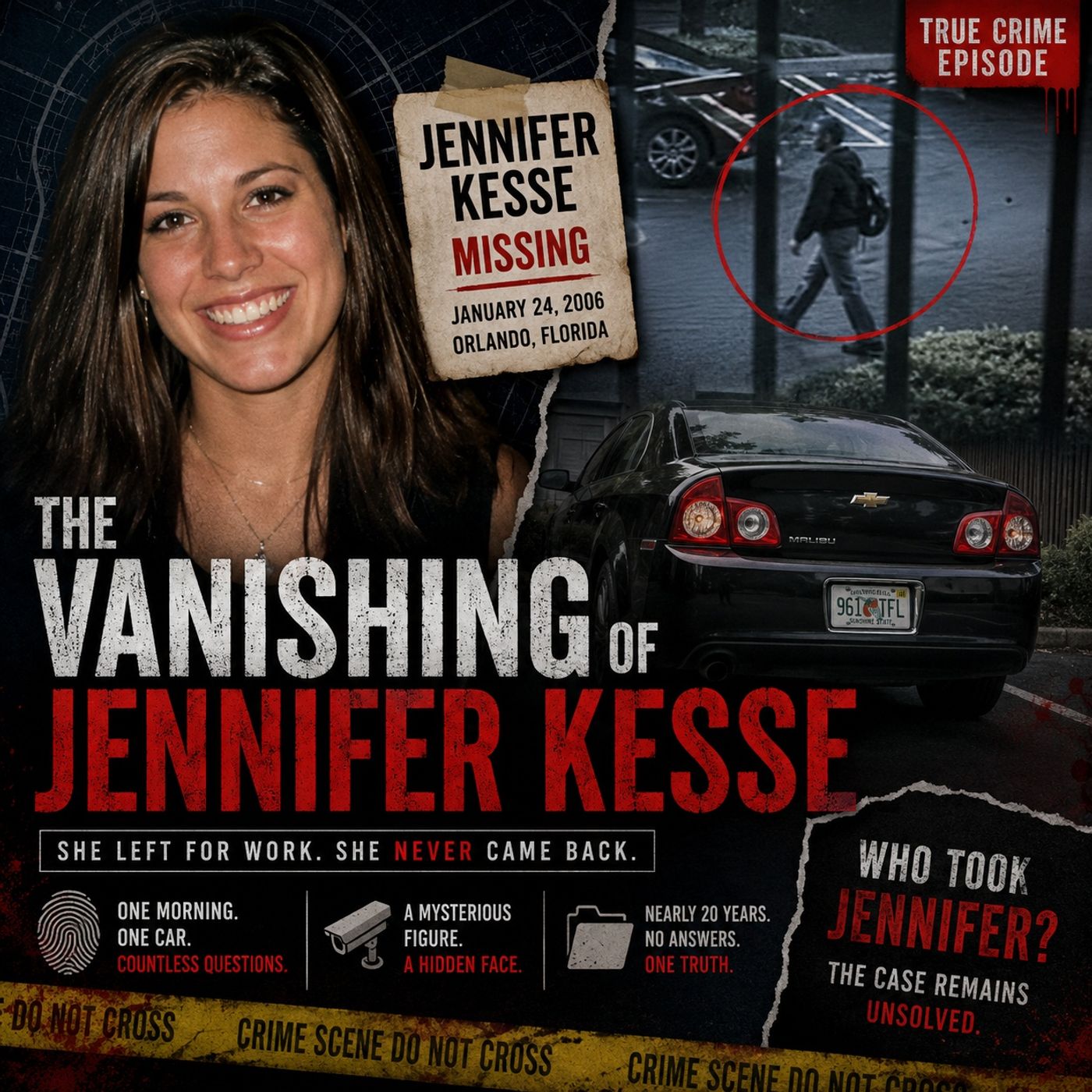
The Vanishing of Jennifer Kesse
The Story
Jennifer Kesse left for work on an ordinary morning in 2006—and vanished without a trace. Her abandoned car and a mysterious figure caught on surveillance became the only clues in one of America's most chilling unsolved disappearances. Who took Jennifer, and what really happened that day?Become a supporter of this podcast: https://www.spreaker.com/podcast/dark-american-crime--7005371/support.
Thanks for listening to Dark American Crime. The next episode is coming soon.
This episode includes AI-generated content.
The Jennifer Kess disappearance, Orlando, Florida, two thousand and six. January twenty fourth, two thousand and six began like any other Tuesday in Orlando, Florida. The city was waking up beneath a clear winter sky. Commuters filled the roads, coffee shops opened their doors, and office workers prepared for another ordinary day. For twenty four year old Jennifer Kess, it should have been another routine morning. Instead, it would become the day she vanished without a trace. Jennifer had everything many young professionals dreamed of.
She had recently purchased her own condominium at the Mosaic at Millennia, was building a successful career in finance, and had a close relationship with her family and longtime boyfriend. Friends described her as responsible, organized, and dependable. She wasn't someone who disappeared unexpectedly. Just two days earlier, Jennifer had returned from a romantic vacation to the US Virgin Islands with her boyfriend, Rob Allen. They had talked about their future together, and Jennifer seemed excited to get back to work.
On Monday, January twenty third, she completed a normal work day before returning to her condominium. That evening, she spoke with Rob on the phone, as they often did. She also talked with her parents. Nothing about those conversations suggested fear or concern. Jennifer mentioned that some construction workers were renovating vacant units around her condominium complex. She had previously told family members that a few workers had made her feel uncomfortable, but she didn't indicate that she believed she was in immediate danger.
After saying good night, Jennifer went to bed. It was the last confirmed contact anyone would ever have with her. The next morning, Jennifer was expected at work. She never arrived. At first, her coworkers assumed she was running late, but as the hours passed, concern grew. Calls to her cell phone went unanswered. By that afternoon, her employer contacted her family. Jennifer's parents immediately sensed something was terribly wrong. Their daughter always answered her phone. She was punctual, responsible, reliable.
Missing work without telling anyone was completely out of character. Without hesitation, her parents drove more than two hours from their home toward Orlando. When they arrived at Jennifer's condominium, they were met by an unsettling scene. Her car was gone. Inside the condo, everything appeared normal. There were no signs of a struggle. Her bed looked as though she had slept in it. Clothes were laid out for work. Her purse, keys, and cell phone were missing, as if she had simply left for the office, but she never got there.
As daylight faded, Jennifer Keuss had officially become a missing person. No one knew where she had gone, no one had seen what happened, and somewhere in her landendo a mystery had already begun, one that would baffle investigators, frustrate her family, and become one of the most haunting unsolved disappearances in American history. As soon as Jennifer Kes's family realized something was wrong, they refused to waste precious time. They knew Jennifer. She wasn't impulsive, She wasn't someone who would simply disappear without telling anyone.
Every passing hour made them more certain that something terrible had happened. When they entered Jennifer's condominium, they searched every room, hoping to find some explanation. Instead, they found only questions. The apartment looked almost exactly as Jennifer had left it the night before. The bed had been slept in. Her makeup and toiletries suggested she had gotten ready for work that morning. A damp towel lay in the bathroom, indicating she had likely taken a shower before leaving. Nothing appeared broken or disturbed.
There was no sign of a struggle. To invest instigators, it looked as though Jennifer had started another ordinary work day. Then somewhere between her front door and her office, she vanished. Police officially began investigating her disappearance. The first priority was to establish a timeline. Jennifer had spoken with her boyfriend Rob Allen on the evening of January twenty third. She had also spoken with her parents. After those calls, no one could confirm seeing or hearing from her again. Detectives questioned neighbors, coworkers, and friends.
No one reported anything unusual. No one remembered hearing screams or signs of a confrontation that morning. Then investigators made another troubling discovery. Jennifer's car was missing. If she had driven to work, where was it. If someone had taken her, had they also taken her vehicle? Search teams began looking throughout Orlando. Days passed without an answer. Then, nearly two days after jan Jennifer disappeared, a breakthrough finally came. A resident at the Huntington on the Green apartment complex noticed an unfamiliar black Chevrolet Malibu parked in the lot.
The vehicle had been sitting there without moving. Police were called. When officers checked the license plate, they confirmed it belonged to Jennifer Keuss. The discovery brought both hope and fear. If her car had been abandoned, perhaps it contained evidence. Crime scene investigators carefully processed the vehicle inside, they found surprisingly little. There were no obvious signs of violence, no clear forensic evidence pointing to a suspect. The car appeared to have been wiped clean. Detectives recovered only a few fingerprints and traces of DNA, but none provided a definitive lead.
Then they learned something even more important. A nearby surveillance camera had recorded the moment someone parked Jennifer's car. The footage was grainy and taken from a distance, but it showed an unknown individual walking away from the vehicle shortly after parking it. Investigators believed this person could be responsible for Jennifer's disappearance, or at the very least knew exactly what had happened to her. But there was one extraordinary problem. Every time the person walked past a fence post, the camera captured an image, and by incredible coincidence, each frame obscured the person's face behind one of the fence posts.
The surveillance video had captured the suspect's body, but never a clear view of the face. It was a one in a million twist that would become one of the most frustrating pieces of evidence in modern true crime. The mystery had only deepened. Jennifer was still missing, her car had been recovered, possible suspect had been caught on camera, yet investigators still had no name, no motive, and no idea where Jennifer Quss had gone. The surveillance footage quickly became the most important piece of evidence in Jennifer Kes's disappearance.
Investigators watched it over and over again. The video was recorded on the afternoon of January twenty sixth, two thousand and six, at the Huntington on the Green apartment complex, nearly two days after Jennifer was last seen. It showed a lone person calmly parking Jennifer's black Chevrolet Malibu. The individual stepped out, locked the car, and walked away. There was no sign of panic, no indication they were in a hurry. It was as if abandoning the vehicle had been carefully planned. Detectives believe the person on the video was either responsible for Jennifer's disappearance or had direct knowledge of what had happened to her, but identifying that person proved almost impossible.
The security camera was designed to take still images at regular intervals rather than continuous video. By an astonishing coincidence, every image captured the person as they passed behind one of the property's fence posts. Each photograph blocked the face almost perfectly. Investigators later estimated the odds of this happening were extraordinarily small. The one feature they needed most, the person's face, was never visible. Police released the footage to the public, hoping someone would recognize the person's clothing, build or manner of walking.
Thousands of tips poured in. People from across the country studied the images. Some believed the individual was a man, Others thought it could have been a woman. Experts analyzed the person's height based on the fence and nearby objects, estimating they stood somewhere between five feet three inches and five feet five inches, but even that estimate wasn't enough to identify anyone. Meanwhile, detectives returned to Jennifer's condominium. They searched every inch of the property again, they examined the parking lot, where Jennifer normally kept her car If she had left for work that morning.
Investigators believed something likely happened before she could drive very far. There were no signs of a violent struggle in the parking area, no obvious bloodstains, no witnesses who reported hearing screams. It was as though Jennifer had vanished into thin air. Attention then turned to the construction workers renovating vacant units at the Mosaic at Millennia condominium complex. Jennifer had previously mentioned to family members that some workers made her uncomfortable. Detectives interviewed many of them.
Some had already returned to their home countries. Others were located and questioned. Police searched for evidence connecting any worker to Jennifer's disappearance. Despite extensive interviews, investigators announced they had not found sufficient evidence to charge anyone. The case remained wide open. As days turned into weeks, Jennifer's family refused to give up hope. They appeared on television, They organized searches, They offered rewards for information. Every phone call brought a mix of anticipation and fear.
Could this finally be the the lead that solved the mystery, or would it become another dead end. The surveillance images continued circulating nationwide. The unidentified figure became known simply as the person of interest. Years would pass, technology would improve, experts would examine the footage repeatedly. Yet the identity of the person who parked Jennifer's car remained one of the greatest unanswered questions in the investigation. And somewhere beyond that mystery lay an even bigger one.
What happened to Jennifer Kess after she left her condominium on that ordinary Tuesday morning. As investigators searched for Jennifer Kess, they began reconstructing every minute of her final known movements. The timeline was surprisingly short. On the evening of January twenty third, two thousand and six, Jennifer returned home after work. She spoke with her boyfriend Rob Allen, and later with her parents. Both conversations were normal. She sounded relaxed and was looking forward to the rest of the week.
The next morning, she was expected to leave for work around seven thirty am, but somewhere between her front door and her office, she disappeared. Detectives believe the crime most likely occurred near Jennifer's condominium. Her workplace was only a short drive away, and there was no evidence she had ever arrived. The lack of witnesses was deeply frustrating. No one reported seeing Jennifer leave her apartment. No one recalled hearing an argument or screams. No neighbor reported seeing a struggle in the parking lot.
It was as if Jennifer had simply vanished. Police began interviewing everyone connected to her daily life. Her coworkers described her as dependable and professional. Her friends said she had no known enemies. Her relationship with Rob Allen appeared stable, and investigators found no evidence linking him to her disappearance. His whereabouts at the time were verified. Attention again turned to the construction site at the Mosaic at Millennia. The complex was still under development, with numerous workers moving in and out each day.
Jennifer had previously told her family that some of the workers had made her uncomfortable by staring at her and trying to get her attention. While that raised concern, investigators stressed that feeling uncomfortable did not prove anyone had committed a crime. Police interviewed workers, collected information, and followed every lead they could. Some workers had already left the area, making the investigation even more difficult. Despite extensive efforts, detectives found no evidence that allowed them to identify a suspect.
Meanwhile, forensic experts continued examining Jennifer's abandoned car. The vehicle had been carefully parked at the Huntington on the Green apartment complex, about a mile from Jennifer's home. It wasn't hidden, it wasn't damaged. It appeared to have been deliberately left there. The discovery suggested that whoever had driven the car wanted to distance it from the place where Jennifer disappeared. Investigators searched the vehicle for fingerprints, DNA fibers, and any trace that could identify the person who abandoned it.
Although some forensic material was recovered, none of it produced a conclusive breakthrough, the mysterious person of interest seen on surveillance footage remained unidentified. For Jennifer's family, each day without answers became harder than the last. They refused to believe she had simply walked away from her life. Everything about Jennifer's character suggested the opposite. She had plans, she had responsibilities, she had people who loved her. Then, as weeks turned into months, investigators faced a painful reality.
Without new evidence, the search was beginning to slow. The case that had started with urgency was in danger of becoming another unsolved mystery. But Jennifer's parents made a promise they would not let their daughter's name be forgotten, no matter how long it took. They would continue searching for the truth behind the disappearance that had shattered their family. Weeks turned into months, but there was still no sign of Jennifer Kuss. Search teams combed wooded areas, lakes, construction sites, and vacant properties throughout Orlando.
Volunteers joined law enforcement, hoping that even the smallest clue could lead them to Jennifer. Nothing was found, no clothing, no personal belongings, no confirmed sightings. It was as if she had disappeared without leaving a trace. For investigators, one question became increasingly important. Why was Jennifer's car abandoned at the Huntington on the Green apartment complex. The location didn't appear to have any obvious connection to Jennifer. She didn't live there, and there was no known reason for her to visit.
Detectives believe the person who parked the car may have chosen the complex because it was close enough to leave the vehicle unnoticed, while still being far enough from Jennifer's condominium to delay its discovery. The mysterious person of interest remained the investigation's strongest lead. Experts carefully analyzed the surveillance images. The person's clothing appeared ordinary, a light colored top and dark pants. Their walk seemed calm and deliberate. Nothing about their appearance stood out enough for someone to identify them.
Despite the publicity surrounding the case, no one came forward to say that's someone I know. Meanwhile, investigators looked closely at Jennifer's personal life. They examined her finances, her phone records, her email accounts, her friendships and relationships. There was no evidence that Jennifer had planned to disappear. Her bank accounts remained untouched, her credit cards were not used, her cell phone stopped communicating with the network shortly after she vanished. Everything pointed to the same conclusion.
Jennifer had not chosen to leave. As the investigation continued, detectives explored numerous possibilities. Could she have been abducted by someone she knew, was she targeted by a stranger, was the crime planned or was it a random opportunity. Each theory had strengths, Each also had unanswered questions. Without Jennifer herself or a suspect, none of the possibilities could be proven. Her parents, Drew and Joycecuss, refused to let the case fade from public attention. They appeared on television programs, gave interviews, and worked tirelessly to keep Jennifer's story alive.
They believed someone somewhere held the key to solving the mystery. Someone had seen something, someone knew more than they had admitted. As the first anniversary of Jennifer's disappearance approached, the pain remained as sharp as ever. Instead of celebrating another year of her life, her family gathered to remember the daughter who had without explanation. The investigation had reached a difficult point. The strongest clue was still a surveillance image of an unidentified person, the most important witness was someone no one could identify, And the biggest question remained unanswered.
What happened to Jennifer Quess after she stepped out of her condominium that Tuesday morning. The answer seemed to exist just beyond the investigator's reach, hidden behind a mystery that refused to reveal itself. By the second year of Jennifer Qus's disappearance, the investigation had entered one of the most difficult stages any missing person case can reach. The initial wave of tips had slowed, the national headlines had begun to fade, But for Jennifer's family, the search never stopped. Every morning they woke with the same hope that today might finally bring the phone call they had been waiting for.
Investigators revisited every piece of evidence they had collected. They reviewed witness statements. They re EXAs samin forensic evidence from Jennifer's condominium and her abandoned car. They watched the surveillance footage again and again, hoping advances in technology might reveal something that had been missed, but the mysterious person of interest remained just that a person of interest. The fence posts continued to block the individual's face in every frame. It was one of the most frustrating pieces of surveillance evidence detectives had ever encountered.
Police also continued investigating the workers who had been renovating units at the Mosaic at Millennia. Jennifer had previously mentioned feeling uneasy around some of them. Detectives interviewed numerous workers, checked backgrounds where possible, and tried to verify who had been present on the morning she disappeared. However, many of the workers had moved on to other jobs or returned to their home countries by the time the investigation intensified. This made locating and interviewing everyone extremely difficult.
Despite extensive efforts, investigators said they did not have enough evidence to identify any worker as being responsible for Jennifer's disappearance. The case remained open. As years passed, Jennifer's parents became increasingly involved in the investigation themselves. They organized awareness campaigns, They spoke to the media, They worked with private investigators and missing person organizations to generate new leads. Their determination inspired many people across the country. For them, giving up was never an option.
They believed Jennifer deserved to be found, no matter how much time had passed. The case also attracted national attention because of how little evidence existed. Unlike many disappearances, there was no ransom demand, no confirmed eyewitness to the abduction, no body, no confession, no identified suspect, only unanswered questions. Experts who reviewed the case often agreed on one point. Whoever was res responsible appeared to have acted quickly and left very little behind. Whether the crime was planned or opportunistic remained unknown.
One thing, however, seemed increasingly likely. Jennifer had probably encountered her attacker within moments of leaving her condominium. If that theory was correct, the crime happened so quickly that she had little or no opportunity to call for help. That possibility haunted investigators Somewhere between her front door and her car. Jennifer's ordinary mourning had turned into one of America's most enduring mysteries, and despite years of searching, interviews, forensic testing, and public appeals, the person who knew exactly what happened to Jennifer Kess had never come forward.
The silence surrounding that January morning remained almost as unsettling as the disappearance itself. As the investigation entered its third year, Jennifer Keuss's disappearance had officially become a cold case. That label didn't mean detectives had stopped working. It meant every obvious lead had been exhausted. The case now depended on something new, a fresh witness, new evidence, or advances in forensic technology. For Jennifer's parents, Drew and Joycecuss, accepting that reality was impossible, they refused to let their daughter become just another unsolved file sitting on a shelf.
Instead, they devoted their lives to keeping her story alive. They attended conferences on missing persons, They spoke with investigators across the country, They met families facing similar tragedies, and they continued urging anyone with information to come forward. Meanwhile, investigators returned once again to the surveillance footage from the Huntington on the Green Apartment Complex. Technology had improved since two thousand and six. Experts hoped newer image enhancement techniques might reveal details that were impossible to see before the results were disappointing.
The video became clearer in some respects, but the critical problem remained. The person's face was still hidden behind the fence posts in every captured frame. It remained one of the most unfortunate coincidences in the history of surveillance evidence. Detectives also explored whether Jennifer's disappearance could be connected to similar crimes in Florida. They reviewed reports of abductions, assaults, and unsolved cases involving young women. Some similarities emerged, but none produced evidence strong enough to establish a connection.
Without physical evidence linking the cases, investigators could not conclude they were related. The mystery only deepened. Jennifer's abandoned car also continued to puzzle detectives. Why park it where it could eventually be found. Why not destroy it or leave it somewhere more remote. Some investigators believed the location suggested the person responsible wanted to leave the area, quickly, choosing a nearby apartment complex before escaping on foot. Others believed the car's location might indicate the offender was familiar with the neighborhood, but those ideas remained theories.
None could be proven. The case had reached a frustrating point, every clue seemed to create more questions instead of answers. Yet Jennifer's family never lost hope. They believed that someone had seen something unusual that morning, but either didn't realize its importance or had never spoken to police. Sometimes, they said, the smallest detail can solve the biggest mystery. Parked car, a familiar face, an unusual conversation. Any one of those details could unlock the case. Years after Jennifer disappeared, investigators still had one undeniable fact.
Someone parked her car, That person walked away, and somewhere in Orlando. They knew exactly what had happened to Jennifer Kess. Whether they acted alone or knew someone else involved remained unknown. But until that person's identity was discovered, the missatory of Jennifer's disappearance would continue to haunt investigators, her family, and everyone who had followed the case from the very beginning. As the years passed, Jennifer Kess's case remained one of Florida's most haunting unsolved disappearances.
While many missing person investigations fade from public attention, Jennifer's family refused to let that happen. They organized media interviews, distributed updated missing person posters, and continued working with investigators to generate new leads. Every anniversary of Jennifer's disappearance was another reminder that the mystery remained unsolved. Detectives continued reviewing the evidence. They revisited witness interviews. They re examined forensic material collected from Jennifer's car.
They compared the case with other unsolved crimes. But despite years of work, no suspect was publicly identified. One of the greatest frustrations was the lack of physical evidence. The person who parked Jennifer's car appeared to have left almost nothing behind. If fingerprints or DNA had been present, they either could not be matched to anyone in law enforcement databases or were not sufficient to identify a suspect. It was as though whoever abandoned the vehicle had taken extraordinary care not to leave evidence.
Attention again turned to Jennifer's condominium complex. The Mosaic at Millennia, was still considered one of the most likely locations where the crime began. Because the complex was under construction at the time, workers, contractors, and visitors moved through the area every day. Investigators believed This busy environment may have made it easier for someone to approach Jennifer without immediately attracting attention. Still, after interviewing numerous workers and following available leads, police announced they had not developed evidence sufficient to charge anyone connected to the construction site.
The investigation remained open. As technology improved, forensic specialists revisited old evidence. Advances in DNA analysis and digital imaging gave investigators hope that something overlooked in two thousand and six might finally reveal a breakthrough, but each new review ended with the same conclusion. The mystery remained. Jennifer's parents also became vocal advocates for changes in how missing person investigations are handled. They argued that critical time had been lost in the earliest hours of the case, and believed a faster, more coordinated response might have uncovered additional evidence.
Whether that would have changed the outcome is impossible to know, but they remained committed to improving investigations for other families. For them, Jennifer's disappearance became more than a personal tragedy. It became a mission, a mission to keep searching, to keep asking questions, and to ensure that Jennifer would never be forgotten. Meanwhile, investigators held on to one belief, someone somewhere knew the identity of the person captured on surveillance after abandoning Jennifer's car.
That person had walked calmly away from the vehicle, they had disappeared into the surrounding neighborhood, and they had never been identified. For nearly two decades, that anonymous figure remained one of the most mysterious images in American true crime, a faceless silhouette, a silent witness, or perhaps the person responsible for Jennifer Kes's disappearance. More than a decade after Jennifer Kess disappeared, hope for answers had not disappeared with time. Cold cases are often reopened when new technology becomes available, and Jennifer's case was no exception.
Investigators revisited the evidence repeatedly, hoping modern forensic science could uncover what had been impossible to detect in two thousand and six. But while technology had advanced, the mystery remained. The surveillance images were enhanced again. Experts sharpened the footage, adjusted contrast, and examined every frame. The result was disappointing. The person of interest could still not be identified. The fence posts continued to block the face at exactly the wrong moments. It remained one of the most frustrating coincidences in the investigation.
Jennifer's family, however, refused to lose faith. In twenty eighteen, after years of asking for greater access to the investigative file, Drew and Joycequss won a legal battle that allowed them to receive thousands of pages from the case file held by the Orlando Police Department. Working with private investigators, they began reviewing the material themselves. Their goal wasn't to replace law enforcement, it was to find overlooked leads that might breathe new life into the investigation. The files revealed the enormous amount of work detectives had done, hundreds of interviews, countless tips, extensive searches, numerous persons of interest investigated and eliminated.
Despite all that effort, no single piece of evidence pointed conclusively to Jennifer's fate. The Kess family hoped that fresh eyes might notice something investigators had missed. They believed even a small detail, a forgotten statement, an overlooked timeline, or a seemingly insignificant clue could change everything. At the same time, advances in DNA technology offered another source of hope. Cases that had remained unsolved for decades were being cracked through improved forensic testing and genetic genealogy.
Although Jennifer's case did not immediately benefit from those breakthroughs, her family remained optimistic that future scientific advances might one day identify the person responsible. Public interest also continued. Television documentaries, podcasts, and true crime programs featured Jennifer's disappearance, introducing her story to new audiences. Each new broadcast generated additional tips, Most led nowhere, but investigators understood that solving a cold case sometimes requires hearing from the one person who has stayed silent for years, someone who was afraid, someone who didn't realize what they knew mattered, or someone whose conscience finally became too heavy to carry.
For Jennifer's parents, every new lead represented another chance, another possibility, another reason to believe the mystery could still be solved. Yet one haunting fact remained unchanged. Jennifer Quess left for work on an ordinary Tuesday morning. She vanished. Within minutes. Her car was recovered. A mysterious person was seen abandoning it, and despite years of investigation, no one has publicly explained what happened between those two moments. Somewhere in that missing piece of time lies the answer that investigators, Jennifer's family, and the public have been searching for since January twenty fourth, two thousand and six.
As Jennifer Quest's disappearance approached its second decade, the case had become one of the most well known unsolved miss missing person investigations in the United States. Despite the passage of time, investigators never officially closed the case. Instead, it remained active, waiting for the one breakthrough that could finally explain what happened on that January morning. For Jennifer's parents, time had changed many things, but not their determination. They continued giving interviews, speaking at events, and encouraging the public to keep Jennifer's story alive.
They believed that someone still held the missing piece of the puzzle, one witness, one forgotten memory, one decision to finally speak. In twenty eighteen, after years of legal efforts, the Kess family gained access to much of the investigative file from the Orlando Police Department. The thousands of pages documented years of investigative work, every lead, every interview, every search. Reading through the files was emotionally difficult. It showed just how many possibilities detected had explored and how many had ultimately reached dead ends.
Still, the family believed that fresh eyes might discover something investigators had overlooked. Private investigators began reviewing the material line by line. They searched for inconsistencies, forgotten witnesses, or details that might now make sense with the benefit of time. At the same time, forensic science continued evolving. Advances in DNA analysis and digital evidence had solved numerous cold cases across the country. Jennifer's family hoped those same advances might someday unlock her case.
They also renewed calls for anyone with information to come forward. Sometimes, investigators said, a witness doesn't realize the importance of what they saw until years later. Parked car, a familiar face, an unusual conversation. Even the smallest detail could become the key to solving a mystery. The unidentified person captured abandoning Jennifer's car remained central to the investigation. Police continued to describe the individual as a person of interest, not because they had been identified as the perpetrator, But because they almost certainly knew how Jennifer's car ended up where it was found, finding that person could answer questions that had remained unresolved for years.
Who drove the car, why was it left there? And what had happened to Jennifer before it was abandoned. For Jennifer's loved ones, the answers mattered more than ever. They wanted accountability, They wanted the truth. They wanted Jennifer to be brought home if possible, or at the very least to know what happened. Nearly two decades after she vanished, the case remained open. No suspect had been publicly charged, no definitive explanation had emerged, But hope had not disappeared because history has shown that cold cases can be solved long after the trail seems to have gone cold, and somewhere hidden in the evidence or in someone's memory could be the truth about what happened to Jennifer Kess on the morning she disappeared.
Forever. As the years stretched on, Jennifer Keuss's disappearance became more than just an unsolved case. It became a symbol of perseverance. While many investigations fade from public memory, Jennifer's family refused to let hers become another forgotten file. They continued searching for answers with the same determination they had shown in the first days after she vanished. Every January twenty fourth marked another year without Jennifer, Another year without knowing what happened after she walked out of her condominium, Another year without justice.
For investigators, the case remained one of Orlando's most challenging mysteries. There was evidence, but not enough. There were theories but no proof. There was a person of interest on surveillance footage, but no identity. The investigation had reached a point where any major breakthrough would likely come from new information rather than existing evidence. Jennifer's parents understood that They repeatedly appealed to the public. If someone remembered seeing anything unusual near the Mosaic at Millennia on the morning of January twenty fourth, two thousand and six, they urged them to contact investigators.
Even a detail that seemed unimportant at the time could make a difference years later. As forensic science advanced, hope remained that older evidence could eventually reveal something new Across the United States, cold cases were being solved through improved DNA testing and investigative techniques. Each success gave Jennifer's family another reason to believe their daughter's case could someday be solved as well. The case also attracted renewed attention through documentaries, podcasts, and television specials.
Millions of people who had never heard Jennifer's story learned about the mysterious surveillance footage and the unexplained disappearance. New tips continued to arrive. Most were investigated and ruled out, but detectives never dismissed the possibility that the next call could be the one that finally changed everything. One fact continued to trouble everyone involved. Jennifer disappeared during what should have been one of the safest parts of her daily routine. She wasn't traveling to an unfamiliar place.
She wasn't alone late at night. She was simply leaving for work on a Tuesday morning. Somewhere between her condominium and her car. Something interrupted that routine forever. The exact sequence of events remains unknown. Did someone confront her as she approached her vehicle, was she forced into another car? Did someone she recognized approach. Her investigators have never publicly answered those questions because the evidence has never provided definitive answers. For Jennifer's family, speculation was never enough.
They wanted facts, They wanted proof. Most of all, they wanted Jennifer. Until that day came, they vowed to continue fighting for answers, believing that someone somewhere still knew the truth about what happened on that ordinary January morning in Orlando. As Jennifer Kess's disappearance entered its third decade, the investigation remained active, but the passage of time made every new lead more difficult to pursue. People moved away, memories faded, businesses closed. The Orlando of two thousand and six was no longer the same city.
Yet one thing had never changed. Jennifer was still missing. For her parents, Drew and Joycecuess, the search had become a lifelong mission. They continued working with private investigators, reviewing evidence, and keeping Jennifer's story in the public eye. They often said they would never stop looking for answers. Investigators also continued examining the case whenever new forensic techniques became available. Evidence collected in two thousand and six was reviewed again in the hope that advances in science could reveal something previously undetectable.
Across the country, decades old cold cases were being solved through in proved DNA analysis and other forensic methods. Jennifer's family hoped her case would someday join that list. One question continued to dominate the investigation. Who was the unidentified person captured abandoning Jennifer's car. The surveillance images remained the strongest visual clue in the entire case. That individual had driven, or at least parked Jennifer's Chevrolet Malibu at the Huntington on the Green apartment complex.
Whether that person was directly responsible for Jennifer's disappearance or simply knew what had happened has never been publicly established, but investigators have long believed identifying that person could be critical to solving the case. Over the years, thousands of tips were received, Many were carefully investigated. Some appeared promising at first but ultimately led nowhere. Others were quickly ruled out. The case remained filled with possibilities, but very few certainties. Jennifer's disappearance also prompted conversations about personal safety.
Friends remembered that she had mentioned feeling uncomfortable around some workers at her condominium complex before she vanished. Investigators examined those concerns thoroughly. However, despite extensive interviews and follow up, no publicly available evidence has linked those workers to Jennifer's disappearance. The distinction remained important. Concern is not proof, Suspicion is not evidence, and in a criminal investigation, conclusions must be supported by facts. For Jennifer's family, those facts remained painfully incomplete.
They still didn't know where Jennifer was, They still didn't know exactly how she disappeared, and they still didn't know who had parked her car. Despite the uncertainty, they never abandoned hope. They believed that someone who had remained silent for years might eventually come forward. Someone might recognize the person in the surveillance images, someone might remember seeing Jennifer that morning. Someone might finally decide it was time to tell the truth. Until then, Jennifer Kes's case remained one of the most haunting unsolved disappearances in America.
A mystery suspended between the evidence investigators had and the answers they still desperately needed. Nearly two decades after Jennifer Kess disappeared, investigators still faced the same haunting reality. There was no confirmed suspect, no arrest, no definitive explanation of what happened after she left her condominium on the morning of January twenty fourth, two thousand and six. Yet the case was far from forgotten. Jennifer's disappearance had become one of the most widely recognized missing person cases in the United States.
Law enforcement agencies, private investigators, journalists, and volunteers continued reviewing evidence, hoping that one overlook detail might finally unlock the mystery. For Jennifer's family, every year brought renewed determination. They continued to mark anniversaries, not with closure, but with appeals to the public. If you know something, they urged, please come forward. They believed someone somewhere had remained silent for too long. As forensic technology continued to improve, investigators revisited evidence collected years earlier.
Items that once seemed insignificant could now be tested using more advanced methods. Across the country, cold cases that had remained unsolved for decades were finally being solved through scientific breakthroughs that gave Jennifer's family reason to hope. The unidentified persons seen abandoning Jennifer's car remained one of the investigation's greatest mysteries. Despite countless attempts to enhance the surveillance footage, no clear facial image could be recovered. The individuals simply walked away and disappeared.
Who they were, how they came into possession of Jennifer's car, and what they knew about her disappearance. Those questions remained unanswered. Meanwhile, detectives continued evaluating every credible tip that arrived. Some came from people who believed they had seen Jennifer. Others claimed to recognize the mysterious person in the surveillance images. Each tip was investigated carefully. None produced the evidence needed to solve the case. The investigation had become a race against time. Memories fade, witnesses relocate, evidence deteriorates, but sometimes time also changes people.
Someone who was once too frightened to speak may eventually decide to tell the truth. Someone burdened by guilt may choose to come forward. Investigators have seen it happen before. Jennifer's family held onto that possibility. They refused to believe that the truth had disappeared forever somewhere. They believed there was a person who knew exactly what had happened on that January morning. Until that person spoke or knew evidence submerged, the mystery would continue. A young woman had left for work, she never arrived, her car was found, a mysterious figure walked away from it, and one of America's most enduring missing person cases remained without the answer everyone was still searching for.
As the years passed, Jennifer Kess's disappearance became more than an unsolved case. It became a reminder of how quickly an ordinary day can turn into a lifelong mystery. For nearly two decades, investigators continued to review the evidence whenever new leads emerged. The case was never officially closed. Every credible tip was examined, Every new development in forensic science offered another chance, but the answers remained out of reach. Jennifer's family never stopped believing that the truth could still be found.
Drew and Joyce Quss devoted years of their lives to searching for their daughter. They worked with private investigators, spoke to the media and kept pressure on the investigation determined that Jennifer would not be forgotten. Their message never changed. Someone knows what happened. Someone knows who parked Jennifer's car. Someone knows why she disappeared. The unidentified person captured on surveillance remained one of the biggest mysteries in the case. Investigators believed that identifying that individual could answer critical questions, yet despite repeated efforts to enhance the footage, no positive identification has ever been made public.
The image became one of the most recognizable pieces of evidence in modern true crime. A figure walking away, a face hidden by chance, a clue that seemed so close yet remained impossible to solve. Jennifer's case also changed the way many people viewed missing person investigations. It highlighted the importance of preserving evidence, acting quickly in the earliest hours of a disappearance, and continuing to revisit cold cases as technology improves. Over the years, advances in DNA analysis, digital forensics, and investigative methods have solved many cases once thought impossible that continued to give Jennifer's family hope.
They believed the final chapter of Jennifer's story had not yet been written. Until there were answers, they would continue asking the public for help, not because they wanted attention, but because they wanted the truth. As another anniversary passed, the questions remained the same. What happened after Jennifer walked out of her condominium? Who abandoned her car, where did Jennifer go? And why has no one come forward with the answers For investigators, those questions remained at the heart of the case.
For Jennifer's family, they were questions they had lived with every single day since January twenty fourth, two thousand and six. One day, they hoped those questions would finally become answers, and with those answers would come the one thing they had been seeking for nearly two decades, Jennifer Kuss. On the morning of January twenty fourth, two thousand and six, Jennifer Kess left her condominium to begin another workday. She never arrived at her office. Within hours, her family knew something was terribly wrong.
Jennifer was dependable, She always stayed in touch, She had plans for her future. Walking away from her life simply wasn't who she was. Days later, her black Chevrolet Malibu was found abandoned at the Huntington on the Green apartment complex. A surveillance camera captured a lone individual parking the vehicle and calmly walking away. By an extraordinary coincidence, the person's face was hidden behind fence posts in every usable frame. It became one of the most haunting images in American true crime.
Despite years of investigation, countless interviews, forensic examinations, and public appeals, Jennifer has never been found. No one has been publicly charged in connection with her disappearance. The identity of the person seen on the surveillance footage remains unknown. Jennifer's parents never stopped searching. They refused to let their daughter become just another cold case. They fought to keep her story alive, worked with investigators and private experts, and continue to believe that someone somewhere knows the truth.
Their determination has inspired people across the country to remember Jennifer not only as a missing person, but as a daughter, a friend, and a young woman whose future was stolen. Jennifer Kess's disappearance has also become a powerful reminder of the importance of public awareness. Cold cases are sometimes solved decades later. A forgotten memory, a newly tested piece of evidence, a witness who finally decides to speak. Any one of these can change everything. Today, Jennifer's case remains open.
Investigators continue to encourage anyone with credible information to come forward. For Jennifer's family, hope has never disappeared. They still believe the answers exist, they still believe justice is possible, and they still believe Jennifer deserves to be found. Nearly two decades later, the mystery endures. A young woman vanished on her way to work. Her car was recovered, a mysterious figure walked away from it, then nothing until the missing pieces are found. Jennifer Kest's disappearance will remain one of the most baffling and heartbreaking unsolved mysteries in American history.
Perhaps one day someone will break the silence. Perhaps one day the person who knows the truth will finally come forward. And when that day arrives, Jennifer's story will no longer be remembered as an unsolved mystery. It will be remembered as a case where justice, though delayed, was finally served.
 Apple Podcasts
 Castbox
 Castro
 Goodpods
 Moon FM
 Overcast
 Pocket Casts
 Podbean
 Podcast Addict
 Podcast Republic
 Spotify