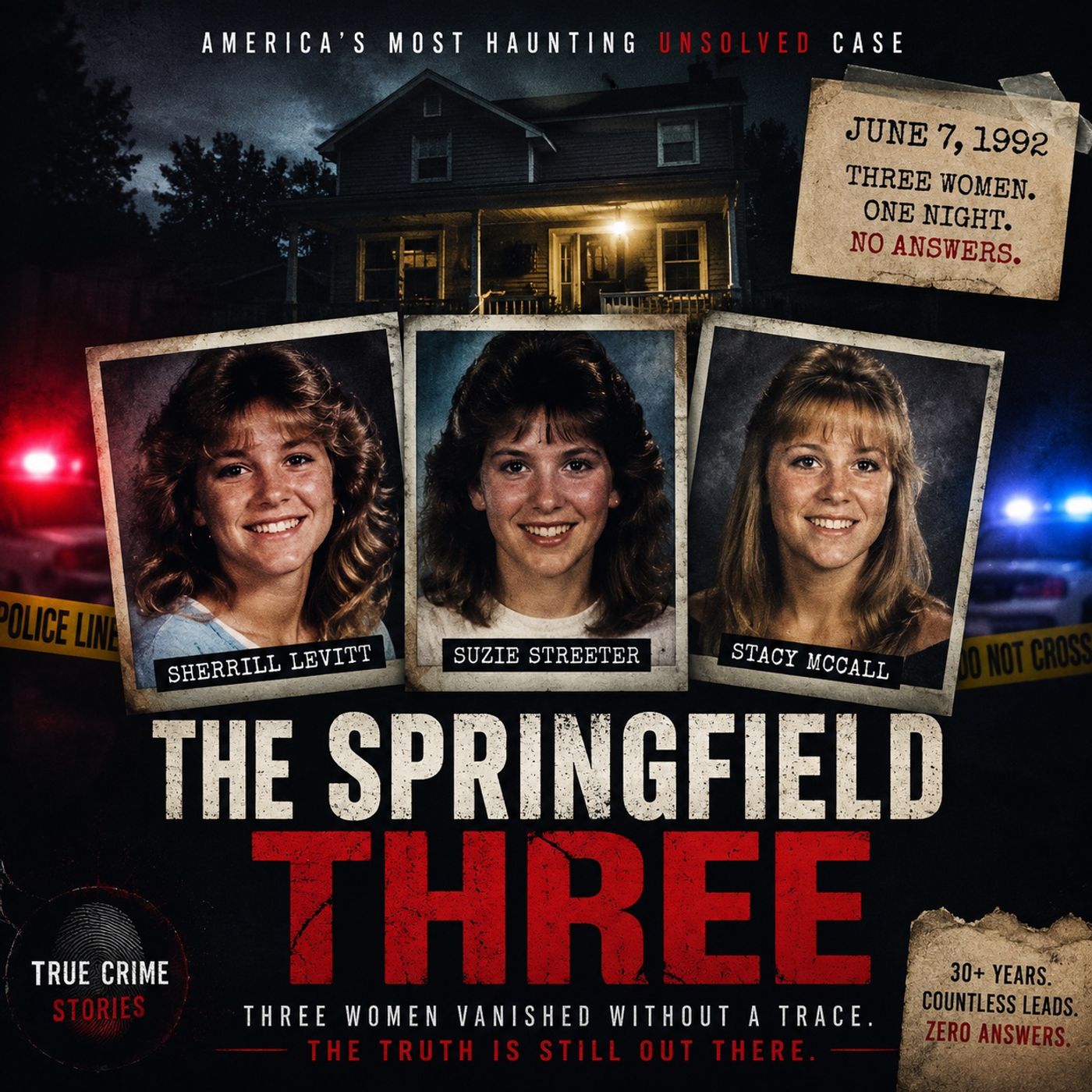
Three Gone Overnight
The Story
Three women vanished from a quiet Missouri home overnight, leaving behind their cars, purses, and no sign of a struggle. Decades later, the Springfield Three remains one of America's most chilling unsolved mysteries. What really happened that night?Become a supporter of this podcast: https://www.spreaker.com/podcast/dark-american-crime--7005371/support.
Thanks for listening to Dark American Crime. The next episode is coming soon.
This episode includes AI-generated content.
On the morning of June seventh, nineteen ninety two, the city of Springfield, Missouri, was waking to what should have been an ordinary Sunday. Families were heading to church, Coffee brewed in quiet kitchens. Graduation celebrations from the night before were still fresh in people's minds. But inside a modest home on East Delmar Street, something was terribly wrong. The house looked normal, the television was on. The family dog wandered through the rooms, anxious but unharmed. Three purses sat neatly together inside the house.
Jewelry had been left behind, cars remained parked outside. Nothing appeared stolen. Yet the three women who lived there or had spent the night there, were gone. They had vanished without leaving a single note, no signs of a struggle, no blood, no broken windows, no obvious clues. The missing women were Cheryl Leavitt, her nineteen year old daughter, Susie Streeter, and Susie's friend Stacy McCall. The disappearance shocked Springfield. One missing person was unusual, two was alarming. Three adults vanishing from the same house overnight without a trace seemed almost impossible.
The previous evening had been filled with celebration. Susie and Stacy had just graduated from high school. Like many graduates, they spent the night attending parties with classmates, laughing, taking photographs, and celebrating the future. The plan had originally been to stay at a friend's house, but after finding it too crowded, the two teenagers made a last minute decision they would spend the night at Susie's home instead. It was a small change, a simple decision, one that would change their lives forever.
They arrived at the house sometime after two am. Inside, Cheryl Levitt was already home. She had recently moved into the house and was looking forward to beginning a new chapter of her life. Neighbors later reported hearing nothing unusual during the night, no screams, no gunshots, no loud arguments, just silence. Then, sometime between the early morning hours in sunrise, all three women disappeared. The first sign that something was wrong came later that morning. Friends arrived at the house, expecting to pick up Susie and Stacy for a day at a local water park.
Instead, they found an unlocked home. The dog was inside, the women's belongings were still there, but the house was empty. At first, they assumed the women had stepped out Briefly, minutes turned into hours, calls went unanswered, Concern quickly turned into fear. By the end of the day, Springfield police had launched one of the largest missing person investigations in Missouri history. Three women had vanished from a single home, No witnesses had seen them leave, no one had reported suspicious activity, and somewhere in the darkness that summer night, a mystery had begun, one that would remain unsolved for decades and become one of America's most haunting missing person cases.
As news of the disappearances spread through Springfield, investigators rushed to the house on East Delmar Street. The first glance, nothing made sense. The front door was unlocked. Inside the home appeared calm and orderly. There were no overturned chairs, no broken furniture, no obvious signs of a violent struggle. It looked as though the three women had simply vanished. Detectives carefully searched each room. They found Cheryl Levitt's purse. Next To it were the purses belonging to Susie Streeter and Stacy McCall.
Inside were their driver's licenses, money, and other personal belongings. If the women had planned to go somewhere, why would they leave without their purses. Even more puzzling, all three cars were still parked outside the house. Nothing suggested they had driven away. The family dog, a Yorkshire Terrier named Cinnamon, wandered through the home unharmed. The frightened little dog appeared to have been left alone for hours. Investigators believed that if the women had left voluntarily, it was unlikely they would have abandoned the dog without arranging for someone to care for it.
Then, detectives noticed another strange detail. Near the front porch was a broken glass globe from the porch light. Several friends had arrived at the house before police were called. Believing it was simply broken by accident, they had swept up the shattered glass and thrown it away. At the time, they had no idea they might be disturbing a potential crime scene. Whether the broken porch light was connected to the disappearances has never been proven, but investigators could no longer examine it as evidence.
The first hours of any investigation are often the most critical. Unfortunately, before officers secured the home, several friends and family members had entered the house. Some answered the ringing telephone, Others cleaned up small items. People walked through rooms that might have contained fingerprints, footprints, or other valuable evidence. By the time detectives took control of the scene, any trace evidence may already have been compromised. Investigators immediately began reconstructing the women's final known movements.
Susie Streeter and Stacy McCall had spent the evening celebrating their high school graduation. After attending several parties, they changed plans at the last minute and decided to sleep at Susie's house instead of a friend's home. That spontaneous decision meant very few people knew exactly where they would be spending the night. Cheryl Levitt had spent the evening at home. She had spoken with friends and family and appeared to be settling in after recently moving into the neighborhood. Nothing suggested she expected visitors.
During the early hours of the morning, as detectives interviewed neighbors, they searched for anyone who had seen a suspicious vehicle or heard unusual noises. Most reported a quiet night, no screams, no gunfire, no obvious disturbance. It was as though whoever had taken the three women had done so swiftly and silently. The investigation was only beginning, but one unsettling question already haunted detectives. How do three adults disappear from a house without leaving behind a single clear clue.
As detectives continued searching the house, they realized they were dealing with something far more unusual than a typical missing person case. Three women had disappeared from the same home. No ransom note had been left behind, no signs of forced entry could be found, and despite a thorough search, there was no blood or obvious evidence of violence. Investigators began by establishing a timeline. On the evening of June sixth, nineteen ninety two, Cheryl Levitt had spent the night at home. Friends later described her as up and excited about settling into her recently purchased house on East Delmar Street.
Meanwhile, Susie Streeter and Stacy McCall were celebrating their high school graduation. They attended several parties with classmates, enjoying what should have been one of the happiest nights of their lives. Originally, the two young women planned to spend the night at another friend's house, but after finding it overcrowded, they changed their plans. Instead, they drove to Susie's home sometime after two am. That unexpected decision would become one of the biggest mysteries in the case. How many people knew they had changed their plans, Did someone follow them, or did someone already know they would be there.
Detectives interviewed everyone who had seen the women that evening. Friends recalled nothing unusual. Neither Susie nor Stacy seemed frightened. No one reported them being followed. The celebrations had ended like any other graduation night. Then investigators discovered another puzzling detail. Several people reported receiving strange phone calls at the house after the women disappeared. One caller allegedly made disturbing, inappropriate comments before hanging up. Unfortunately, because friends answered the phone before police secured the home, the calls could not be traced.
Whether the calls were connected to the disappearances or simply cruel prank calls has never been determined. Meanwhile, officers expanded the search beyond the neighborhood. Roads fields, wooded areas, and nearby lakes were searched. Helicopters flew overhead. Volunteers joined officers in looking for any sign of the missing women. Nothing was found, not a piece of clothing, not a personal item, not a single confirmed clue pointing to where they had gone. As the days passed, investigators faced an unsettling possibility.
Whoever had taken the women appeared to have planned the crime carefully. Three adults had vanished without waking the neighborhood. No witnesses came forward claiming they had seen a struggle. No one reported hearing screams. If an abduction had occurred, it had been carried out with remarkable speed or under circumstances. Investigators still could not explain. The case quickly became front page news across Missouri. Families locked their doors earlier, neighbors watched unfamiliar cars more closely.
Fear spread through Springfield. If three women could disappear from their own home without a trace, could it happen to anyone? With each passing day, the mystery deepened. The house held almost no answers, the neighborhood offered few witnesses, and somewhere beyond East Delmar Street, someone knew exactly what had happened during the final hours before dawn. As the search entered its second week, investigators faced a difficult reality. There was still no trace of Chryl Levitt, Susie Streeter, or Stacey Mca.
The women had seemingly disappeared without leaving behind a trail. The case quickly grew into one of the largest investigations Springfield had ever seen. Hundreds of tips poured into the police department. Some callers claimed they had seen the women in nearby towns. Others reported suspicious vehicles parked near East Delmar Street on the night of June sixth. Every lead was investigated, most ended in disappointment. Detectives began looking closely at the lives of all three women. They wanted to know whether any of them had enemies, received threats, or been involved in situations that could explain their disappearance.
Cheryl Levitt had recently gone through a divorce and had just moved into her new home. Friends described her as independent and optimistic. She was decorating the house and looking forward to a fresh start. There was nothing to suggest she planned to leave. Susie Streeter, only nineteen years old, had just graduated from high school, she was excited about the future and had been making plans with friends. Stacy McCall shared those same dreams. Neither young women had packed belongings or hinted at leaving town.
Investigators concluded that a voluntary disappearance involving all three women was highly unlikely. Attention then shifted to possible suspects. Detectives questioned acquaintances, former partners, and people who had crossed paths with the women in the days leading up to the disappearance. One of the earliest theories was that someone known to at least one of the women had come to the house. The lack of forced entry suggested they may have opened the door willingly, but there was no evidence proving that theory.
Another possibility was that an intruder had entered while the women were asleep. Again, there was no physical evidence to confirm it. The more investigators searched the stranger, the case became three women, one house, no signs of violence, no bodies, no confirmed way witnesses. Then another detail caught investigator's attention. Neighbors reported seeing unfamiliar vehicles in the area around the time of the disappearances. Descriptions varied, and none could be confirmed with certainty. Some mentioned a light colored van, others described different vehicles.
Despite extensive follow up, none of the reports produced a suspect. As national media began covering the story, tips flooded in from across the country. Some claimed the women had been spotted alive. Others pointed investigators toward possible suspects. Many leads sounded promising, almost all were eventually ruled out. Each dead end added to the growing frustration. The Springfield three case had become a mystery unlike any investigators had faced before. The evidence was scarce, the theories were numerous, and somewhere hidden behind countless rumors and false leads was the truth about what had happened after after Susie and Stacy walked through the front door in the early hours of June seventh, nineteen ninety two.
The answers were out there, but finding them would prove far more difficult than anyone could have imagined. As investigators dug deeper into the lives of the three missing women, they began building profiles of everyone who had been in contact with them during the days leading up to the disappearance. Every friend, every neighbor, every coworker, every former boyfriend. No possibility was ignored. Detectives quickly ruled out the idea that the women had simply run away. Their purses, money, keys, and personal belongings had all been left behind.
Cheryl had recently purchased her home and was settling into a new chapter of her life. Susie and Stacy had just celebrated graduating from high school and were making plans for the summer. Nothing suggested they intended to disappear. Attention soon turned to whether someone had targeted one of the women's specific If so, had the other two become unintended victims, or had all three been deliberately taken. Without physical evidence, investigators could not answer either question. Meanwhile, volunteers continued searching fields, wooded areas, abandoned buildings, and nearby lakes.
Search dogs were brought in aircraft surveyed remote locations from above. Despite the enormous effort, nothing connected to the women was found. The absence of evidence became one of the case's greatest mysteries. In many disappearances, investigators eventually discover clothing, a vehicle, or another personal item. In this case, there was almost nothing. It was as though the three women had simply vanished into the night. As media coverage intensified, rumors spread throughout Springfield. Some people believed the women had been kidnapped by a stranger.
Others suspected someone they knew. A few even suggested organ criminal involvement, but investigators repeatedly emphasized that theories were not evidence. One name that attracted attention was a local man with a violent criminal history who was in the area around the time of the disappearances. Detectives looked into him and other individuals whose backgrounds raised concern. Each lead was investigated carefully, yet none produced enough evidence to bring charges. The investigation remained at a standstill.
Then another development complicated the case. Psychics from across the country began contacting law enforcement and the families, claiming they knew where the women were or what had happened to them. Some pointed to rivers, others to farmland or abandoned properties. Investigators followed up on some tips when they could be independently checked, but none led to the missing women. For the families, each false lead brought renewed hope, followed by heartbreak. Weeks became months, months became years.
The mystery only deepened. Three women had disappeared from a quiet suburban home. No ransom demand had ever been made, no confirmed sightings had been verified, no bodies had been found, and no one had been arrested. The Springfield three case was no longer just a local investigation. It had become one of America's most baffling unsolved disappearances, leaving detectives with one haunting question. If someone was responsible for taking all three women, how had they managed to leave almost no trace behind.
Months passed, but the investigation into the disappearance of Cheryl Levitt, Susie Streeter, and Stacy McCall refused to slow down. Detectives continued chasing every credible lead. Every phone call was documented, every reported sighting was investigated, Every possible suspect was examined. Yet the case remained as mysterious as it had been on the first day. The home on East delm Mar Street had yielded very little physical evidence. Investigators believed the women had most likely been inside the house when whatever happened began, but without signs of a struggle, it was impossible to determine exactly how they had left, or whether they had left voluntarily under threat.
One theory suggested the women may have opened the door to someone they knew. If the visitor was familiar, they might have allowed that person inside without hesitation. Another theory proposed that an intruder entered after the women had gone to sleep. Both possibilities were investigated, neither could be proven. As the search widened, detectives received reports from across the country. Some witnesses claimed they had seen three women matching the missing trios descriptions at gas stations, truck stops, or restaurants.
Others believed they had seen them traveling in a suspicious van. Each tip was carefully checked, none could be confirmed. Meanwhile, investigators interviewed people who had attended the graduation parties with Susie and Stacy the night before. They wanted to know whether anyone had followed the young women or overheard their last minute change of plans. No witness could provide evidence that someone had targeted them that evening. The sudden decision to stay at Susie's house instead of another friend's home remained one of the case's biggest mysteries.
Was it a coincidence or had someone learned of the change unexpectedly. The uncertainty made it difficult to establish a clear motive. Over time, several convicted criminals were examined as potential suspects because they had histories of violent offenses or were known to have been in the Springfield area. Investigators questioned them, compared timelines, and searched for connections to the missing women. Despite public speculation, no one was charged in connection with the disappearances. The evidence simply wasn't there.
As the months turned into years, the case officially became a cold case, but cold did not mean for good. The Springfield Police Department continued to keep the investigation open. Detectives revisited evidence as new technology became available. They hoped that a forgotten witness, an overlooked clue, or an advance in forensic science might finally provide the breakthrough they had been waiting for for the families. Hope never disappeared. They continued speaking publicly about Cheryl, Susie, and Stacy.
They wanted people to remember that behind the headlines were three women with dreams, families, and futures that ended in mystery. Somewhere, they believed someone knew exactly what had happened inside or just outside that quiet home on East Delmar Street. The silence surrounding that night had lasted for years, but they believed it would not last forever. As the years passed, the disappearance of the Springfield three became one of America's most infamous unsolved mysteries. The investigation had produced thousands of tips, detectives had had interviewed hundreds of people.
Entire fields, wooded areas, and abandoned properties had been searched. Yet the most important question remained unanswered. Where were Sheryl Levitt, Susie Streeter and Stacy McCall. With so little physical evidence, investigators began taking a closer look at individuals who might have had the opportunity or the motive to commit such a crime. Several convicted offenders were questioned over the years after rumors connected them to the case. Some claimed to know what had happened. Others made vague or contradictory statements while in prison.
Each claim was investigated, none could be verified with evidence. One of the names that frequently surfaced was Robert Craig Cox, a convicted kidnapper and murderer who had been living in the Springfield area in nineteen ninety two. Cox denied involvement in the disappearance. However, investigators considered him a person of interest because of his criminal history and his presence in the area around the time the women vanished. At one point, Cox made cryptic comments suggesting he knew the women were dead, but he refused to provide details.
Police were never able to corroborate those statements, and no charges were filed against him in connection with the Springfield three. Another theory suggested that the women had been abducted by more than one person. Some investigators believed it would have been extremely difficult for a single offender to control three adults without leaving signs of a struggle. Others argued that if a weapon had been used, one individual might have been able to force them to comply. Without evidence from the scene, neither theory could be confirmed.
The mystery surrounding the broken porch light also continued. Because friends had unknowingly cleaned up the shattered glass before police arrived, investigators lost the opportunity to examine it for fingerprints or other forensic evidence. To this day, no one knows whether the broken globe was connected to the disappearance or was simply an unrelated accident. As time went on, rumors spread throughout Springfield. Some claimed the women had been buried in remote farmland. Others believed they had been taken out of the state.
A few even suggested organized criminal involvement. Detectives followed every credible lead they could, None produced the evidence needed to solve the case. For the families, every new rumor brought a mix of hope and disappointment. They wanted answers based on facts, not speculation. They continued urging anyone with genuine information to contact the Springfield Police Department. They believed someone had remained silent for far too long. Somewhere, they said, someone knew what happened during those early morning hours of June seventh, nineteen ninety two.
The question was whether that person would ever come forward. As another year passed without an arrest, the Springfield three investigation remained suspended between possibility and mystery. Women had disappeared from a home without a trace, and despite decades of searching, the truth remained hidden in the silence of that summer night. As the investigation entered another decade, the Springfield three case had become more than a local mystery. It was now one of the most discussed unsolved disappearances in America.
True crime investigators, journalists, and amateur detectives all searched for the clue that police might have missed. Every few years, a new theory emerged. Every few years, hope returned, but the outcome remained the same. No confirmed evidence, no arrest, no answers. One of the most talked about leads involved an anonymous tip claiming the bodies of the three women had been buried beneath the parking garage at Cox Medical Center South, which was under construction around the time of the disappearances.
The claim attracted widespread attention. Some believed it could explain why no trace of the women had ever been found. Investigators were viewed the information carefully. However, there was not enough reliable evidence to justify excavating the entire structure, and no public evidence has confirmed that the women are buried there. The theory remains unproven. Another lead involved reported sightings of a suspicious green van near the neighborhood around the time the women disappeared. Witnesses offered varying descriptions.
Detectives investigated the reports, but no evidence conclusively linked any specific vehicle to the crime. As the years passed, advances in forensic science gave investigators renewed hope. Evidence collected in nineteen ninety two was re examined using newer techniques. Items from the house were reviewed again. Detectives hoped modern technology might reveal fingerprints, DNA, or other clues that earlier methods could not detect. Despite these efforts, no breakthrough was publicly announced. The case remained open.
Meanwhile, the families of Cheryl, Susie, and Stacy continued to live with uncertainty. Without answers, there could be no closure. Birthdays came and went, holidays passed. Every anniversary of June seventh served as a painful reminder that the women had never returned home. Law enforcement never stopped encouraging the public to come forward with credible information. Investigators believed that someone who lived in Springfield in nineteen ninety two might remember a detail that seemed insignificant at the time, a strange vehicle, an unusual conversation, a person behaving suspiciously after the disappearances.
Sometimes, detectives noted cold cases are solved by memories that surface years later. The Springfield three investigation had become exactly that a case waiting for one missing piece, Somewhere, someone knew the truth. Whether it was the person responsible, an eyewitness who had remained silent, or someone who unknowingly held an important clue, Investigata believe the answer still existed. Until that answer was found, The disappearance of Cheryl Levitt, Susie Streeter, and Stacey McCall would remain one of the most haunting mysteries in American criminal history.
As the years became decades, the Springfield three investigation entered a new phase. The search was no longer driven only by witness interviews and neighborhood canvasses. It was driven by technology. Detectives revisited old evidence, hoping that advances in forensic science could uncover something that had been impossible to detect. In nineteen ninety two, every item recovered from the house was reviewed again. Investigators looked for fingerprints that might now be identifiable. They searched for DNA that earlier testing methods could not detect.
They compared evidence against expanding criminal databases. But despite these advances, no publicly announced breakthrough emerged. The mystery endured. At the same time, independent journalists and true crime Researchers continued examining the case. Some uncovered forgotten interviews, others revisited old witness statements. Many proposed new theories, but investigators consistently emphasized one point, A theory is not the same as evidence. Without verifiable proof, no conclusion could be drawn.
The case also remained clouded by rumors. Over the years. Numerous people claimed to know what had happened to Cheryl, Susie and Stacy. Some alleged the women had been buried in remote locations. Others claimed they had been taken across state lines. Every credible tip was investigated, none produced evidence that could solve the case. One challenged detectives faced was the passage of time. Witnesses memories faded, Some people who had been questioned in the early years had since died. Potential evidence may have been lost or destroyed.
Yet history had shown that even decades old cases could be solved through persistence. The families never gave up. They continued participating in interviews and public appeals, asking anyone with genuine information to contact the Springfield Police Department. Their message remained simple, no matter how much time has passed, the truth still matters. Investigators also believed it was possible that someone involved in the crime had confided in another person years ago, a family member, a friend, a cellmate, someone who had dismissed the information at the time might now realize its significance.
That possibility kept the investigation alive. The Springfield three case became a powerful reminder that unsolved disappearances affect far more than the missing. Families spend years wondering, communities continue asking questions, and investigators keep searching for answers that refused to come. More than thirty years after that summer morning, one fact remained unchanged. Three women had heared from a quiet home on East Delmar Street. No confirmed trace of them had ever been found, and somewhere hidden beneath decades of silence lay the truth investigators had been seeking.
Since June nineteen ninety two, more than thirty years after the disappearance of Cheryl Levitt, Susie Streeter, and Stacy McCall, the investigation remained open. The case file had grown to thousands of pages, contained interviews, search records, forensic reports, maps, photographs, and countless tips from people who believed they knew what had happened. Yet none of it had provided the one thing investigators needed most, a definitive answer. Over the years, detectives revisited several persons of interest.
Some had criminal histories involving violence, others were connected only through rumors. Each credible lead was examined, but despite decades of investigation, no one was publicly charged urged in connection with the disappearances. The lack of physical evidence continued to frustrate investigators. Without confirmed DNA, a body, or a reliable eyewitness, proving what happened was extraordinarily difficult. Still, the case was never abandoned. Advances in forensic science gave detective's reason to keep reviewing the evidence.
Items collected in nineteen ninety two were re examined using modern techniques. Investigators hoped that new methods might reveal a fingerprint, a DNA profile, or another overlooked clue. So far, no publicly announced breakthrough has resulted. Meanwhile, the families of the missing women continued their search for answers. They participated in interviews and documentaries, reminding the public that behind every headline were three people whose lives had suddenly and mysteriously ended. They asked only one thing, If you know something come forward.
The case also became a landmark in true crime discussions because of its unusual circumstances. Three adults disappeared from the same home, no obvious signs of a struggle, no confirmed witnesses, no ransom demand, no trace of the victims. Few cases combine so many unanswered questions. Investigators continued to believe that someone somewhere had information that had never reached police. Perhaps someone had seen an unfamiliar vehicle, perhaps someone remembered a strange conversation after the disappearances, or perhaps someone had kept a secret for decades.
History has shown that cold cases can be solved many years later when a witness finally decides to speak. That possibility kept hope alive for detectives. Every new tip represented another opportunity for the families. Every passing year was another reminder that they still did not know what happened to Cheryl, Susie, and Stacy. The mystery remained frozen in time. A quiet neighborhood, a summer night, three women, one house, and a disappearance so complete that even after decades, it continues to challenge investigators and haunt everyone who hears the story.
As the investigation moved through its third decade, the disappearance of the Springfield three remained one of the oldest active missing person cases in Missouri. Despite the passing years, detectives never officially closed the file. Instead, they continued reviewing evidence whenever new information or advances in forensic science became available. Every few years the case returned to the national spotlight. A television documentary, a newspaper investigation, a true crime podcast. Each brought renewed public interest and another wave of tips.
Most were carefully investigated. Most led nowhere, but detectives knew that cold cases are sometimes solved because one person finally remembers or finally decides to speak. The families of Cheryl lay of It, Susie Streeter, and Stacy McCall never stopped hoping. They urged anyone with credible information to contact the Springfield Police Department. Even after decades they believed the truth had not disappeared. Someone still knew what happened During those early hours of June seventh, nineteen ninety two.
Investigators also continued evaluating long discussed theories. Could the women have been abducted by someone they knew, did they unknowingly let the offender into the house, or was it the work of a stranger who happened upon them that night. Each theory explained some parts of the mystery. None explained all of it. Without conclusive evidence, Detectives refused to declare any single theory as fact. That caution was important. Over the years, rumors had often spread faster than verified information.
Some people claimed to know where the women had been buried. Others accused specific individuals without proof. Investigators repeatedly emphasized that speculation could not replace evidence. The goal was not simply to solve the case, It was to solve it correctly. As technology advanced, forensic experts revisited old evidence once again. Modern DNA testing had solved numerous cold cases across the United States. The hope remained that one overlooked sample or one future scientific breakthrough might finally unlock the Springfield three mystery.
For the families, however, the greatest burden was uncertainty. Without answers, there could be no true closure. Every birthday, every holiday, every anniversary served as another reminder of the loved ones who never came home. The Springfield three case had become more than an investigation. It had become a symbol of unanswered questions. Three women vanished from a quiet home. No confirmed trace of them has ever been found, and after all these years, investigators still belie leave the truth existed.
It was simply waiting for the one piece of evidence or the one witness that could finally bring the silence to an end. More than three decades had passed since the disappearance of Cheryl Levitt, Susie Streeter, and Stacey McCall. Time had changed. Springfield neighborhoods had grown, businesses had come and gone, New generations had moved into the city, but the mystery of the Springfield Three remained frozen. In the early hours of June seventh, nineteen ninety two, investigators continued to examine every credible lead.
The case was never forgotten. Whenever new information surfaced, detectives reviewed it carefully, hoping it would finally provide the breakthrough that had eluded them for decades. Advances in forensic science brought renewed optimism. DNA technology had helped solve many cold cases across the United States. Evidence that once seemed insignificant could now reveal crucial details. The Springfield Three and investigation benefited from these advancements, as detectives revisited preserved evidence.
Though no publicly announced breakthrough emerged, the families never stopped asking for answers. They encouraged anyone with knowledge of the case to come forward, no matter how small the detail might seem. Sometimes, investigators explained, a single forgotten memory can unlock an entire investigation. A conversation overheard years ago, a vehicle scene near the neighborhood, a confession made in private, even after decades, those details could still matter. Over the years, numerous books, documentaries, and podcasts explored the disappearance.
Each presentation introduced the case to new audiences. With every renewed wave of attention came additional tips. Most were investigated, few could be verified. The mystery remained intact. Investigators continued to emphasize an important point. Many theories had been discussed public Some suggested the women had been targeted. Others believed the crime was random. Some focused on individuals who had been questioned during the investigation, but none of those theories had been proven by publicly available evidence.
The official investigation remained guided by facts rather than speculation. For the families, the passage of time did not lessen the pain. Every year without answers was another year without knowing what had happened to their loved ones. Hope, however, remained. History had shown that cold cases can be solved decades later, sometimes through new forensic methods, sometimes through a witness who finally speaks, sometimes through a mistake made by the person responsible. The Springfield three case still held that possibility.
Somewhere. Investigators believed someone knew the truth, someone knew why three women vanished from a quiet home without leaving a trace, and until that truth was uncovered, the case would remain one of the most enduring and heartbreaking mysteries in American criminal history. More than thirty years after the disappearance, the Springfield three case remained one of the most perplexing unsolved investigations in the United States. The evidence had been examined countless times, witnesses had been interviewed and re interviewed.
Searches had been conducted across Missouri and beyond, Yet the mystery endured. Investigators believed the answer was still out there simply had not been found. Over the years, several cold cases across America were solved after decades of silence. New DNA techniques identified suspects, old witnesses revealed forgotten details. People who had lived with secrets finally chose to speak. Those cases gave the families of Chryl Levitt, Susie Streeter, and Stacy McCall hope that their loved one's disappearance could one day be solved as well.
The Springfield Police Department continued to encourage the public to submit credible information, even if a memory seemed insignificant. Investigators wanted to hear it. A suspicious vehicle, an unusual conversation, someone who suddenly left town after June nineteen ninety two. Any detail could become the missing piece of the puzzle. The case had also become a lesson in the importance of protecting crime scenes. Before police arrived on the morning the women were reported missing, friends and family had unknowingly entered the house, answered the telephone, cleaned up broken glass from the porch light, and moved through rooms that might have contained valuable evidence.
They acted with good intentions, believing the women had simply stepped out. No one realized they might be disturbing the scene of a major criminal investigation. Detectives have never publicly stated that those actions prevented the case from being solved. However, they highlighted how critical the earliest moments of an investigation can be for the family. Speculation offered little comfort. They had heard hundreds of theories over the years. Some sounded convincing, others were clearly impossible, but without evidence, none could answer the one question they had lived with since June seventh, nineteen ninety two.
What happened to Cheryl, Susie and Stacy. That question remained unanswered. Somewhere beyond the rumors and false leads lay the truth, whether it rested and forgotten evidence, an overlooked witness, or the memory of someone who had remained silent for decades. Investigators believed it still existed until it was found. The Springfield three would remain one of America's most haunting unsolved disappearances, a case where three women vanished in a single night, leaving behind only silence, unanswered questions, and a mystery that has refused to fade.
More than three decades after that quiet summer night, the disappearance of Cheryl Levitt, Susie Streeter, and Stacy McCall remained and one of the most enduring mysteries in American true crime. The case was still open. It had never been forgotten. Detectives continued to review new tips whenever they arrived, knowing that even after many years, a single piece of credible information could change everything. The families never stopped searching for answers. Although time had passed, the pain of not knowing remained.
Without knowing what happened, there could be no real closure. They continued to honor the memories of Cheryl, Susie, and Stacy, while hoping that someone somewhere would finally reveal the truth. The disappearance also became a powerful reminder of how fragile ordinary life can be. One evening, two teenagers celebrated their high school graduation with friends. A mother spent a quiet night at home. By sunrise, all three had vanished. No confirmed struggle, no clear suspect, no explanation. Investigators repeatedly stressed that the case should be guided by evidence, not rumors.
Over the years, countless theories had circulated. Some focused on known criminals. Others claimed the women had been buried in secret locations. Many stories spread through books, television programs, and the Internet. Yet none of those theories have been publicly proven. The official investigation continued to rely on verified facts. As forensic science advanced, hope remained. Across the United States, cold cases that once seemed impossible to solve had been reopened through improved DNA testing, digital analysis, and witness cooperation.
The Springfield three investigation could still benefit from future breakthroughs. That possibility kept the case alive. Law enforcement continued encouraging anyone with credible information to contact the Springfield Police Department. Investigators believed the answer might still exist in someone's memory, a conversation overheard years ago, an unusual event that suddenly made sense, or a person who had carried a secret for far too long. For the families, justice was not about revenge. It was about truth.
They wanted to know what happened to their loved ones. They wanted answers supported by evidence, and they wanted the mystery that had haunted them for decades to finally come to an end. Because at the center of this extraordinary case were not just headlines or theories. They were three real women, three lives, three families still waiting for the day when silence would finally give way to the truth. On the morning of June seventh, nineteen ninety two, three women disappeared from a quiet home in Springfield, Missouri, Cheryl Levitt, Susie Streeter, Stacy McCall.
Their purses remained inside the house, their cars were parked outside. The family dog was left behind. There were no obvious signs of a struggle, no ransom demand, no confirmed eyewitness, and despite one of the largest investigations in Missouri's history, no one has ever been charged with their disappearance. Over the years, investigators followed thousands of tips. They questioned persons of interest. They searched fields, forests, lakes, abandoned buildings, and remote properties. They revisited the evidence using newer forensic techniques.
Still, no confirmed trace of the three women has ever been found. The case became one of America's most haunting unsolved mysteries. It has inspired documentaries, books, podcasts, and countless discussions among investigators and true crime enthusiasts. Yet, after decades of speculation, one fact remains unchanged. No publicly available evidence has conclusively explained what happened inside or just outside the home on East Delmar Street that summer night. For the families, the pain has never been about the publicity it has always been about the absence.
Birthdays passed without celebrations, holidays came and went with empty chairs at the table. Every anniversary brought the same unanswered question, what happened to Cheryl, Susie and Stacy. Investigators continue to believe that someone knows the truth. Perhaps it is a witness who has remained silent, Perhaps it is someone who was told a secret years ago, or perhaps future advances in forensic science will reveal evidence that today's technology has not yet uncovered. History has shown that cold cases can be solved decades later.
Justice is sometimes delayed, but it is not always denied until that day comes. The Springfield three case remains open, a reminder that even in the quietest neighborhoods, mysteries can endure for generations. Three women left behind everything that mattered, a home, family, future, and a mystery that continues to challenge in investigators more than thirty years later. Perhaps one day the silence will end, perhaps one witness will finally speak, Perhaps one overlooked clue will unlock the truth.
Until then, the disappearance of the Springfield three remains one of the most chilling and heartbreaking unsolved cases in American history,
 Apple Podcasts
 Castbox
 Castro
 Goodpods
 Moon FM
 Overcast
 Pocket Casts
 Podbean
 Podcast Addict
 Podcast Republic
 Spotify